Galaxy-Induced Transformation of Dark Matter Halos
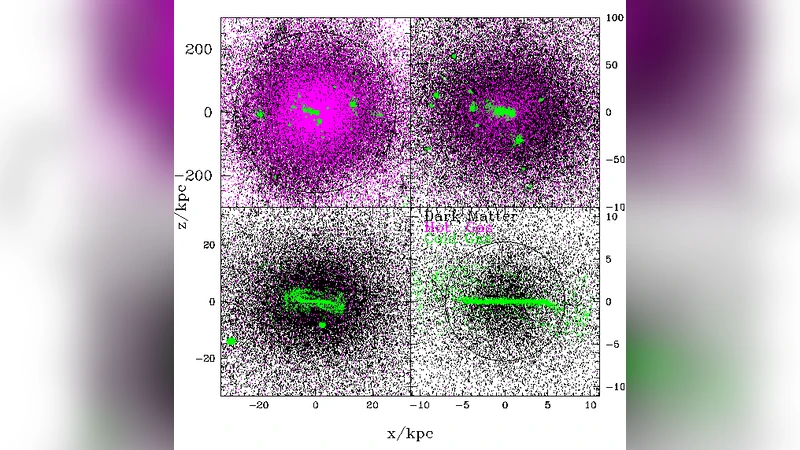
We use N-body/gasdynamical LambdaCDM cosmological simulations to examine the effect of the assembly of a central galaxy on the shape and mass profile of its dark halo. Two series of simulations are compared; one that follows only the evolution of the dark matter component and a second one where a baryonic component is added. These simulations include radiative cooling but neglect star formation and feedback, leading most baryons to collect at the halo center in a disk which is too small and too massive when compared with typical spiral. This unrealistic model allows us, nevertheless, to gauge the maximum effect that galaxies may have in transforming their dark halos. We find that the shape of the halo becomes more axisymmetric: halos are transformed from triaxial into essentially oblate systems, with well-aligned isopotential contours of roughly constant flattening (c/a ~ 0.85). Halos always contract as a result of galaxy assembly, but the effect is substantially less pronounced than predicted by the “adiabatic contraction” hypothesis. The reduced contraction helps to reconcile LambdaCDM halos with constraints on the dark matter content inside the solar circle and should alleviate the long-standing difficulty of matching simultaneously the scaling properties of galaxy disks and the luminosity function. The halo contraction is also less pronounced than found in earlier simulations, a disagreement that suggests that halo contraction is not solely a function of the initial and final distribution of baryons. Not only how much baryonic mass has been deposited at the center of a halo matters, but also the mode of its deposition. It might prove impossible to predict the halo response without a detailed understanding of a galaxy’s assembly history. (Abriged)
💡 Research Summary
This paper investigates how the assembly of a central galaxy reshapes the structure and mass distribution of its surrounding dark‑matter halo within the ΛCDM framework. The authors run two parallel sets of cosmological N‑body/gasdynamical simulations: one that follows only the collision‑less dark‑matter component, and a second that adds a baryonic component subject to radiative cooling but deliberately omits star formation and feedback. Because cooling proceeds unchecked, virtually all baryons collapse into a compact, overly massive central disk—an unrealistic configuration that the authors adopt deliberately as an upper bound on the possible influence of a galaxy on its halo.
The key findings are threefold. First, the halo’s shape evolves dramatically. In the dark‑only runs halos are triaxial, but the presence of a massive central disk forces the halo to become nearly axisymmetric and oblate, with isopotential surfaces that remain at a roughly constant flattening of c/a ≈ 0.85 and whose major and minor axes stay well aligned. This transformation is far stronger than reported in earlier work that found only modest shape changes.
Second, the halo contracts in response to the added central mass, but the contraction is substantially weaker than predicted by the classic adiabatic‑contraction (AC) model. The AC hypothesis assumes that baryons settle slowly and adiabatically, preserving the actions of dark‑matter particles. In contrast, the rapid, highly concentrated disk formation in these simulations generates strong, non‑linear gravitational perturbations that scatter dark‑matter orbits and redistribute energy. Consequently, the inner density profile is only modestly steepened, yielding a lower dark‑matter mass within the solar circle (≈8 kpc) than AC would suggest. This reduced contraction brings ΛCDM halo predictions into better agreement with dynamical constraints on the Milky Way and alleviates the long‑standing tension between reproducing realistic disk scaling relations and matching the observed galaxy luminosity function.
Third, the authors demonstrate that halo response cannot be captured solely by the initial and final baryonic mass distributions. The mode of baryon deposition—how quickly and in what geometry the gas collapses—plays a decisive role. Even when the total baryonic mass is the same, a rapid, centrally‑focused collapse produces a markedly different halo response than a more gradual, extended buildup. This insight explains why earlier simulations, which often employed different cooling or feedback prescriptions, reported stronger halo contraction.
Overall, the study argues that predicting halo contraction requires a detailed understanding of a galaxy’s assembly history, including cooling, disk formation, and any feedback processes that may regulate the central mass concentration. The authors conclude that future simulations must incorporate realistic star‑formation and feedback physics to capture the full spectrum of galaxy‑halo interactions, and that simple analytic prescriptions based on final baryon fractions are insufficient for accurate modeling of dark‑matter halo structure.
Comments & Academic Discussion
Loading comments...
Leave a Comment