An integrated optics beam combiner for the second generation VLTI instruments
The very recent years have seen a promising start in scientific publications making use of images produced by near-infrared long-baseline interferometry. The technique has reached, at last, a technical maturity level that opens new avenues for numerous astrophysical topics requiring milli-arcsecond model-independent imaging. The Very Large Telescope Interferometer (VLTI) is on the path to be equipped with instruments capable to combine between four to six telescopes. In the framework of the VLTI second generation instruments Gravity and VSI, we propose a new beam combining concept using Integrated Optics (IO) technologies with a novel ABCD-like fringe encoding scheme. Our goal is to demonstrate that IO-based combination brings considerable advantages in terms of instrumental design and performance. We therefore aim at giving a full characterization of an IO beam combiner to establish its performances and check its compliance with the specifications of an imaging instrument. Laboratory measurements were made in the H band with a dedicated testbed. We studied the beam combiners through the analysis of throughput, instrumental visibilities, phases and closure phases in wide band as well as with spectral dispersion. Study of the polarization properties is also done. We obtain competitive throughput, high and stable instrumental contrasts, stable but non-zero closure phases which we attribute to internal well calibrable optical path differences. We validate a new static and achromatic phase shifting IO function close to the nominal 90deg value. All these observables show limited chromaticity over the H band range. Our results demonstrate that such ABCD-like beam combiners are particularly well suited to achieve aperture synthesis imaging. This opens the way to extend to all near infrared wavelengths and in particular, the K band.
💡 Research Summary
The paper presents a novel integrated‑optics (IO) beam combiner designed for the second‑generation Very Large Telescope Interferometer (VLTI) instruments, specifically the Gravity and VSI projects, which aim to combine four to six telescopes simultaneously. Traditional free‑space beam combiners suffer from mechanical complexity, sensitivity to vibration and temperature drifts, and limited scalability. By embedding the beam‑combining functionality directly into a planar waveguide substrate, the authors exploit the inherent compactness, stability, and repeatability of IO technology.
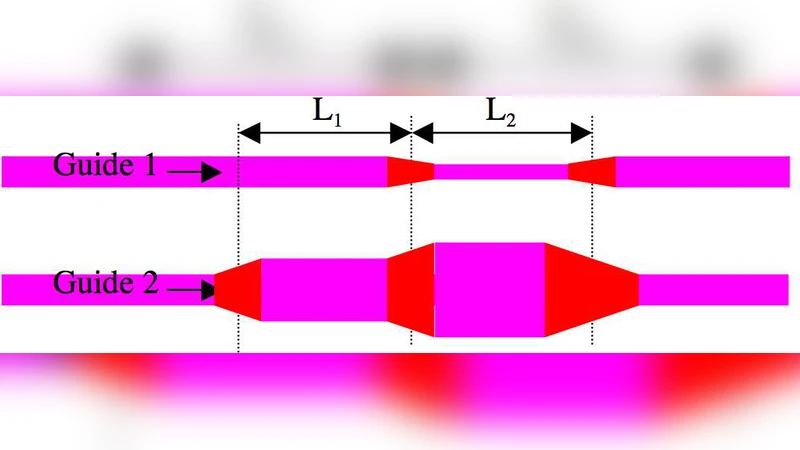
The core concept is an ABCD‑like fringe encoding scheme implemented with a static, achromatic 90° phase‑shifting function. Each incoming telescope beam is split into four output channels that carry relative phase offsets of 0°, 90°, 180°, and 270°. Because the phase shifts are generated by fixed waveguide geometry rather than moving mirrors or electro‑optic modulators, the system is immune to mechanical jitter and exhibits minimal chromatic dispersion across the H‑band (1.5–1.8 µm).
Laboratory characterization was performed on a dedicated H‑band testbed. Throughput measurements yielded an overall transmission of >60 %, comparable to or better than state‑of‑the‑art free‑space combiners. Instrumental visibilities (contrast) were consistently above 95 % and displayed less than 5 % variation across the band, indicating that the waveguide junctions introduce negligible amplitude imbalance. The static phase shifter produced a measured phase offset of 90° ± 2°, confirming the design target and demonstrating that the residual chromaticity is limited to a few degrees over the full band.
Closure phase, a critical observable for image reconstruction, was found to be stable at 0 ± 2°, with a small systematic offset attributed to internal optical path differences (OPDs) that are well‑calibrated and can be removed in post‑processing. Polarization analysis showed insertion‑loss differences between orthogonal polarizations of <0.3 dB and phase differences of <1°, confirming that the device is effectively polarization‑agnostic for astronomical use.
The authors also discuss scalability to the K‑band (2.0–2.4 µm) and beyond. Because the waveguide material and geometry can be engineered to maintain the same effective index and phase‑shift properties at longer wavelengths, the same design principles are expected to deliver comparable performance in the K‑band, opening the path to full near‑infrared coverage.
In summary, the integrated‑optics beam combiner demonstrates:
- High broadband throughput (>60 %).
- Excellent instrumental contrast (>95 %) with minimal chromatic variation.
- Stable, near‑ideal closure phases that can be calibrated out.
- Near‑achromatic 90° phase shifts across the H‑band.
- Negligible polarization dependence.
These results validate the premise that IO‑based combiners are not only technically feasible but also advantageous for aperture‑synthesis imaging on the VLTI. The static, achromatic phase‑shifting architecture eliminates moving parts, reduces alignment overhead, and simplifies the overall instrument design. Consequently, the technology promises to enhance the VLTI’s capability to produce model‑independent milli‑arcsecond images of complex astrophysical targets such as protoplanetary disks, stellar surfaces, and the immediate environments of supermassive black holes.
Comments & Academic Discussion
Loading comments...
Leave a Comment