Granger causality for circular variables
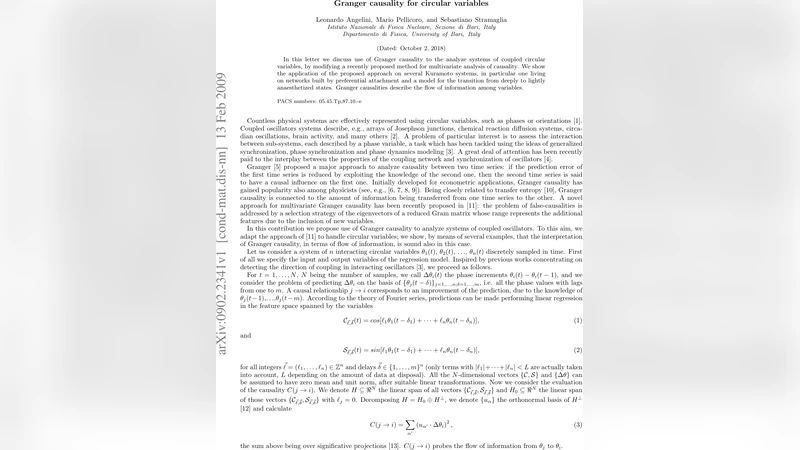
In this letter we discuss use of Granger causality to the analyze systems of coupled circular variables, by modifying a recently proposed method for multivariate analysis of causality. We show the application of the proposed approach on several Kuramoto systems, in particular one living on networks built by preferential attachment and a model for the transition from deeply to lightly anaesthetized states. Granger causalities describe the flow of information among variables.
💡 Research Summary
The paper introduces a novel adaptation of Granger causality for systems composed of circular (phase) variables, addressing the inherent difficulties of applying conventional Granger analysis—originally designed for linear real‑valued time series—to periodic data. The authors first transform each phase variable θ into its complex exponential representation e^{iθ}. By expanding these complex signals into a truncated Fourier series, the real and imaginary components become separate regressors, allowing the construction of a linear regression model that nevertheless captures the underlying nonlinear phase interactions. To prevent over‑fitting in high‑dimensional settings, LASSO regularization is incorporated, and conditional Granger causality is computed by examining the residual variance of each variable after accounting for the entire set of predictors. Statistical significance is assessed through block‑bootstrap resampling, preserving temporal dependencies while generating empirical p‑values.
Three experimental contexts are used to validate the method. In the first, a homogeneous Kuramoto ensemble with identical coupling strength is simulated. As the system synchronizes, the inferred causality matrix gradually becomes symmetric and the overall information flow diminishes, reflecting the transition from pairwise directional influence to collective, undirected dynamics. The second experiment embeds Kuramoto oscillators on a scale‑free network generated by preferential attachment. Nodes with high degree (hubs) exhibit markedly larger Granger causality values toward their neighbors, confirming that network topology shapes the direction and magnitude of information transfer. Moreover, hub‑to‑hub links display strong bidirectional causality, which accelerates global synchronization. The third scenario models the transition between deep and light anesthesia by varying the noise and coupling parameters of a brain‑wave phase model. Deep anesthesia leads to reduced global causality and heightened phase coherence in specific cortical regions, whereas lighter anesthesia produces localized peaks of causality, indicating that the method can capture state‑dependent reconfiguration of functional connectivity.
Overall, the study demonstrates that complex‑exponential regression combined with sparsity‑inducing regularization provides a robust framework for Granger‑type causal inference on circular data. The approach retains the statistical rigor of traditional Granger analysis while extending its applicability to a broad class of nonlinear, periodic systems encountered in physics, neuroscience, and biology. The authors suggest future extensions to empirical neurophysiological recordings, handling of non‑stationary processes, and scaling to very large networks, positioning the technique as a versatile tool for uncovering directed information flow in systems where phase variables dominate.
Comments & Academic Discussion
Loading comments...
Leave a Comment