A molecular outflow evidencing star formation activity in the vicinity of the HII region G034.8-0.7 and the SNR W44
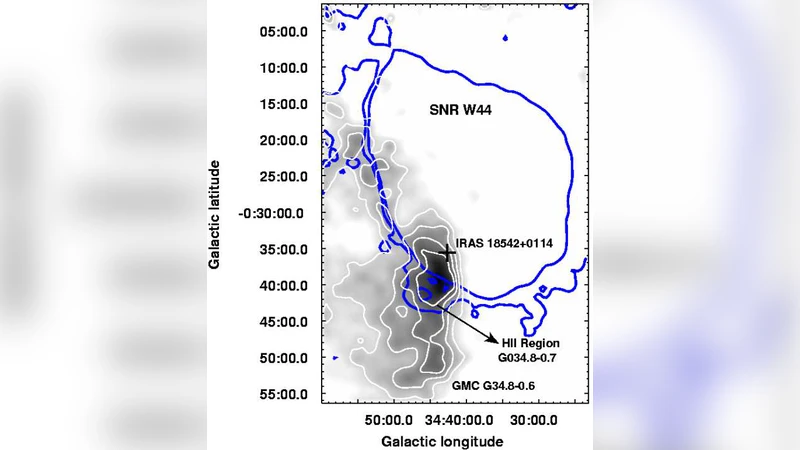
This work aims at investigating the molecular gas component in the vicinity of two young stellar object (YSO) candidates identified at the border of the HII region G034.8-0.7 that is evolving within a molecular cloud shocked by the SNR W44. The purpose is to explore signatures of star forming activity in this complex region. We performed a near and mid infrared study towards the border of the HII region G034.8-0.7 and observed a 90" X 90" region near 18h 56m 48s, +01d 18’ 45" (J2000) using the Atacama Submillimeter Telescope Experiment (ASTE) in the 12CO J=3–2, 13CO J=3–2, HCO+ J=4–3 and CS J=7–6 lines with an angular resolution of 22". Based on the infrared study we propose that the source 2MASS 18564827+0118471 (IR1 in this work) is a YSO candidate. We discovered a bipolar 12CO outflow in the direction of the line of sight and a HCO+ clump towards IR1, confirming that it is a YSO. From the detection of the CS J=7–6 line we infer the presence of high density (>10^7 cm^-3) and warm (>60 K) gas towards IR1, probably belonging to the protostellar envelope where the YSO is forming. We investigated the possible genetic connection of IR1 with the SNR and the HII region. By comparing the dynamical time of the outflows and the age of the SNR W44, we conclude that the possibility of the SNR has triggered the formation of IR1 is unlikely. On the other hand, we suggest that the expansion of the HII region G034.8-0.7 is responsible for the formation of IR1 through the “collect and collapse” process.
💡 Research Summary
The paper investigates the molecular environment surrounding two young stellar object (YSO) candidates located at the edge of the H II region G034.8‑0.7, which itself is embedded in a molecular cloud that has been shocked by the supernova remnant (SNR) W44. The authors first performed a near‑ and mid‑infrared analysis using 2MASS and Spitzer data to identify potential YSOs. Among the candidates, the source 2MASS 18564827+0118471 (referred to as IR1) displayed infrared colors consistent with a Class I or early Class II object, indicating an early evolutionary stage with substantial circumstellar material.
To probe the gas dynamics and physical conditions, the authors mapped a 90″ × 90″ region centered near 18h 56m 48s, +01° 18′ 45″ (J2000) with the Atacama Submillimeter Telescope Experiment (ASTE). Observations were carried out in four molecular transitions: 12CO J = 3–2, 13CO J = 3–2, HCO⁺ J = 4–3, and CS J = 7–6, all at an angular resolution of 22″. The CO data revealed a clear bipolar outflow oriented roughly along the line of sight. The blue‑shifted lobe spans velocities from –15 to –5 km s⁻¹, while the red‑shifted lobe covers +5 to +15 km s⁻¹. Using standard CO‑to‑H₂ conversion factors, the authors estimate an outflow mass of ~1 M⊙ and a dynamical timescale of ~10⁴ yr, typical of low‑mass protostellar outflows.
In addition to the outflow, a compact HCO⁺ J = 4–3 clump is detected precisely at the IR1 position, indicating the presence of dense gas (critical density ≳10⁶ cm⁻³). The detection of CS J = 7–6, which requires even higher excitation (critical density ≳10⁷ cm⁻³ and temperatures >60 K), confirms that IR1 is embedded in a warm, very dense environment, likely the protostellar envelope. These molecular signatures together provide strong evidence that IR1 is an actively forming star.
The authors then examine possible triggering mechanisms for IR1’s formation. The age of SNR W44 is estimated at ~2 × 10⁴ yr, comparable to the outflow dynamical time, but the spatial and temporal alignment suggests that the supernova shock is unlikely to have directly compressed the natal core of IR1. Conversely, the expanding H II region G034.8‑0.7 can sweep up surrounding molecular material, forming a dense shell that becomes gravitationally unstable—a process described by the “collect and collapse” model. By comparing the expansion age of the H II region with the estimated formation time of IR1, the authors argue that the H II region’s expansion is a more plausible trigger for the YSO’s birth.
In summary, the study combines infrared photometry with high‑resolution sub‑millimeter spectroscopy to confirm the presence of a young protostar (IR1) and its associated bipolar outflow within a complex environment shaped by both an SNR and an expanding H II region. The analysis favors the collect‑and‑collapse scenario driven by the H II region as the dominant mechanism for star formation in this locale, while deeming direct supernova‑induced triggering unlikely. The work provides a valuable case study for disentangling multiple feedback processes in star‑forming regions and highlights the need for higher‑resolution observations (e.g., with ALMA) to further resolve the protostellar core and outflow morphology.
Comments & Academic Discussion
Loading comments...
Leave a Comment