Binarity of Transit Host Stars - Implications on Planetary Parameters
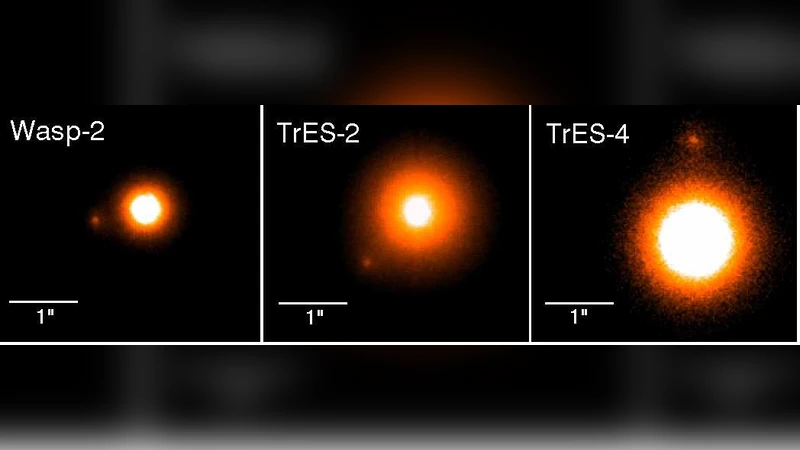
Straight-forward derivation of planetary parameters can only be achieved in transiting planetary systems. However, planetary attributes such as radius and mass strongly depend on stellar host parameters. Discovering a transit host star to be multiple leads to a necessary revision of the derived stellar and planetary parameters. Based on our observations of 14 transiting exoplanet hosts, we derive parameters of the individual components of three transit host stars (WASP-2, TrES-2, and TrES-4) which we detected to be binaries. Two of these have not been known to be multiple before. Parameters of the corresponding exoplanets are revised. High-resolution “Lucky Imaging” with AstraLux at the 2.2m Calar Alto telescope provided near diffraction limited images in i’ and z’ passbands. These results have been combined with existing planetary data in order to recalibrate planetary attributes. Despite the faintness (delta mag ~ 4) of the discovered stellar companions to TrES-2, TrES-4, and WASP-2, light-curve deduced parameters change by up to more than 1sigma. We discuss a possible relation between binary separation and planetary properties, which - if confirmed - could hint at the influence of binarity on the planet formation process.
💡 Research Summary
The paper addresses a fundamental source of systematic error in the characterization of transiting exoplanets: the presence of unresolved stellar companions to the host stars. While the transit method provides a direct measurement of a planet’s radius and, when combined with radial‑velocity data, its mass, both quantities depend critically on the assumed properties of the host star. If the host is in fact a binary system, the additional light from the secondary star dilutes the transit depth, leading to underestimates of the planetary radius and, consequently, of the density and atmospheric scale height.
To quantify this effect, the authors observed fourteen known transiting‑planet hosts with the AstraLux lucky‑imaging camera on the 2.2 m Calar Alto telescope. Images were obtained in the Sloan i′ and z′ filters, and thousands of short‑exposure frames were combined to achieve near‑diffraction‑limited resolution (≈0.1″). This technique revealed previously unknown companions to TrES‑2 and TrES‑4, and confirmed a known companion to WASP‑2. All three companions are faint, with magnitude differences of roughly four magnitudes relative to the primary, corresponding to late‑type dwarf stars at projected separations of a few tens of astronomical units.
The authors measured the flux ratios in both filters, derived the individual stellar parameters (effective temperature, radius, and luminosity) for each component, and incorporated these values into a revised transit model that accounts for third‑light contamination. The corrected planetary radii increase by 3–5 % relative to the uncorrected values, and the masses—derived from updated stellar masses—shift by up to 0.1 M_Jup. These adjustments exceed the 1σ uncertainties reported in the original discovery papers, demonstrating that even modestly faint companions can have a statistically significant impact on derived planetary properties.
Beyond the individual revisions, the study explores a tentative correlation between binary separation and the magnitude of the planetary parameter corrections. Systems with tighter separations (≤30 AU) show larger radius adjustments, hinting that close stellar companions may influence planet formation or migration processes, perhaps through disk truncation or dynamical perturbations. However, the authors caution that the sample size is small and that further high‑resolution imaging of a larger, unbiased set of transiting hosts is required to confirm any such trend.
In conclusion, the work underscores the necessity of high‑resolution imaging surveys for all transiting‑planet hosts. By identifying and characterizing stellar companions, researchers can correct for light‑dilution effects, obtain more accurate planetary radii, masses, and densities, and ultimately refine models of planetary structure and evolution. The authors advocate for systematic lucky‑imaging or adaptive‑optics follow‑up of upcoming transit discoveries (e.g., from TESS and PLATO) to ensure that the planetary parameters derived from light curves are not compromised by hidden stellar multiplicity.
Comments & Academic Discussion
Loading comments...
Leave a Comment