Detection and Characterization of Planetary Systems with $mu$as Astrometry
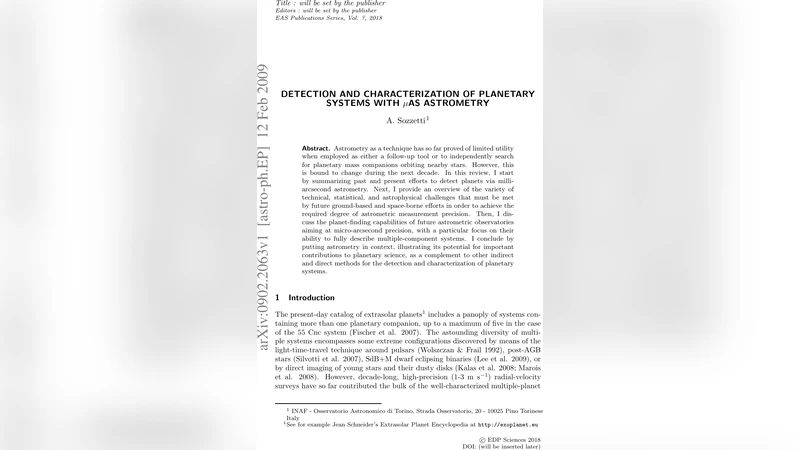
Astrometry as a technique has so far proved of limited utility when employed as either a follow-up tool or to independently search for planetary mass companions orbiting nearby stars. However, this is bound to change during the next decade. In this review, I start by summarizing past and present efforts to detect planets via milli-arcsecond astrometry. Next, I provide an overview of the variety of technical, statistical, and astrophysical challenges that must be met by future ground-based and space-borne efforts in order to achieve the required degree of astrometric measurement precision. Then, I discuss the planet-finding capabilities of future astrometric observatories aiming at micro-arcsecond precision, with a particular focus on their ability to fully describe multiple-component systems. I conclude by putting astrometry in context, illustrating its potential for important contributions to planetary science, as a complement to other indirect and direct methods for the detection and characterization of planetary systems.
💡 Research Summary
The paper provides a comprehensive review of astrometry as a tool for discovering and characterizing planetary systems, tracing its evolution from early milliarcsecond (mas) attempts to the forthcoming micro‑arcsecond (μas) era. It begins by summarizing historic efforts such as Hipparcos, the Hubble Space Telescope Fine Guidance Sensors, and ground‑based interferometers (VLTI/PRIMA, Keck Interferometer, CHARA). These campaigns demonstrated the principle that precise stellar position measurements can reveal the reflex motion induced by orbiting companions, but they were limited by atmospheric turbulence, optical‑path instability, detector non‑linearity, and insufficient long‑term stability, resulting in typical precisions of 0.2–1 mas.
The author then outlines the technical, statistical, and astrophysical challenges that must be overcome to reach the μas regime. Technically, future instruments must combine ultra‑stable opto‑mechanical structures, laser metrology, and thermal control to keep optical path differences stable at the picometer level. A dense network of reference stars, anchored to the Gaia catalog, is required to define a global reference frame with sub‑μas accuracy. Statistically, the extraction of weak astrometric signals from noisy data demands high‑dimensional Bayesian inference, Markov‑Chain Monte Carlo or nested‑sampling algorithms, and rigorous false‑alarm probability assessments. Astrophysically, stellar activity (spots, plages, granulation) can mimic or mask planetary signatures, so simultaneous photometric and spectroscopic monitoring is essential for decorrelation.
The paper surveys upcoming ground‑based facilities (ELT‑MICADO, TMT‑IRIS, adaptive‑optics assisted interferometers) and dedicated space missions (Theia, NEAT, a revived SIM‑Lite concept) that aim for 1 μas or better precision. Gaia’s ongoing mission already delivers a catalog with ~10 μas accuracy and will improve to a few μas for bright stars after the full mission, providing a valuable baseline for detecting long‑period planets. Simulations suggest that a μas‑level survey could detect dozens of Earth‑mass planets within 0.5 AU of nearby Sun‑like stars, hundreds of super‑Earths and Neptunes, and fully resolve the orbital architecture of multi‑planet systems, including mutual inclinations and resonant configurations.
A key strength of astrometry highlighted in the review is its ability to deliver absolute planetary masses and three‑dimensional orbital geometry, which complement radial‑velocity (gives only m sin i) and transit (gives radius) measurements. When combined, these methods enable precise density determinations, atmospheric modeling, and assessments of habitability. Moreover, astrometric orbital planes can be cross‑checked with direct‑imaging detections to refine inclination and phase information, improving the efficiency of future imaging campaigns.
In conclusion, the author argues that astrometry will transition from a niche follow‑up technique to a primary discovery method within the next decade. By overcoming the outlined challenges, μas astrometry will provide the missing third dimension of planetary system architecture, allowing astronomers to map the full dynamical structure of nearby planetary systems, test formation theories, and identify truly Earth‑like worlds in the habitable zones of their stars.
Comments & Academic Discussion
Loading comments...
Leave a Comment