Simulations of minor mergers. II. The phase-space structure of thick discs
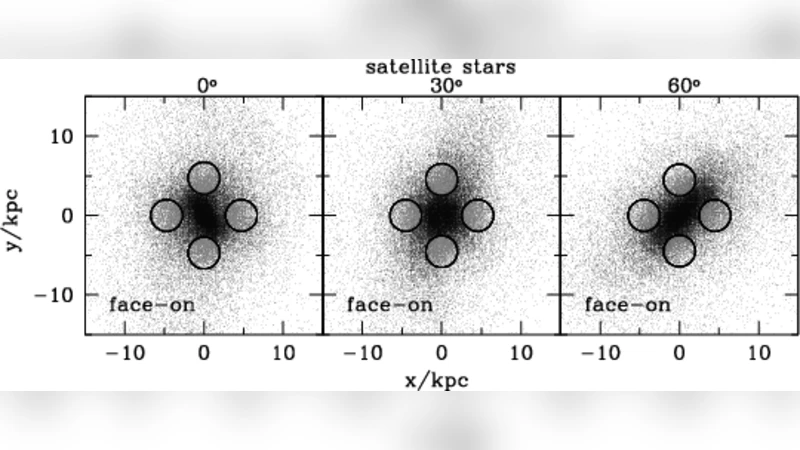
We analyse the phase-space structure of simulated thick discs that are the result of a significant merger between a disc galaxy and a satellite. Our main goal is to establish what would be the characteristic imprints of a merger origin for the Galactic thick disc. We find that the spatial distribution predicted for thick disc stars is asymmetric, seemingly in agreement with recent observations of the Milky Way thick disc. Near the Sun, the accreted stars are expected to rotate more slowly, to have broad velocity distributions, and to occupy preferentially the wings of the line-of-sight velocity distributions. The majority of the stars in our model thick discs have low eccentricity orbits (in clear reference to the pre-existing heated disc) which gives rise to a characteristic (sinusoidal) pattern for their line of sight velocities as function of galactic longitude. The z-component of the angular momentum of thick disc stars provides a clear discriminant between stars from the pre-existing disc and those from the satellite, particularly at large radii. These results are robust against the particular choices of initial conditions made in our simulations, and thus provide clean tests of the disc heating via a minor merger scenario for the formation of thick discs.
💡 Research Summary
The paper investigates whether a minor merger—i.e., the accretion of a satellite galaxy with roughly one‑tenth the mass of a pre‑existing disc—can produce the structural and kinematic signatures observed in the Milky Way’s thick disc. Using high‑resolution N‑body simulations (∼10⁶ particles for the host disc and ∼10⁵ for the satellite), the authors explore a range of satellite orbital inclinations (0°, 30°, 60°) and internal density profiles (cored, Plummer, NFW). The simulations are run for 5 Gyr with the Gadget‑2 code, and snapshots are analysed to separate particles into two populations: (1) stars originally belonging to the thin disc that have been heated (the “heated‑disc” component) and (2) stars that originated in the satellite and were deposited into the disc (the “accreted” component).
Key findings are as follows. First, the spatial distribution of the resulting thick disc is noticeably asymmetric with respect to the Galactic mid‑plane; the side opposite the satellite’s initial approach contains a ∼10 % excess of stars, a pattern that matches recent observations of the Milky Way thick disc. Second, the accreted stars rotate more slowly than the heated‑disc stars, lagging by 30–50 km s⁻¹, and exhibit a much broader velocity dispersion. In line‑of‑sight velocity histograms this manifests as pronounced wings, especially at large Galactic longitudes. Third, the heated‑disc stars retain low orbital eccentricities (e < 0.2) and therefore produce a sinusoidal variation of line‑of‑sight velocity with Galactic longitude, with maxima near l ≈ 90° and minima near l ≈ 270°. This sinusoid is a direct consequence of the near‑conservation of the vertical component of angular momentum (Lz) for the disc‑origin stars. Fourth, the Lz–R (angular momentum versus radius) diagram provides a clean discriminator: disc‑origin stars cluster at positive Lz values that decline smoothly with radius, whereas accreted stars populate a region of lower or even negative Lz, especially beyond ∼12 kpc. This separation persists across all tested initial conditions, indicating that the signatures are robust against variations in satellite mass ratio, orbital inclination, or internal structure.
The authors compare these simulated signatures with existing data from Gaia DR3, APOGEE, and large spectroscopic surveys. Observationally, the Milky Way thick disc indeed shows a modest rotational lag, an asymmetric vertical density profile, and a population of stars with high velocity dispersion that populate the tails of the line‑of‑sight velocity distribution. Moreover, recent studies have identified a bifurcation in the Lz–R plane that could correspond to the two simulated components. The paper argues that such concordance strongly supports a minor‑merger contribution to thick‑disc formation, while acknowledging that internal heating mechanisms (e.g., gas inflow, secular evolution) may also play a role and could be disentangled by combining kinematics with detailed chemical abundances.
In conclusion, the study provides a set of observable, phase‑space diagnostics—vertical asymmetry, rotational lag, broad velocity wings, sinusoidal v_los(l) pattern, and a distinct Lz–R split—that together constitute a “fingerprint” of a minor‑merger origin for thick discs. These diagnostics are testable with current and forthcoming large‑scale stellar surveys, offering a concrete pathway to assess the relative importance of satellite accretion versus internal processes in building the thick disc component of the Milky Way and similar spiral galaxies.
Comments & Academic Discussion
Loading comments...
Leave a Comment