Using X-Ray Observations to Explore the Binary Interaction in Eta Carinae
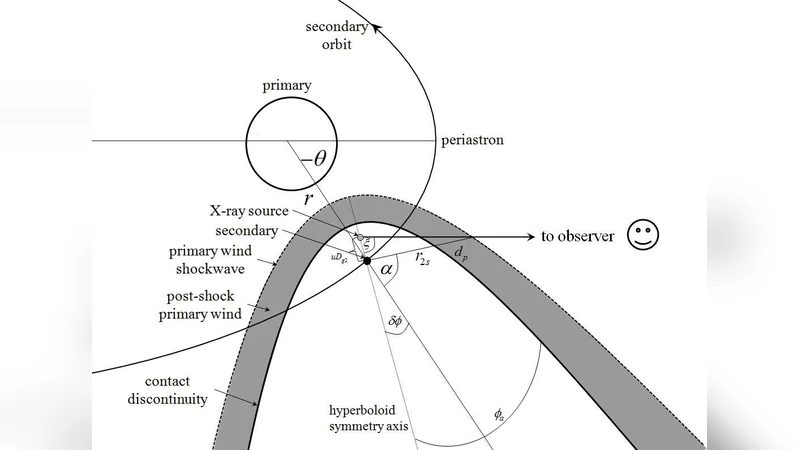
We study the usage of the X-ray light curve, column density toward the hard X-ray source, and emission measure (density square times volume), of the massive binary system Eta Carinae to determine the orientation of its semi-major axis. The source of the hard X-ray emission is the shocked secondary wind. We argue that, by itself, the observed X-ray flux cannot teach us much about the orientation of the semi-major axis. Minor adjustment of some unknown parameters of the binary system allows to fit the X-ray light curve with almost any inclination angle and orientation. The column density and X-ray emission measure, on the other hand, impose strong constrains on the orientation. We improve our previous calculations and show that the column density is more compatible with an orientation where for most of the time the secondary - the hotter, less massive star - is behind the primary star. The secondary comes closer to the observer only for a short time near periastron passage. The ten-week X-ray deep minimum, which results from a large decrease in the emission measure, implies that the regular secondary wind is substantially suppressed during that period. This suppression is most likely resulted by accretion of mass from the dense wind of the primary luminous blue variable (LBV) star. The accretion from the equatorial plane might lead to the formation of a polar outflow. We suggest that the polar outflow contributes to the soft X-ray emission during the X-ray minimum; the other source is the shocked secondary wind in the tail. The conclusion that accretion occurs at each periastron passage, every five and a half years, implies that accretion had occurred at a much higher rate during the 20 Great Eruption of Eta Carinae in the 19th century.
💡 Research Summary
The paper investigates the orientation of the highly eccentric binary system η Carinae by exploiting three X‑ray diagnostics: the hard‑X‑ray light curve (2–10 keV), the line‑of‑sight column density (NH) toward the hard‑X‑ray source, and the emission measure (EM = ∫ n² dV). The authors adopt the widely accepted picture that the hard X‑ray emission originates in the shocked wind of the secondary star, which is hotter and less massive than the primary luminous blue variable (LBV). They argue that the light curve alone is insufficient to constrain the orbital geometry because modest adjustments of uncertain binary parameters (mass‑loss rates, wind speeds, shock opening angle, etc.) can reproduce the observed flux for almost any inclination (i) and argument of periastron (ω).
In contrast, the column density and emission measure provide independent, geometry‑sensitive probes. By constructing three‑dimensional hydrodynamic models for a range of i and ω, the authors calculate synthetic NH(t) and EM(t) curves and compare them with the observed behavior. The observed NH rises sharply a few weeks before periastron, peaks near periastron, and then declines, a pattern that is reproduced only when the secondary spends most of the orbit behind the primary (i.e., the line of sight passes through the dense primary wind for the majority of the cycle). The best‑fit orientation corresponds to ω≈270°, meaning that the secondary is behind the primary for most of the time and comes to the front only briefly around periastron.
The EM shows a different but equally diagnostic signature. During the ten‑week X‑ray minimum that coincides with periastron, the EM drops by more than an order of magnitude, indicating a drastic reduction in the volume of hot shocked gas or a severe drop in its density. The authors interpret this as a suppression of the secondary wind caused by accretion of primary wind material onto the secondary. Near periastron, the dense primary wind overwhelms the secondary wind, leading to a temporary “accretion phase” (often called the “accretion model”). The accreted material is thought to settle in the equatorial plane of the secondary and may be redirected into a polar outflow.
The polar outflow, being cooler than the shocked secondary wind, can emit soft X‑rays. The authors therefore propose that the residual soft X‑ray emission observed during the deep minimum originates from two components: (1) the weak, trailing shocked secondary wind that still exists downstream of the accretion region, and (2) the newly formed polar outflow. This two‑component picture accounts for the observed spectral softening and the persistence of low‑level X‑ray flux throughout the minimum.
A key implication of the model is that the accretion episode recurs at every periastron passage, i.e., every 5.5 years. Extrapolating this behavior back to the 19th‑century “Great Eruption” of η Car, the authors suggest that accretion onto the secondary must have been far more intense during that epoch, potentially playing a major role in shaping the massive ejecta and the Homunculus nebula.
In summary, the study demonstrates that while the hard X‑ray light curve is highly degenerate with respect to orbital orientation, the combination of column density and emission measure breaks this degeneracy and strongly favors an orbital configuration in which the secondary is behind the primary for most of the orbit, emerging to the front only near periastron. The deep X‑ray minimum is best explained by a temporary shutdown of the secondary wind due to accretion of primary wind material, accompanied by the formation of a polar outflow that contributes to the observed soft X‑ray emission. This framework not only clarifies the present‑day X‑ray behavior of η Car but also provides a plausible mechanism for the extreme mass‑loss events that characterized its historic eruptions.
Comments & Academic Discussion
Loading comments...
Leave a Comment