The clustering of barred galaxies in the local Universe
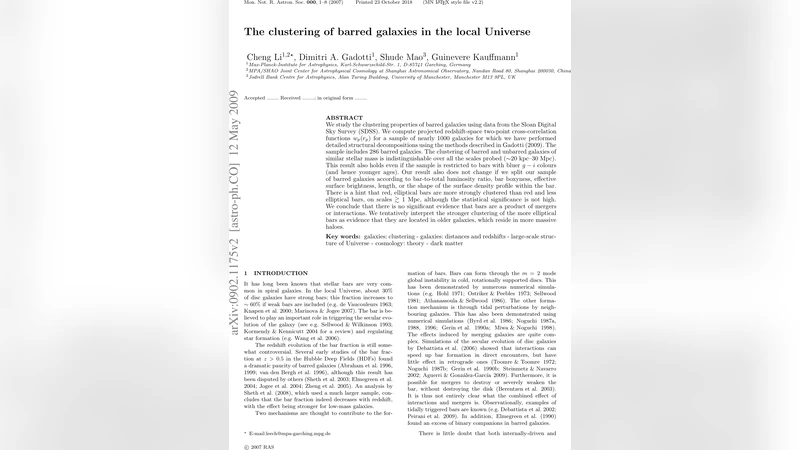
We study the clustering properties of barred galaxies using data from the Sloan Digital Sky Survey (SDSS). We compute projected redshift-space two-point cross-correlation functions w_p(r_p) for a sample of nearly 1000 galaxies for which we have performed detailed structural decompositions using the methods described in Gadotti (2009). The sample includes 286 barred galaxies. The clustering of barred and unbarred galaxies of similar stellar mass is indistinguishable over all the scales probed (20kpc - 30Mpc). This result also holds even if the sample is restricted to bars with bluer g-i colours (and hence younger ages). Our result also does not change if we split our sample of barred galaxies according to bar-to-total luminosity ratio, bar boxyness, effective surface brightness, length, or the shape of the surface density profile within the bar. There is a hint that red, elliptical bars are more strongly clustered than red and less elliptical bars, on scales > 1 Mpc, although the statistical significance is not high. We conclude that there is no significant evidence that bars are a product of mergers or interactions. We tentatively interpret the stronger clustering of the more elliptical bars as evidence that they are located in older galaxies, which reside in more massive haloes.
💡 Research Summary
The authors investigate whether the presence of a stellar bar in a galaxy correlates with its large‑scale environment. Using Sloan Digital Sky Survey imaging and spectroscopy, they assemble a sample of roughly 1,000 nearby galaxies for which detailed two‑dimensional structural decompositions (Gadotti 2009) have been performed; 286 of these host a bar. Stellar masses are estimated from colour–mass relations, and barred and unbarred galaxies are matched in narrow mass bins to eliminate mass‑driven bias. The projected redshift‑space two‑point cross‑correlation function, wₚ(rₚ), is measured over scales from ~20 kpc to 30 Mpc, with jackknife resampling providing robust error estimates.
Across all scales, the wₚ of barred galaxies is statistically indistinguishable from that of mass‑matched unbarred galaxies, indicating that bars do not preferentially reside in denser or more massive dark‑matter haloes. The authors further subdivide the barred sample by six bar properties—g‑i colour, bar‑to‑total luminosity ratio, boxiness (C₄), effective surface brightness, length, and the shape of the surface‑density profile—and repeat the clustering analysis. None of these subdivisions yields a significant difference in wₚ, suggesting that bar age, strength, or morphology does not depend on large‑scale environment.
A modest hint emerges that red, highly elliptical bars (g‑i > 1.2, ellipticity > 0.5) show slightly stronger clustering on >1 Mpc scales, but the effect is only at ~2σ significance and thus not conclusive. The authors interpret this tentative signal as evidence that more elliptical bars tend to inhabit older, more massive haloes, consistent with the notion that bar shape evolves with galaxy age.
The study therefore challenges the merger‑driven bar formation scenario; instead, it supports the view that bars arise primarily from internal disk instabilities, largely independent of external interactions. Limitations include the relatively modest number of barred galaxies, especially at the high‑density end, and the lack of three‑dimensional kinematic data for the bars. The authors propose that future work combining integral‑field spectroscopy, deeper infrared imaging, and halo mass estimates from weak lensing or abundance matching will allow a more precise test of subtle environmental influences on bar formation and evolution.
Comments & Academic Discussion
Loading comments...
Leave a Comment