r-modes and mutual friction in rapidly rotating superfluid neutron stars
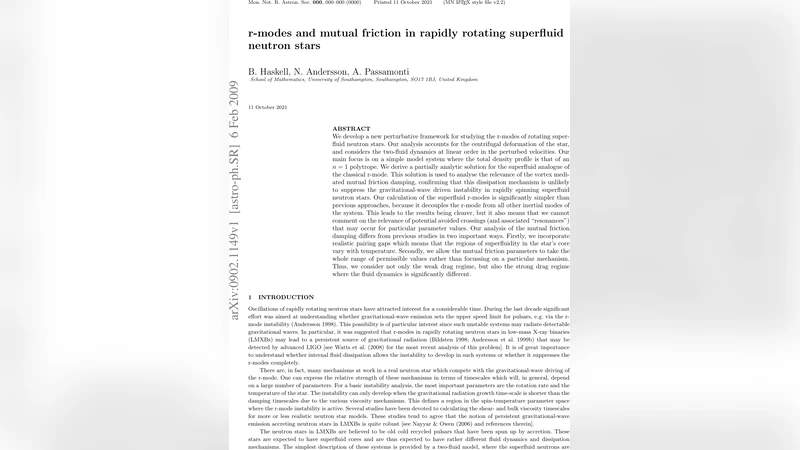
We develop a new perturbative framework for studying the r-modes of rotating superfluid neutron stars. Our analysis accounts for the centrifugal deformation of the star, and considers the two-fluid dynamics at linear order in the perturbed velocities. Our main focus is on a simple model system where the total density profile is that of an $n=1$ polytrope. We derive a partially analytic solution for the superfluid analogue of the classical r-mode. This solution is used to analyse the relevance of the vortex mediated mutual friction damping, confirming that this dissipation mechanism is unlikely to suppress the gravitational-wave driven instability in rapidly spinning superfluid neutron stars. Our calculation of the superfluid r-modes is significantly simpler than previous approaches, because it decouples the r-mode from all other inertial modes of the system. This leads to the results being clearer, but it also means that we cannot comment on the relevance of potential avoided crossings (and associated “resonances”) that may occur for particular parameter values. Our analysis of the mutual friction damping differs from previous studies in two important ways. Firstly, we incorporate realistic pairing gaps which means that the regions of superfluidity in the star’s core vary with temperature. Secondly, we allow the mutual friction parameters to take the whole range of permissible values rather than focussing on a particular mechanism. Thus, we consider not only the weak drag regime, but also the strong drag regime where the fluid dynamics is significantly different.
💡 Research Summary
The paper presents a streamlined perturbative framework for investigating r‑modes in rapidly rotating superfluid neutron stars, explicitly incorporating centrifugal deformation and two‑fluid dynamics at linear order in the velocity perturbations. By adopting an n = 1 polytropic density profile, the authors obtain a partially analytic solution for the superfluid analogue of the classical r‑mode. This solution is decoupled from all other inertial modes, which greatly simplifies the analysis but precludes discussion of possible avoided crossings and resonant interactions.
A central contribution is the treatment of vortex‑mediated mutual friction. Unlike earlier works that focused on a single weak‑drag mechanism, the study spans the full admissible range of the mutual‑friction parameters (B, B′), covering both weak and strong drag regimes. Realistic temperature‑dependent pairing gaps for neutrons and protons are incorporated, allowing the superfluid region of the core to evolve with temperature. This enables a physically motivated mapping of the drag coefficient across the star’s interior.
Using the analytic r‑mode eigenfunction, the authors compute the mutual‑friction damping time τ_mutual as a function of rotation rate Ω, temperature T, and drag strength. Their results show that for rapid rotation (Ω ≈ 0.5–0.9 Ω_K) and low temperatures (T ≲ 10⁸ K), τ_mutual is typically 10⁴–10⁸ s, far longer than the gravitational‑wave growth time τ_grav. Consequently, mutual friction—whether in the weak‑drag or strong‑drag regime—does not suppress the gravitational‑wave driven r‑mode instability in fast‑spinning superfluid neutron stars.
The paper also discusses the limitations of the decoupled approach. While it yields clear analytic insight, it cannot capture mode coupling effects that may arise near avoided crossings, where resonant enhancement of damping could become significant. The authors suggest that future work should combine their simplified analytic treatment with global numerical simulations to assess the impact of such resonances.
Overall, the study provides a more comprehensive and realistic assessment of mutual‑friction damping, demonstrating that the r‑mode instability remains robust in rapidly rotating superfluid neutron stars across the full spectrum of plausible drag coefficients. This has important implications for the detectability of continuous gravitational waves from young, fast‑spinning neutron stars.
Comments & Academic Discussion
Loading comments...
Leave a Comment