CCD Photometry of a Newly Confirmed SU UMa-Type Dwarf Nova, NSV 4838
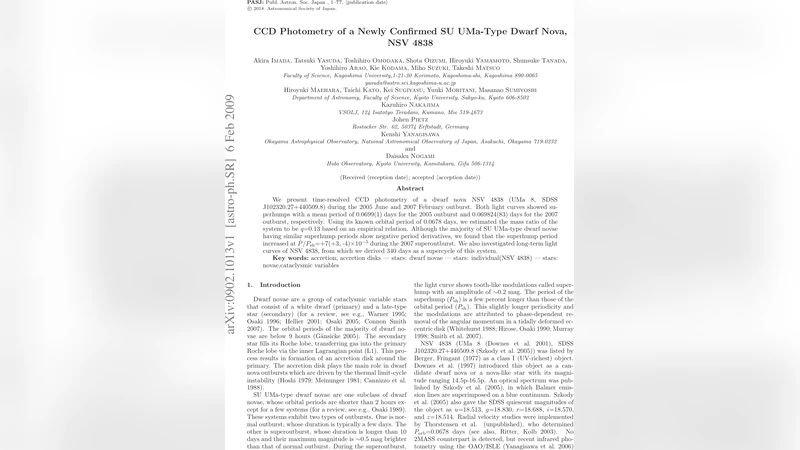
We present time-resolved CCD photometry of a dwarf nova NSV 4838 (UMa 8, SDSS J102320.27+440509.8) during the 2005 June and 2007 February outburst. Both light curves showed superhumps with a mean period of 0.0699(1) days for the 2005 outburst and 0.069824(83) days for the 2007 outburst, respectively. Using its known orbital period of 0.0678 days, we estimated the mass ratio of the system to be $q$=0.13 based on an empirical relation. Although the majority of SU UMa-type dwarf novae having similar superhump periods show negative period derivatives, we found that the superhump period increased at $\dot{P}$ / $P_{\rm sh}$=+7(+3, -4)$\times10^{-5}$ during the 2007 superoutburst. We also investigated long-term light curves of NSV 4838, from which we derived 340 days as a supercycle of this system.
💡 Research Summary
This paper presents time‑resolved CCD photometry of the dwarf nova NSV 4838 (also known as UMa 8 and SDSS J102320.27+440509.8) obtained during two superoutbursts, one in June 2005 and the other in February 2007. Both events displayed the characteristic superhumps of SU UMa‑type dwarf novae. The authors measured a mean superhump period of 0.0699 ± 0.0001 d for the 2005 outburst and 0.069824 ± 0.000083 d for the 2007 outburst. Using the previously determined orbital period of 0.0678 d, they derived the fractional period excess ΔP/Pₒᵣb ≈ 0.031 and, applying the empirical relation of Patterson (1998), estimated a mass ratio q ≈ 0.13.
A key result is the determination of the superhump period derivative during the 2007 superoutburst. By constructing an O–C diagram for the superhump maxima, the authors found a positive period change, quantified as (\dot P/P_{\rm sh}=+7^{+3}_{-4}\times10^{-5}). This positive (\dot P) is unusual because the majority of SU UMa systems with comparable superhump periods exhibit negative period derivatives, reflecting a shrinking precessing accretion disk as the outburst evolves. The observed increase suggests that, in NSV 4838, the disk either expands or its precession rate accelerates during the plateau phase, possibly due to a low mass ratio, a higher mass‑transfer rate, or a particular temperature/viscosity structure that sustains the 3:1 resonance longer than typical.
The long‑term light curve, assembled from archival observations and the authors’ own monitoring, reveals a supercycle of roughly 340 days. This relatively short supercycle places NSV 4838 among the more frequently outbursting SU UMa stars, implying a comparatively high mass‑transfer rate from the secondary. The combination of a short supercycle, low q, and a positive (\dot P) makes NSV 4838 a valuable test case for theories of tidal instability and disk precession in dwarf novae.
In the discussion, the authors compare NSV 4838 with other short‑period SU UMa systems. They note that while many objects with (P_{\rm sh}) near 0.07 d show decreasing periods (negative (\dot P)), a subset—including V1028 Cyg, V1251 Cyg, and now NSV 4838—exhibit period increases. The paper suggests that the sign of (\dot P) may be governed not solely by the superhump period but also by the evolutionary state of the binary, the size of the accretion disk at outburst maximum, and the detailed physics of the tidal torque.
Overall, the study provides high‑quality photometric data, precise period measurements, and a clear detection of an atypical positive period derivative. These results support the view that the superhump period evolution is sensitive to the underlying binary parameters and disk conditions, and they highlight the need for more extensive monitoring of short‑period SU UMa stars. Future work, including time‑resolved spectroscopy to directly measure the radial velocity curve and thus refine the mass ratio, as well as multi‑wavelength photometry to probe disk temperature changes, will be essential to fully understand why NSV 4838 deviates from the norm and what this tells us about the broader population of cataclysmic variables.
Comments & Academic Discussion
Loading comments...
Leave a Comment