The rate of type Ia Supernovae and the star formation history
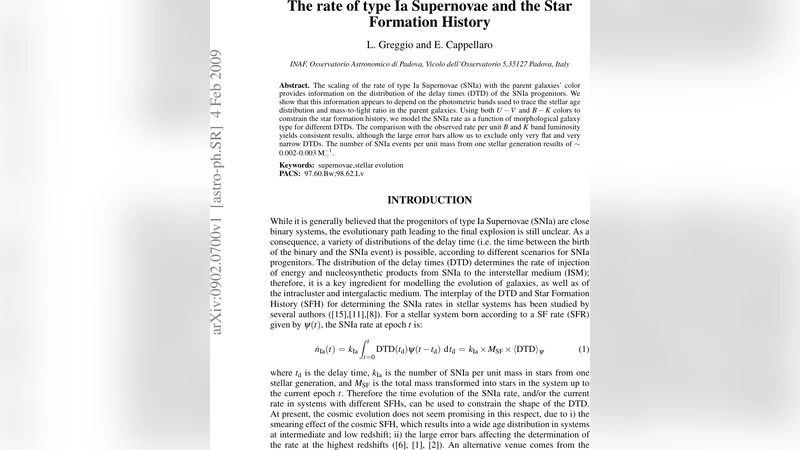
The scaling of the rate of type Ia Supernovae (SNIa) with the parent galaxies’ color provides information on the distribution of the delay times (DTD) of the SNIa progenitors. We show that this information appears to depend on the photometric bands used to trace the stellar age distribution and mass-to-light ratio in the parent galaxies. Using both (U-V) and (B-K) colors to constrain the star formation history, we model the SNIa rate as a function of morphological galaxy type for different DTDs. The comparison with the observed rate per unit B and K band luminosity yields consistent results, although the large error bars allow us to exclude only very flat and very narrow DTDs. The number of SNIa from one stellar generation results of ~ 2, 3 events every 1000 Mo of stars formed.
💡 Research Summary
The paper investigates how the rate of Type Ia supernovae (SNIa) varies with the colour and morphological type of their host galaxies, with the ultimate goal of constraining the delay‑time distribution (DTD) of SNIa progenitors. The authors begin by noting that the SNIa rate per unit stellar mass (or per unit luminosity) is the convolution of the star‑formation history (SFH) of a galaxy with the DTD, which describes the probability that a star formed at time t = 0 will explode as a SNIa after a delay τ. Because the SFH is not directly observable, it must be inferred from integrated galaxy colours. The study therefore adopts two colour indices: (U‑V), which is sensitive to recent star formation and the presence of hot, massive stars, and (B‑K), which traces the older, redder stellar population and is closely linked to the mass‑to‑light ratio (M/L). By fitting these colours with population‑synthesis models, the authors reconstruct a plausible SFH for each morphological class (E, S0, Sa, Sb, Sc, etc.).
With the SFHs in hand, the authors explore several functional forms for the DTD: (i) an exponential decay DTD, characterised by a characteristic timescale τₑₓₚ and representing a scenario where the bulk of SNIa explode shortly after star formation but with a long tail; (ii) a power‑law DTD ∝ τ⁻¹, motivated by binary‑population synthesis studies that predict a broad distribution of delay times extending to several gigayears; and (iii) a bimodal DTD with two distinct peaks (a “prompt” component at ≈0.1 Gyr and a “delayed” component at ≈3 Gyr) intended to capture the possibility of multiple progenitor channels (e.g., double‑degenerate versus single‑degenerate). For each DTD the convolution with the SFH yields a predicted SNIa rate per unit B‑band luminosity (SNuB) and per unit K‑band luminosity (SNuK) for each galaxy type.
The observational benchmark consists of published SNIa rates normalised to B and K band luminosities. The comparison shows that very flat DTDs (i.e., constant rate independent of τ) and extremely narrow DTDs (all explosions at a single delay) are inconsistent with the data, as they either over‑predict the rate in early‑type galaxies or under‑predict it in late‑type systems. In contrast, both the exponential and the power‑law DTDs lie within the large observational error bars for most morphological classes, with the power‑law providing a slightly better match to the K‑band normalised rates, which are more directly tied to stellar mass. This suggests that a substantial fraction of SNIa arise from old stellar populations, but a non‑negligible “prompt” component is also required to explain the elevated rates in star‑forming spirals.
A further quantitative outcome is the estimate of the number of SNIa produced per unit stellar mass formed. By integrating the best‑fit DTDs over all delay times, the authors obtain a yield of roughly 2–3 × 10⁻³ SNIa per solar mass of stars formed (i.e., about 2–3 events per 1,000 M☉). This figure is in line with previous empirical estimates and provides a useful calibration for chemical‑evolution models that need to account for iron enrichment from SNIa.
The paper acknowledges several limitations. The colour‑to‑SFH conversion depends on assumptions about metallicity, dust attenuation, and the initial mass function, all of which introduce systematic uncertainties. The observational sample, especially in the K‑band, is relatively small, leading to large statistical errors that prevent a decisive discrimination between the exponential and power‑law DTDs. Moreover, the DTD models considered are simplistic; real progenitor populations may involve a continuum of channels that cannot be captured by a single analytic form.
In conclusion, the study demonstrates that using multiple colour diagnostics to reconstruct galaxy SFHs, combined with a range of plausible DTDs, can reproduce the observed dependence of SNIa rates on galaxy type and on the band used for normalisation. While the current data rule out the most extreme DTD shapes, they are insufficient to pinpoint the exact functional form. Future large‑scale surveys (e.g., LSST, Euclid) that will deliver precise SNIa rates across a wide range of host‑galaxy properties, together with improved stellar‑population models, are required to break the remaining degeneracies and to achieve a definitive measurement of the SNIa delay‑time distribution.
Comments & Academic Discussion
Loading comments...
Leave a Comment