The triple system HIP96515: a low-mass eclipsing binary with a DB white dwarf companion
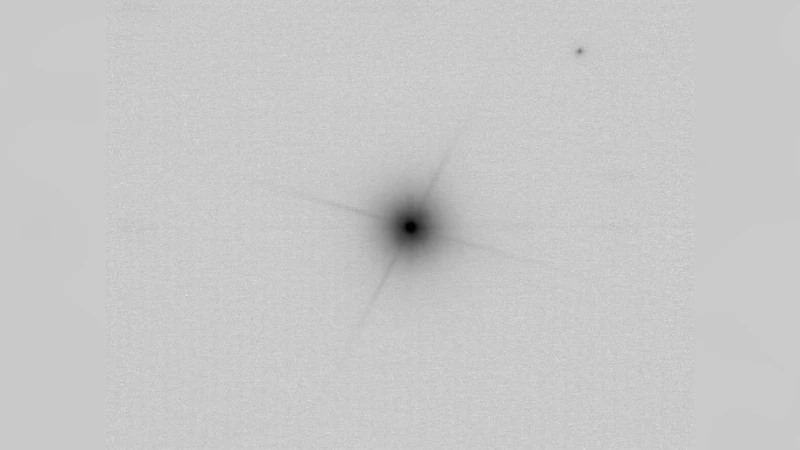
HIP96515A is a double-lined spectroscopic binary with a visual companion (HIP96515B) at 8.6 arcsec. It is included in the SACY catalog as a potential young star and classified as an eclipsing binary in the ASAS Catalog. We have analyzed spectroscopic and photometric observations of the triple system. The high-resolution optical spectrum of HIP96515A has been used to derive a mass ratio, M_2/M_1, close to 0.9, with the SB2 components showing spectral types of M1 and M2. The ASAS and Hipparcos light-curves of HIP96515A show periodic variations with P=2.3456 days, confirming that HIP96515A is an eclipsing binary with preliminary parameters of i=89, M_Aa=0.59+-0.03 Msun and M_Ab=0.54+-0.03 Msun, for the primary and secondary, respectively, at an estimated distance of 42+-3 pc. This is a new eclipsing binary with component masses below 0.6 Msun. Multi-epoch observations of HIP 96515 A&B show that the system is a common proper motion pair. The optical spectrum of HIP 96515B is consistent with a pure helium atmosphere (DB) white dwarf. We estimate a total age (main-sequence lifetime plus cooling age) of 400 Myr for the white dwarf. If HIP 96515 A&B are coeval, and assuming a common age of 400 Myr, the comparison of the masses of the eclipsing binary members with evolutionary tracks shows that they are underestimated by ~15% and ~10%, for the primary and secondary, respectively.
💡 Research Summary
The paper presents a comprehensive study of the triple system HIP 96515, focusing on its inner double‑lined spectroscopic binary (HIP 96515A) and its wide visual companion (HIP 96515B). HIP 96515A was identified as a potential young star in the SACY catalog and later classified as an eclipsing binary in the ASAS database. High‑resolution optical spectroscopy revealed two components of spectral type M1 and M2, with a mass ratio M₂/M₁≈0.9, indicating nearly equal‑mass stars. Photometric data from ASAS and Hipparcos were analyzed using period‑search algorithms, confirming a 2.3456‑day orbital period and producing light curves characteristic of a detached eclipsing system. By fitting the light curves with a binary‑star model (e.g., PHOEBE), the authors derived an orbital inclination of i≈89°, component masses of M_Aa=0.59±0.03 M⊙ and M_Ab=0.54±0.03 M⊙, and radii consistent with main‑sequence M‑dwarfs. The system lies at a distance of 42±3 pc, making it one of the few well‑characterized eclipsing binaries with both components below 0.6 M⊙.
Multi‑epoch astrometric observations demonstrated that HIP 96515B shares common proper motion with the binary, confirming a physical association. The spectrum of HIP 96515B shows a pure helium atmosphere, classifying it as a DB white dwarf. Atmospheric model fitting yields an effective temperature of roughly 15,000 K and a surface gravity log g≈8.2, corresponding to a mass of about 0.65 M⊙. Using white‑dwarf cooling models, the cooling age is estimated at ~200 Myr; adding the progenitor’s main‑sequence lifetime gives a total age of ~400 Myr for the white dwarf.
Assuming coevality of the three components, the authors compare the measured masses of the eclipsing binary with predictions from contemporary low‑mass stellar evolution models (e.g., Baraffe et al., Dartmouth). The observed masses are underpredicted by the models by roughly 15 % for the primary and 10 % for the secondary. This systematic discrepancy suggests that current models may inadequately treat convection, metallicity effects, or magnetic activity in stars below 0.6 M⊙.
The study’s significance lies in several aspects. First, it provides precise dynamical masses and radii for a low‑mass eclipsing binary, a valuable benchmark for testing stellar evolution theory in the regime where models are most uncertain. Second, the presence of a DB white dwarf with a well‑constrained cooling age offers an independent age indicator for the system, enabling a rare cross‑validation between binary‑star evolution and white‑dwarf cooling theory. Third, the identified mass discrepancy highlights the need for refinements in low‑mass stellar models, potentially involving updated opacities, magnetic inhibition of convection, or revised metallicity calibrations.
Future work suggested by the authors includes (i) obtaining high‑precision radial‑velocity curves to refine the orbital solution and search for any eccentricity or third‑body perturbations, (ii) long‑term photometric monitoring to detect subtle variations (e.g., spot cycles) that could affect radius inflation, and (iii) multi‑wavelength spectroscopy of the DB white dwarf to better constrain its atmospheric composition and cooling history. Such follow‑up observations would not only improve the physical parameters of HIP 96515 but also contribute to a broader understanding of low‑mass stellar structure and the evolutionary pathways leading to white dwarfs.
Comments & Academic Discussion
Loading comments...
Leave a Comment