Time-resolved spectroscopy of the planet-hosting sdB pulsator V391 Pegasi
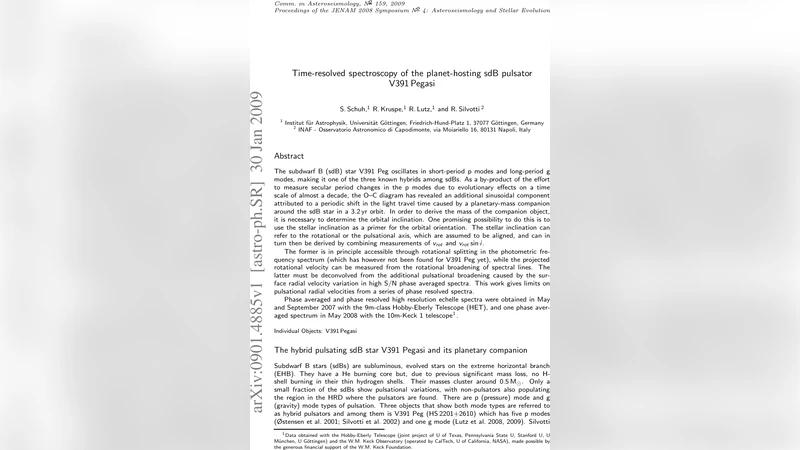
The subdwarf B (sdB) star V391 Peg oscillates in short-period p modes and long-period g modes, making it one of the three known hybrids among sdBs. As a by-product of the effort to measure secular period changes in the p modes due to evolutionary effects on a time scale of almost a decade, the O-C diagram has revealed an additional sinusoidal component attributed to a periodic shift in the light travel time caused by a planetary-mass companion around the sdB star in a 3.2 yr orbit. In order to derive the mass of the companion object, it is necessary to determine the orbital inclination. One promising possibility to do this is to use the stellar inclination as a primer for the orbital orientation. The stellar inclination can refer to the rotational or the pulsational axis, which are assumed to be aligned, and can in turn then be derived by combining measurements of v_(rot) and v_(rot)sin i. The former is in principle accessible through rotational splitting in the photometric frequency spectrum (which has however not been found for V391 Peg yet), while the projected rotational velocity can be measured from the rotational broadening of spectral lines. The latter must be deconvolved from the additional pulsational broadening caused by the surface radial velocity variation in high S/N phase averaged spectra. This work gives limits on pulsational radial velocities from a series of phase resolved spectra. Phase averaged and phase resolved high resolution echelle spectra were obtained in May and September 2007 with the 9m-class Hobby-Eberly Telescope (HET), and one phase averaged spectrum in May 2008 with the 10m-Keck 1 telescope.
💡 Research Summary
V391 Pegasi is a subdwarf B (sdB) star that exhibits both short‑period pressure (p) modes and long‑period gravity (g) modes, placing it among the very few hybrid sdB pulsators known. Long‑term monitoring of its pulsation timings has produced an O‑C (observed minus calculated) diagram that not only shows the secular period changes expected from stellar evolution but also reveals a sinusoidal component with a 3.2‑year period. This periodic O‑C variation has been interpreted as a light‑travel‑time effect caused by a planetary‑mass companion orbiting the sdB star. While the presence of the companion is robust, its true mass remains uncertain because the orbital inclination (i) is unknown; the O‑C analysis alone yields only a minimum mass (M sin i).
The authors propose to infer i by measuring the stellar inclination, assuming that the star’s rotation axis and the pulsation axis are aligned. The stellar inclination can be derived if both the true equatorial rotational velocity (v_rot) and its projected value (v_rot sin i) are known. In principle, v_rot could be obtained from rotational splitting of the pulsation frequencies in the photometric power spectrum, but no such splitting has yet been detected for V391 Peg. Consequently, the study focuses on determining v_rot sin i from high‑resolution spectroscopy.
A major complication is that the pulsations themselves induce surface radial‑velocity variations, which broaden spectral lines in addition to rotational broadening. To isolate the rotational contribution, the authors obtained a series of high‑resolution echelle spectra with the 9‑meter Hobby‑Eberly Telescope (HET) in May and September 2007 and a phase‑averaged spectrum with the 10‑meter Keck I telescope in May 2008. The HET data were divided into several phase bins covering the dominant p‑mode (≈ 349 s) and the strongest g‑mode (≈ 5400 s). For each bin, they measured line profiles of H β and several metal lines, employing cross‑correlation techniques to derive radial‑velocity shifts as a function of pulsation phase.
The analysis found no statistically significant radial‑velocity modulation associated with the pulsation phases. The 3‑σ upper limit on the pulsational radial‑velocity amplitude is ≈ 16 km s⁻¹. By modeling the observed line widths with a combination of instrumental broadening, pulsational broadening (constrained by the above limit), and rotational broadening, the authors derived an upper limit on the projected rotational velocity of v_rot sin i < 9 km s⁻¹. These values imply that V391 Peg is a relatively slow rotator and that the pulsation‑induced line broadening is modest compared with the instrumental resolution.
Because the current spectra have signal‑to‑noise ratios (S/N) of only a few hundred per pixel, the authors caution that more precise constraints on v_rot and on any rotational splitting in the photometric spectrum will require substantially higher S/N (≈ 1000) and possibly longer time‑baseline observations. Detecting rotational splitting would directly yield v_rot, allowing the inclination to be calculated from the measured v_rot sin i. With a reliable inclination, the true mass of the planetary companion could be determined, providing a rare dynamical mass measurement for a planet orbiting an evolved sdB star.
In summary, the paper presents the first spectroscopic limits on both pulsational radial‑velocity amplitudes and projected rotational velocity for V391 Peg. The limits (Δv_puls < 16 km s⁻¹, v_rot sin i < 9 km s⁻¹) are consistent with a slowly rotating, weakly pulsating sdB star. The work highlights the observational challenges of disentangling pulsation and rotation in hot subdwarfs and sets the stage for future high‑precision spectroscopic campaigns aimed at fully characterizing the orbital geometry of the V391 Peg planetary system.
Comments & Academic Discussion
Loading comments...
Leave a Comment