Semi-indefinite-inner-product and generalized Minkowski spaces
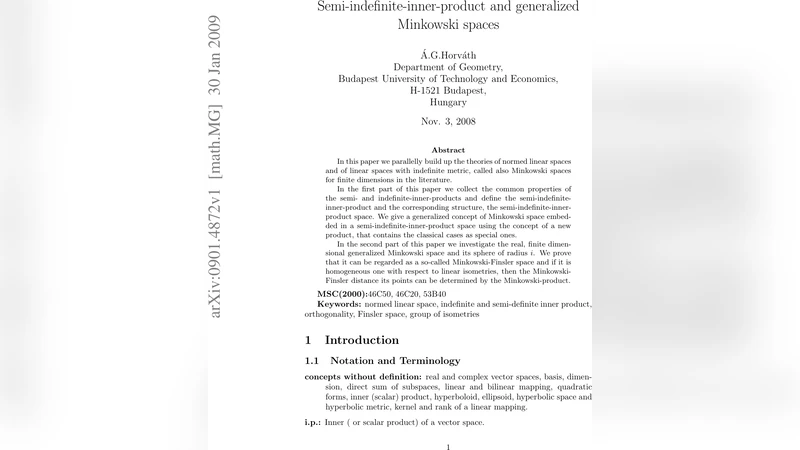
In this paper we parallelly build up the theories of normed linear spaces and of linear spaces with indefinite metric, called also Minkowski spaces for finite dimensions in the literature. In the first part of this paper we collect the common properties of the semi- and indefinite-inner-products and define the semi-indefinite-inner-product and the corresponding structure, the semi-indefinite-inner-product space. We give a generalized concept of Minkowski space embedded in a semi-indefinite-inner-product space using the concept of a new product, that contains the classical cases as special ones. In the second part of this paper we investigate the real, finite dimensional generalized Minkowski space and its sphere of radius $i$. We prove that it can be regarded as a so-called Minkowski-Finsler space and if it is homogeneous one with respect to linear isometries, then the Minkowski-Finsler distance its points can be determined by the Minkowski-product.
💡 Research Summary
The paper introduces a novel algebraic structure called a semi‑indefinite inner product (s.i.p.) that simultaneously generalizes the positive‑definite inner products underlying normed linear spaces and the indefinite metrics used in Minkowski (or pseudo‑Euclidean) spaces. After reviewing the basic properties of semi‑inner‑products (which require only positivity and the triangle inequality) and indefinite inner products (which require symmetry and non‑degeneracy), the author defines an s.i.p. on a real vector space V that admits an orthogonal decomposition V = V⁺ ⊕ V⁻. On V⁺ a positive‑definite inner product is prescribed, while on V⁻ a negative‑definite one is prescribed; the combined bilinear form is linear in each argument but may take both positive and negative values.
A new binary operation, the Minkowski‑product ⟨·,·⟩M, is then defined by
⟨x, y⟩M = ⟨x⁺, y⁺⟩{V⁺} – ⟨x⁻, y⁻⟩{V⁻},
where x = x⁺ + x⁻ and y = y⁺ + y⁻ are the orthogonal projections onto V⁺ and V⁻. This product reduces to the usual inner product when V⁻ = {0} and to the standard indefinite Minkowski form when V⁺ = {0}. It may be complex‑valued, and the sign of ⟨x, x⟩_M classifies vectors as “space‑like” (positive), “time‑like” (negative), or “null” (zero).
Focusing on finite‑dimensional real spaces, the author studies the set
S_i = { x ∈ V | ⟨x, x⟩_M = –1 },
which can be thought of as a sphere of (imaginary) radius i. On S_i a distance function is introduced:
d_M(p, q) = arccosh( –⟨p, q⟩_M ),
which satisfies the axioms of a Finsler metric. Consequently, (S_i, d_M) is a Minkowski‑Finsler space. The paper proves that if the space is homogeneous with respect to its linear isometry group G = { T ∈ GL(V) | ⟨Tx, Ty⟩_M = ⟨x, y⟩_M ∀x, y }, then G acts transitively on S_i, and the distance between any two points is completely determined by the Minkowski‑product. In other words, the geodesic distance in this generalized Minkowski space can be expressed algebraically without recourse to differential geometry.
The author further shows that classical Minkowski (Lorentzian) spaces and ordinary normed spaces appear as special cases of the s.i.p. framework: setting V⁻ = {0} recovers a normed space, while taking V⁺ one‑dimensional and V⁻ of dimension n – 1 yields the standard Lorentz metric. This unified viewpoint suggests new avenues for applications: in relativity the S_i sphere resembles the light cone, in optimization it provides a natural way to handle asymmetric distance measures, and in information geometry it may lead to non‑Euclidean divergence functions.
The paper concludes with several open problems: extending the theory to infinite‑dimensional Banach or Hilbert spaces, developing a spectral theory for operators that are self‑adjoint with respect to an s.i.p., and investigating non‑linear isometry groups that preserve the Minkowski‑product. Overall, the work offers a coherent bridge between normed linear analysis and indefinite metric geometry, opening the door to a richer class of spaces where both positive and negative curvature aspects coexist.
Comments & Academic Discussion
Loading comments...
Leave a Comment