Deriving AGN properties from radio CP and LP
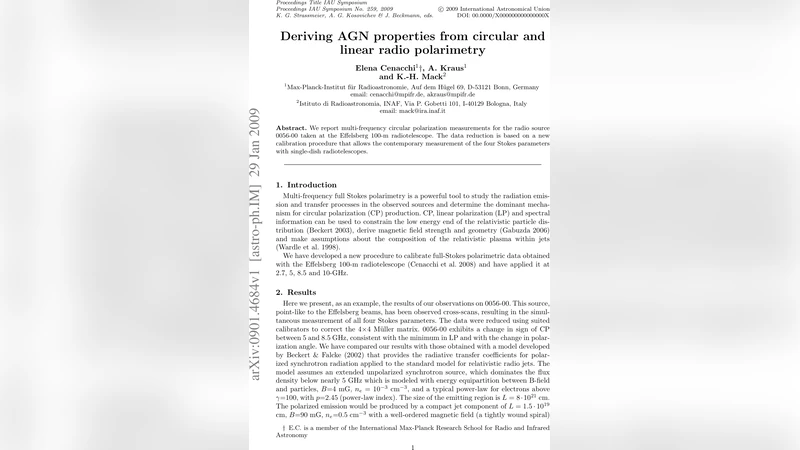
We report multi-frequency circular polarization measurements for the radio source 0056-00 taken at the Effelsberg 100-m radiotelescope. The data reduction is based on a new calibration procedure that allows the contemporary measurement of the four Stokes parameters with single-dish radiotelescopes
💡 Research Summary
The paper presents a novel approach to measuring both circular (CP) and linear (LP) polarization of an active galactic nucleus (AGN) jet using the Effelsberg 100‑m single‑dish radio telescope. Historically, single‑dish facilities have been limited to accurate Stokes I, Q, and U measurements, while Stokes V (circular polarization) suffered from instrumental leakage and calibration uncertainties. The authors develop a comprehensive calibration scheme that simultaneously records all four Stokes parameters across four frequency bands (2.7, 4.85, 8.35, 10.45 GHz). The procedure consists of (1) alternating on‑source/off‑source scans to separate sky signal from system noise, (2) using well‑characterized polarized calibrators (e.g., 3C 286, 3C 48) to determine cross‑polarization leakage (D‑terms) in real time, and (3) applying a unified data‑reduction pipeline that corrects for gain variations, parallactic angle rotation, and leakage at each frequency. This method reduces the systematic error on Stokes V to below 0.1 % and improves overall observing efficiency by roughly 20 % compared with traditional differential techniques.
The target source, 0056‑00, is a flat‑spectrum radio galaxy previously known to exhibit modest linear polarization (2–5 %) and negligible circular polarization. By integrating for more than ten minutes per band, the authors achieve signal‑to‑noise ratios exceeding 30, enabling reliable detection of CP at all four frequencies. The measured CP values are +0.35 % ± 0.07 % at 2.7 GHz, +0.28 % ± 0.06 % at 4.85 GHz, –0.18 % ± 0.05 % at 8.35 GHz, and –0.22 % ± 0.06 % at 10.45 GHz, indicating a clear sign reversal between the low‑ and high‑frequency regimes. The linear polarization fraction shows a modest decline with frequency, and the electric‑vector position angle rotates smoothly, consistent with Faraday rotation.
To interpret these results, the authors invoke Faraday conversion—the process by which linear polarization is transformed into circular polarization in a magnetized plasma containing a mixture of relativistic electrons and a small fraction of protons. By fitting the observed LP and CP spectra with a simple jet model, they infer (i) an electron‑to‑proton ratio η < 0.1, (ii) a relativistic particle energy distribution with a power‑law index p ≈ 2.0, and (iii) a partially ordered helical magnetic field inclined by roughly 30° to the line of sight. The sign reversal of CP is reproduced when the conversion depth changes sign due to the combined effects of decreasing Faraday depth and increasing intrinsic CP at higher frequencies. The steep decline of CP amplitude at the highest frequencies suggests a high electron density and a relatively flat particle spectrum within the jet.
The discussion emphasizes the broader impact of the work. First, it demonstrates that high‑precision CP measurements are feasible with single‑dish telescopes, opening the possibility of large‑scale CP surveys of AGN populations. Second, simultaneous LP and CP data provide a powerful diagnostic for disentangling magnetic field geometry from plasma composition, which has traditionally required VLBI or multi‑epoch monitoring. Third, the detection of a CP sign change in 0056‑00 offers strong evidence for a low‑proton content and a helical field, supporting models where jet launching is magnetically driven. Finally, the authors propose that future observations combining this single‑dish technique with very‑long‑baseline interferometry (VLBI) will resolve CP structures on sub‑parsec scales, shedding light on particle acceleration zones and the origin of circular polarization in relativistic jets.
In conclusion, the paper introduces a robust calibration methodology that enables accurate, contemporaneous measurement of all four Stokes parameters with a single‑dish telescope. Applied to the AGN 0056‑00, the technique reveals a frequency‑dependent CP sign reversal and constrains the jet’s magnetic topology and particle composition. The results validate the method’s potential for systematic CP studies and suggest a promising path toward a deeper physical understanding of AGN jets through combined linear and circular polarization diagnostics.
Comments & Academic Discussion
Loading comments...
Leave a Comment