Searching for Main-Belt Comets Using the Canada-France-Hawaii Telescope Legacy Survey
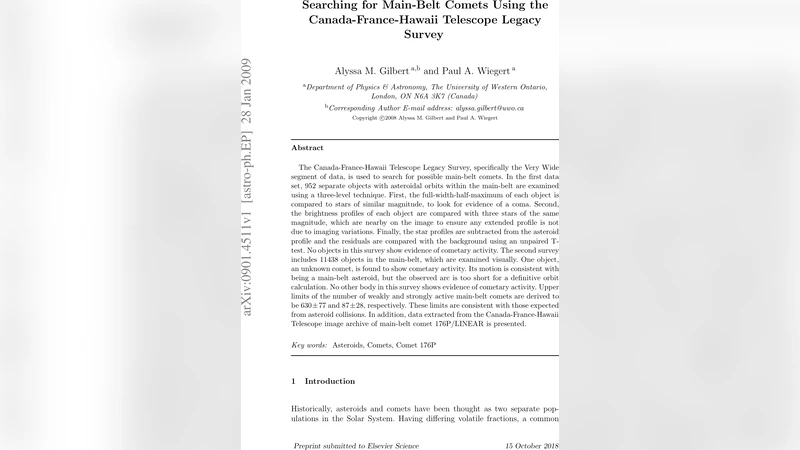
The Canada-France-Hawaii Telescope Legacy Survey, specifically the Very Wide segment of data, is used to search for possible main-belt comets. In the first data set, 952 separate objects with asteroidal orbits within the main-belt are examined using a three-level technique. First, the full-width-half-maximum of each object is compared to stars of similar magnitude, to look for evidence of a coma. Second, the brightness profiles of each object are compared with three stars of the same magnitude, which are nearby on the image to ensure any extended profile is not due to imaging variations. Finally, the star profiles are subtracted from the asteroid profile and the residuals are compared with the background using an unpaired T-test. No objects in this survey show evidence of cometary activity. The second survey includes 11438 objects in the main-belt, which are examined visually. One object, an unknown comet, is found to show cometary activity. Its motion is consistent with being a main-belt asteroid, but the observed arc is too short for a definitive orbit calculation. No other body in this survey shows evidence of cometary activity. Upper limits of the number of weakly and strongly active main-belt comets are derived to be 630+/-77 and 87+/-28, respectively. These limits are consistent with those expected from asteroid collisions. In addition, data extracted from the Canada-France-Hawaii Telescope image archive of main-belt comet 176P/LINEAR is presented.
💡 Research Summary
The paper presents a systematic search for main‑belt comets (MBCs) using data from the Canada‑France‑Hawaii Telescope (CFHT) Legacy Survey, focusing on the Very Wide component. Two complementary samples were examined. The first comprised 952 main‑belt asteroids (MBAs) with well‑determined orbits. For each object a three‑stage automated pipeline was applied. Stage 1 compared the full‑width‑half‑maximum (FWHM) of the asteroid image to that of stars of similar magnitude to flag any broadening that might indicate a coma. Stage 2 constructed radial brightness profiles for the asteroid and for three nearby stars of the same magnitude; this step removed the possibility that local seeing variations or optical distortions could mimic an extended source. Stage 3 subtracted the stellar profile from the asteroid profile and subjected the residuals to an unpaired t‑test against the background noise. An object would be deemed active only if the residuals were statistically significant (p < 0.05). None of the 952 objects passed all three criteria, indicating no detectable cometary activity at the sensitivity limit of the survey (approximately magnitude 22).
The second sample was much larger, containing 11 438 MBAs. Because the automated pipeline is less sensitive to very faint or irregular comae, a visual inspection was performed by multiple independent reviewers. This human‑based approach is capable of recognizing subtle asymmetries, faint tails, or low‑contrast comae that may escape statistical tests. The visual search identified a single previously unknown object that displayed a clear cometary appearance. Its apparent motion was consistent with a main‑belt orbit, but the observational arc was only a few hours, preventing a definitive orbital solution. No other object in this set showed any sign of activity.
From the null detections the authors derived upper limits on the number of active MBCs in the main belt. Assuming a detection efficiency derived from the survey depth and the three‑stage pipeline, they estimate that at most 630 ± 77 weakly active MBCs (those with only a faint coma) and 87 ± 28 strongly active MBCs (those with a pronounced tail or coma) could exist in the entire main‑belt population (≈ 10⁶ objects). These limits are in line with theoretical expectations based on collisional activation models, wherein impacts expose subsurface volatiles that sublimate temporarily.
In addition to the survey work, the authors extracted archival CFHT images of the known MBC 176P/LINEAR and processed them through the same analysis pipeline. The successful recovery of its coma and tail validates the methodology and demonstrates that the pipeline would have identified similar activity if present in the surveyed objects.
Overall, the study demonstrates that a combination of automated quantitative analysis and human visual inspection can efficiently probe large asteroid datasets for cometary activity. The lack of detections suggests that active MBCs are either intrinsically rare or that their activity levels are below the detection threshold of current wide‑field surveys. The derived upper limits provide useful constraints for models of volatile retention and collisional activation in the asteroid belt. The authors anticipate that forthcoming deep, high‑cadence surveys such as the Vera C. Rubin Observatory’s LSST will dramatically improve sensitivity, allowing the community to tighten these limits and potentially uncover a larger population of faint, transiently active main‑belt objects.
Comments & Academic Discussion
Loading comments...
Leave a Comment