Radial extent of the SGB in NGC 1851
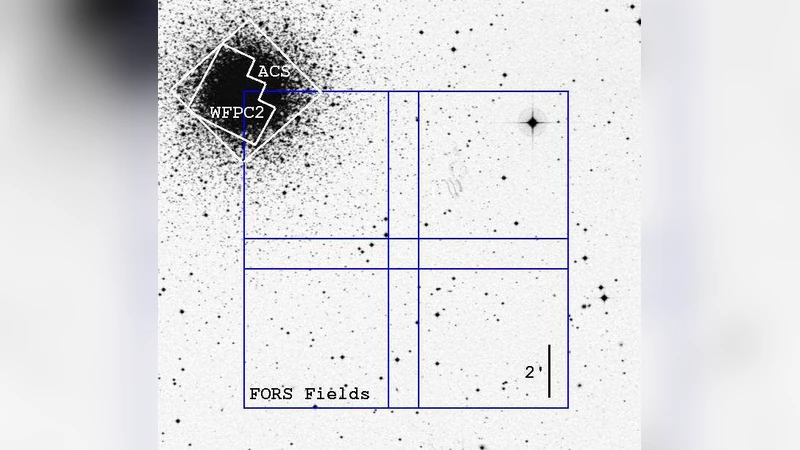
Recent HST-ACS observations revealed the presence of a double subgiant branch (SGB) in the core of the Galactic globular cluster NGC 1851. This peculiarity was tentatively explained by the presence of a second population with either an age difference of about 1 Gyr, or a higher C+N+O abundance, probably due to pollution by the first generation of stars. In the present Letter, we analyze VLT-FORS V,I images, covering 12.7x12.7 arcmin, in the southwest quadrant of the cluster, allowing us to probe the extent of the double SGB from ~1.4 to ~13 arcmin from the cluster center. Our study reveals, for the first time, that the “peculiar” population is the one associated to the fainter SGB. Indeed, while the percentage of stars in this sequence is about 45% in the cluster core (as previously found on the basis of HST-ACS data), we find that it drops sharply, to a level consistent with zero in our data, at ~2.4 arcmin from the cluster center, where the brighter SGB, in our sample, still contains ~100 stars. Implications for the proposed scenarios are discussed.
💡 Research Summary
The paper investigates the spatial distribution of the double sub‑giant branch (SGB) recently discovered in the core of the Galactic globular cluster NGC 1851. While Hubble Space Telescope Advanced Camera for Surveys (HST‑ACS) data had revealed two distinct SGB sequences in the innermost region, it remained unclear whether this peculiarity extended to the outer parts of the cluster. To address this, the authors obtained wide‑field V‑ and I‑band images with the Very Large Telescope FOcal Reducer/low dispersion Spectrograph (VLT‑FORS2), covering a 12.7 × 12.7 arcmin field in the southwest quadrant of NGC 1851. The field spans projected radii from roughly 1.4 arcmin out to about 13 arcmin, thus probing the cluster from the core to well beyond its half‑light radius.
Photometric reduction employed point‑spread‑function fitting and extensive artificial‑star tests to quantify completeness and measurement errors across the field, especially in the crowded central zones. The resulting color–magnitude diagrams (CMDs) were calibrated to the same photometric system used in the HST‑ACS study, allowing a direct comparison of the two SGB sequences. The authors defined the “bright” SGB (b‑SGB) and the “faint” SGB (f‑SGB) using the same ridge lines as in the ACS work, and counted stars belonging to each sequence in concentric annuli of 1 arcmin width.
The key result is a dramatic radial gradient in the relative population of the f‑SGB. In the innermost 1 arcmin, the f‑SGB accounts for roughly 45 % of all SGB stars, reproducing the fraction reported from the ACS data. However, moving outward, the fraction drops sharply: by a projected radius of ~2.4 arcmin the number of f‑SGB stars becomes statistically indistinguishable from zero, while the b‑SGB remains well populated (≈ 100 stars) even at the outermost radii examined. This is the first direct evidence that the “peculiar” population associated with the fainter SGB is strongly centrally concentrated.
The authors discuss two main interpretations. The first invokes an age difference of ~1 Gyr: the f‑SGB would represent a second generation of stars formed later, perhaps from gas enriched by the first generation. In this scenario, the second generation would have formed preferentially in the deep potential well of the cluster centre, and dynamical processes such as two‑body relaxation and mass segregation would have kept it centrally concentrated over a Hubble time. The second interpretation attributes the split to a higher overall C+N+O abundance in the second generation, which would shift the evolutionary track to a fainter SGB without requiring an age offset. Both explanations predict that the chemically distinct population should be more centrally concentrated, consistent with the observed radial trend.
The paper also addresses potential observational biases. Artificial‑star experiments demonstrate that the completeness for both SGB sequences remains high (> 90 %) across the radial range studied, and that crowding does not artificially suppress the detection of f‑SGB stars in the outer annuli. Consequently, the observed decline in f‑SGB fraction is robust.
These findings have important implications for models of multiple stellar populations in globular clusters. The strong central concentration of the f‑SGB suggests that the gas reservoir needed to form a second generation was retained only in the cluster core, or that the second generation formed from material that was not efficiently mixed throughout the cluster. This supports scenarios in which early cluster evolution involves a centrally confined second‑generation star formation episode, possibly aided by the deep potential well of massive clusters. The results also provide a stringent test for dynamical evolution models: any successful model must reproduce the observed near‑absence of the second‑generation (f‑SGB) stars beyond ~2.5 arcmin while preserving a substantial fraction in the core.
Future work, such as high‑resolution spectroscopy of stars across the full radial extent, will be crucial to disentangle the age‑difference versus CNO‑enhancement hypotheses. Precise measurements of iron, α‑elements, and the total C+N+O content for both SGB branches will reveal whether the split is primarily chemical or evolutionary. Moreover, extending the wide‑field photometric survey to other quadrants of NGC 1851 will test the azimuthal symmetry of the population gradients and further constrain the cluster’s dynamical history. In summary, the study demonstrates that the double SGB phenomenon in NGC 1851 is a centrally confined feature, providing a new piece of the puzzle in understanding the formation and long‑term evolution of multiple‑population globular clusters.
Comments & Academic Discussion
Loading comments...
Leave a Comment