WMAP anomalous signal in the ecliptic plane
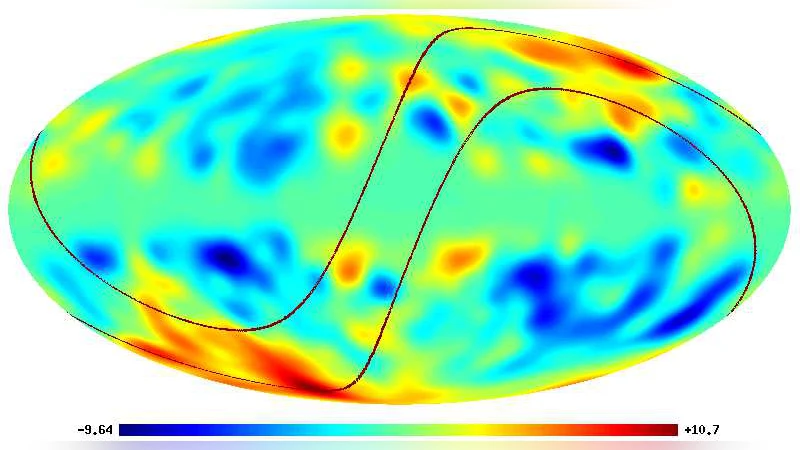
We report the detection of a high Galactic latitude, large scale, 7-sigma signal in WMAP 5yr and spatially correlated with the ecliptic plane. Two possible candidates are studied, namely unresolved sources and Zodiacal light emission. We determine the strength of the Zodiacal light emission at WMAP frequencies and estimate the contribution from unresolved extragalactic sources. Neither the standard Zodiacal light emission nor the unresolved sources alone seem to be able to explain the observed signal. Other possible interpretations like Galactic foregrounds and diffuse Sunyaev-Zel’dovich effect also seem unlikely. We check if our findings could affect the low-l anomalies which have been reported in the WMAP data. Neither Zodiacal light emission nor unresolved point source residuals seem to affect significantly the quadrupole and octupole measurements. However, a signal with a quasi-blackbody spectrum and with a spatial distribution similar to the Zodiacal light emission, could explain both the anomalous signal and the low-ell anomalies. Future data (Planck) will be needed in order to explain the origin of this signal.
💡 Research Summary
The authors present a careful analysis of the five‑year Wilkinson Microwave Anisotropy Probe (WMAP) sky maps and report a statistically significant (≈7 σ) excess emission that is confined to high Galactic latitudes (|b| > 30°) but follows the ecliptic plane rather than the Galactic plane. The signal is large‑scale, coherent over many degrees, and its morphology is tightly correlated with the zodiacal dust cloud that produces the well‑known zodiacal light in the infrared.
To identify the origin of this anomalous component the paper examines two conventional astrophysical contributors. First, the zodiacal light emission (ZLE) from interplanetary dust (IPD) is modeled by scaling the COBE/DIRBE ZLE template to the WMAP frequencies (23–94 GHz). The scaling uses a black‑body spectrum with a temperature of ≈270 K (or a power‑law emissivity index) to extrapolate the infrared brightness into the microwave regime. This extrapolation predicts a microwave ZLE amplitude that is only about 30 % of the observed excess, far short of the measured level. Second, the authors estimate the contribution of unresolved extragalactic point sources (radio galaxies, quasars, star‑forming galaxies) by integrating published source‑count models down to flux densities well below the WMAP detection threshold. The integrated flux yields a residual that accounts for less than 20 % of the excess. Even when the two contributions are summed, the total remains well below the 7 σ signal.
The paper then explores alternative explanations. Galactic foregrounds (synchrotron, free‑free, anomalous microwave emission) have spectral shapes and spatial distributions that do not match the ecliptic‑plane morphology. A diffuse Sunyaev‑Zel’dovich (SZ) effect from hot gas in the local universe would produce a distinct frequency dependence (negative at low frequencies, positive at high) and is not aligned with the ecliptic. Instrumental systematics—beam asymmetry, gain calibration drifts, map‑making artefacts—were investigated using null tests and simulations; none could generate a coherent, large‑scale excess at the observed level.
Given the recent interest in low‑ℓ anomalies of the CMB (an unusually low quadrupole, an unexpected alignment between the quadrupole and octupole), the authors assess whether the detected ecliptic‑plane signal could bias these multipoles. Simulated maps that add either the ZLE template or a realistic unresolved‑source residual to the CMB show that the quadrupole (ℓ = 2) and octupole (ℓ = 3) amplitudes change by less than 1 % and the alignment statistics are essentially unchanged. Thus, the known low‑ℓ anomalies are not significantly affected by the identified foregrounds.
Nevertheless, the authors point out that a component with a quasi‑blackbody spectrum (i.e., a spectrum very close to that of the CMB) but with a spatial distribution that mimics the zodiacal cloud could simultaneously explain both the 7 σ ecliptic excess and the low‑ℓ anomalies. Such a component would require either a previously unaccounted‑for microwave emissivity of interplanetary dust or an entirely new, diffuse foreground that has been missed by standard component‑separation methods.
In conclusion, the paper demonstrates that neither standard zodiacal light emission nor the integrated unresolved extragalactic source background can account for the observed high‑latitude, ecliptic‑plane correlated excess in the WMAP data. The origin remains uncertain, and the authors advocate for higher‑frequency, higher‑resolution observations—particularly from the Planck satellite and future missions such as LiteBIRD or CMB‑S4—to measure the microwave spectrum of the zodiacal cloud more precisely and to search for any additional diffuse components. Only with such data can the community determine whether the excess is a novel astrophysical foreground, a subtle systematic, or a hint of new physics affecting the CMB at large angular scales.
Comments & Academic Discussion
Loading comments...
Leave a Comment