HiZELS: a high redshift survey of H-alpha emitters. II: the nature of star-forming galaxies at z=0.84
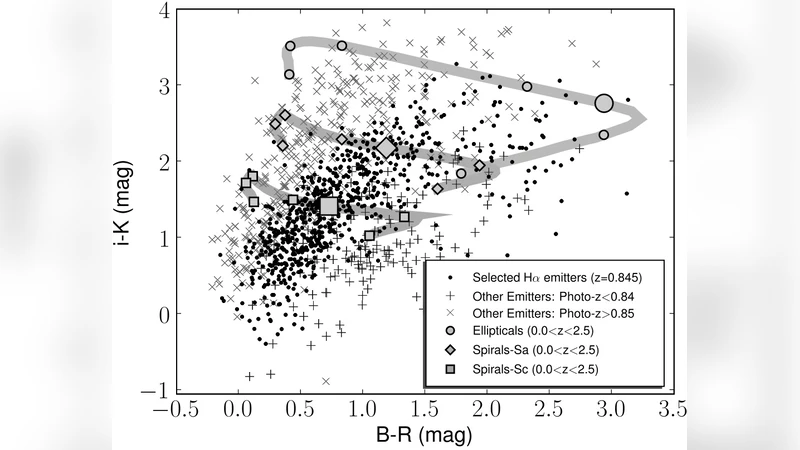
New results from a large survey of H-alpha emission-line galaxies at z=0.84 using WFCAM/UKIRT and a custom narrow-band filter in the J band are presented as part of the HiZELS survey. Reaching an effective flux limit of 1e-16 erg/s/cm^2 in a comoving volume of 1.8e5 Mpc^3, this represents the largest and deepest survey of its kind ever done at z1. There are 1517 potential line emitters detected across 1.4 sq.deg of the COSMOS and UKIDSS UDS fields, of which 743 are selected as H-alpha emitters. These are used to calculate the H-alpha luminosity function, which is well-fitted by a Schechter function with phi*=10^(-1.92+-0.10) Mpc^-3, L*=10^(42.26+-0.05)erg/s, and alpha=-1.65+-0.15. The integrated star formation rate density (SFRD) at z=0.845 is 0.15+-0.01 M_sun/yr/Mpc^3. The results robustly confirm a strong evolution of SFRD from the present day out to z1 and then flattening to z2, using a single star-formation indicator. Out to z1, both the characteristic luminosity and space density of the H-alpha emitters increase significantly; at higher redshifts, L* continues to increase, but phi* decreases. The z=0.84 H-alpha emitters are mostly disk galaxies (82+-3%), while 28+-4% of the sample show signs of merger activity and contribute 20% to the total SFRD. Irregulars and mergers dominate the H-alpha luminosity function above L*, while disks are dominant at fainter luminosities. These results demonstrate that it is the evolution of ’normal’ disk galaxies that drives the strong increase in the SFRD from the current epoch to z1, although the continued strong evolution of L* beyond z=1 suggests an increasing importance of merger activity at higher redshifts.
💡 Research Summary
The paper presents the second results of the HiZELS (High‑z Emission Line Survey) project, focusing on H‑alpha emitting galaxies at redshift z = 0.84. Using the UKIRT 3.8 m telescope equipped with WFCAM and a custom narrow‑band filter in the J‑band, the authors surveyed 1.4 deg² across the COSMOS and UKIDSS‑UDS fields, corresponding to a comoving volume of 1.8 × 10⁵ Mpc³. The survey reaches a 5σ flux limit of 1 × 10⁻¹⁶ erg s⁻¹ cm⁻², enabling the detection of 1 517 line‑emitter candidates. After applying colour‑colour and colour‑magnitude criteria, and removing contaminants such as
Comments & Academic Discussion
Loading comments...
Leave a Comment