The Effects of Gas on Morphological Transformation in Mergers: Implications for Bulge and Disk Demographics
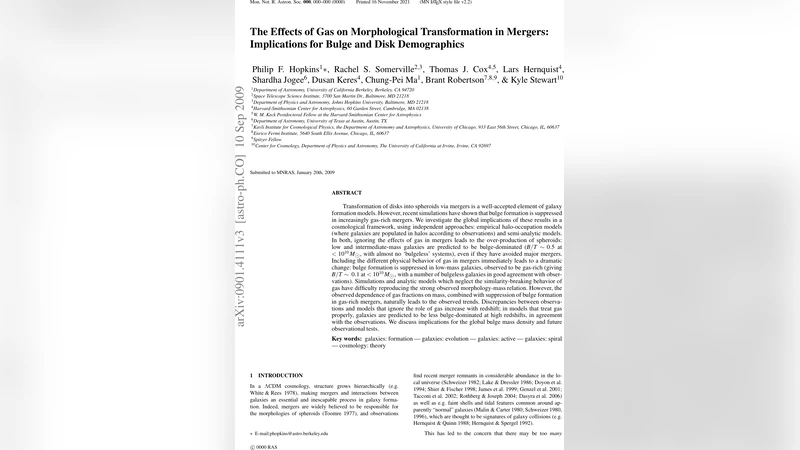
Transformation of disks into spheroids via mergers is a well-accepted element of galaxy formation models. However, recent simulations have shown that bulge formation is suppressed in increasingly gas-rich mergers. We investigate the global implications of these results in a cosmological framework, using independent approaches: empirical halo-occupation models (where galaxies are populated in halos according to observations) and semi-analytic models. In both, ignoring the effects of gas in mergers leads to the over-production of spheroids: low and intermediate-mass galaxies are predicted to be bulge-dominated (B/T0.5 at <10^10 M_sun), with almost no bulgeless systems), even if they have avoided major mergers. Including the different physical behavior of gas in mergers immediately leads to a dramatic change: bulge formation is suppressed in low-mass galaxies, observed to be gas-rich (giving B/T0.1 at <10^10 M_sun, with a number of bulgeless galaxies in good agreement with observations). Simulations and analytic models which neglect the similarity-breaking behavior of gas have difficulty reproducing the strong observed morphology-mass relation. However, the observed dependence of gas fractions on mass, combined with suppression of bulge formation in gas-rich mergers, naturally leads to the observed trends. Discrepancies between observations and models that ignore the role of gas increase with redshift; in models that treat gas properly, galaxies are predicted to be less bulge-dominated at high redshifts, in agreement with the observations. We discuss implications for the global bulge mass density and future observational tests.
💡 Research Summary
The paper investigates how the presence of gas in galaxy mergers fundamentally alters the morphological outcome of galaxies, focusing on the bulge‑to‑total (B/T) ratio across cosmic time. The authors employ two independent, observation‑driven frameworks: an empirical halo‑occupation distribution (HOD) model that populates dark‑matter halos with galaxies using measured stellar‑mass functions, gas‑fraction trends, and merger histories; and a semi‑analytic model (SAM) that implements physically motivated recipes for gas‑dependent star formation, feedback, and bulge growth during mergers. In both approaches they compare a “gas‑blind” scenario—where merger‑driven bulge formation proceeds identically for gas‑rich and gas‑poor systems—to a “gas‑aware” scenario that reduces bulge growth efficiency in proportion to the gas fraction of the merging pair.
The results are strikingly consistent. When gas is ignored, low‑mass galaxies (M★ < 10¹⁰ M⊙) become overly bulge‑dominated, with typical B/T ≈ 0.5, and the predicted number of truly bulgeless systems (B/T < 0.1) drops to near zero. This contradicts numerous local surveys that find a substantial population of disk‑dominated, even pure‑disk, galaxies at these masses. By contrast, incorporating the gas‑dependent suppression of bulge formation yields B/T ≈ 0.1 for the same low‑mass regime, reproducing both the observed steep rise of B/T with stellar mass and the observed fraction of bulgeless galaxies. The authors demonstrate that the observed mass‑dependence of gas fractions—low‑mass galaxies are typically gas‑rich, massive galaxies gas‑poor—combined with the suppression mechanism naturally generates the strong morphology‑mass relation without any fine‑tuning.
Extending the analysis to higher redshifts, the authors note that the cosmic gas fraction rises dramatically toward z ≈ 2–3. Consequently, the gas‑aware models predict that galaxies at these epochs should be less bulge‑dominated than their low‑z counterparts, a trend that aligns with recent Hubble Space Telescope (HST) and James Webb Space Telescope (JWST) observations of abundant high‑z disk‑like systems. Moreover, the integrated bulge stellar mass density (ρ_bulge) derived from the gas‑aware models matches the empirically inferred ρ_bulge, whereas gas‑blind models overproduce bulge mass by a factor of ≈2.
The paper also discusses limitations. The gas‑dependent recipes are simplified (e.g., instantaneous reduction of star‑formation efficiency during a merger) and rely on merger trees whose mass resolution may miss minor interactions that could cumulatively affect morphology. The authors call for higher‑resolution hydrodynamic simulations to calibrate the suppression factor more precisely, and for deeper CO/HI surveys of low‑mass galaxies to tighten the empirical gas‑fraction relations. They suggest that environmental effects (cluster vs. field) and active‑galactic‑nucleus (AGN) feedback could modulate the gas‑driven suppression and merit future study.
In conclusion, the study provides compelling evidence that gas is not a passive component in mergers but a decisive agent that can inhibit bulge growth, especially in low‑mass, gas‑rich systems. Accounting for this effect resolves longstanding discrepancies between hierarchical merger models and the observed distribution of galaxy morphologies, both locally and at early cosmic times. The work therefore urges a revision of galaxy‑formation models to embed gas‑dependent merger physics as a core ingredient for realistic predictions of bulge and disk demographics.
Comments & Academic Discussion
Loading comments...
Leave a Comment