The Ejecta Distributions of the Heavy Elements in the Cygnus Loop
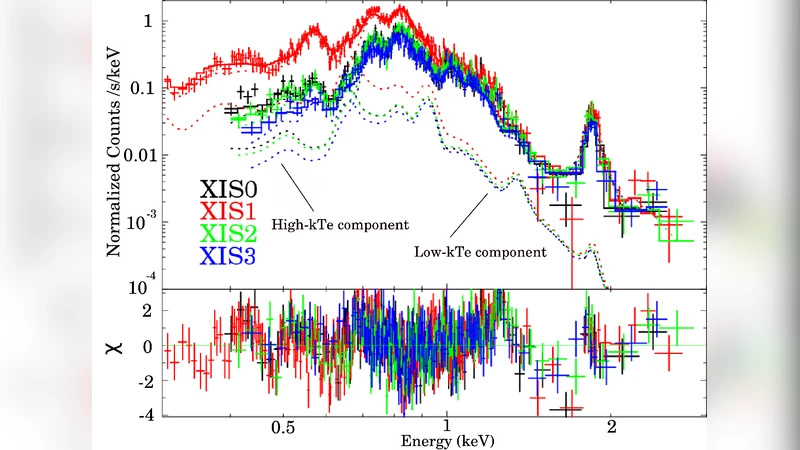
We analyzed the metal distribution of the Cygnus Loop using 14 and 7 pointings observation data obtained by the \textit{Suzaku} and the \textit{XMM-Newton} observatories. The spectral analysis shows that all the spectra are well fitted by the two-$kT_e$ non-equilibrium ionization plasma model as shown by the earlier observations. From the best-fit parameters of the high-$kT_e$ component, we calculated the emission measures about various elements and showed the metal distribution of the ejecta component. We found that the distributions of Si and Fe are centered at the southwest of the geometric center toward the blow-out region. From the best-fit parameters, we also estimated the progenitor mass of the Cygnus Loop from our field of view and the metal rich region with a radius of 25 arcmin from the metal center. The result from the metal circle is similar to that from our entire FOV, which suggests the mixing of the metal. From the results, we estimated the mass of the progenitor star at 12-15\MO.
💡 Research Summary
The authors present a comprehensive study of the heavy‑element ejecta distribution in the Cygnus Loop supernova remnant using archival observations from the Suzaku and XMM‑Newton X‑ray observatories. A total of 21 pointings (14 with Suzaku, 7 with XMM‑Newton) were selected to cover the interior of the remnant, providing sufficient spatial sampling to map elemental abundances across a wide area. All extracted spectra are well described by a two‑temperature non‑equilibrium ionization (NEI) model, consistent with earlier work that identified a low‑temperature component (kTₗ ≈ 0.2–0.3 keV) associated with the shocked interstellar medium (ISM) shell and a high‑temperature component (kTₕ ≈ 0.5–0.7 keV) representing the metal‑rich ejecta.
The key methodological step is the derivation of emission measures (EM = ∫nₑn_H dV) for individual elements (O, Ne, Mg, Si, Fe) from the high‑temperature component. By fitting the NEI model to each spectrum and allowing the abundances of these elements to vary, the authors obtain spatially resolved EM maps that directly trace the distribution of ejecta material. The resulting maps reveal a pronounced asymmetry: silicon and iron show their maximum EM not at the geometric centre of the remnant but displaced toward the southwest, coincident with the well‑known “blow‑out” region where the shell appears to rupture. In contrast, lighter elements such as oxygen, neon, and magnesium are more uniformly distributed or peak nearer the centre, indicating that the heavy‑element ejecta have been preferentially redirected or mixed in a non‑spherical fashion.
To assess the degree of mixing, the authors define a circular region of radius 25 arcmin (≈0.3 pc at the assumed distance of 540 pc) centred on the Si/Fe peak – the “metal centre”. They compare the elemental abundance ratios measured inside this circle with those derived from the entire field of view (FOV). The two sets of ratios are remarkably similar, suggesting that, despite the clear spatial offset of Si and Fe, the ejecta have been mixed throughout the remnant on scales comparable to the size of the FOV. This finding supports a scenario in which large‑scale turbulence, perhaps driven by the interaction of the expanding shock with an inhomogeneous ambient medium, has homogenised the ejecta composition while still preserving a residual bulk displacement of the heaviest elements.
The authors then use the measured abundances to infer the mass of the progenitor star. By integrating the EM of each element over the metal‑centre region and converting to total mass (using standard plasma emissivity tables and an assumed distance), they obtain elemental yields that can be directly compared with nucleosynthesis predictions from core‑collapse supernova models (e.g., Woosley & Weaver 1995; Nomoto et al. 2006). The observed Si/Fe ratio, together with the absolute masses of O, Ne, and Mg, is best reproduced by models of a 12–15 M☉ red supergiant progenitor. This mass range is consistent with earlier estimates based on optical and X‑ray studies, but the present work adds a spatially resolved, quantitative confirmation that the metal‑rich ejecta are compatible with a moderately massive progenitor rather than a very massive star.
In addition to the primary scientific results, the paper demonstrates the robustness of the two‑temperature NEI approach for dissecting complex SNR spectra. The low‑temperature component captures the contribution from the swept‑up ISM, while the high‑temperature component isolates the ejecta, allowing a clean separation of the two physically distinct plasma phases. The authors also discuss systematic uncertainties, including the effect of assumed ionisation timescales, distance uncertainties, and possible projection effects that could bias the inferred abundances.
Overall, the study provides several important insights: (1) it confirms that the Cygnus Loop’s heavy‑element ejecta are not spherically symmetric but are displaced toward the southwest, likely reflecting an intrinsic explosion asymmetry or interaction with a density gradient in the surrounding medium; (2) it shows that the ejecta have been mixed on large scales, as evidenced by the similarity of abundance ratios inside the metal centre and across the whole remnant; (3) it refines the progenitor mass estimate to 12–15 M☉, supporting a red‑supergiant origin; and (4) it validates the use of spatially resolved X‑ray spectroscopy combined with NEI modelling as a powerful tool for probing the composition and dynamics of supernova remnants. The methodology and conclusions are directly applicable to other middle‑aged remnants, offering a template for future investigations into the three‑dimensional structure of supernova ejecta and the physics of their interaction with the interstellar environment.