A Spherical Plasma Dynamo Experiment
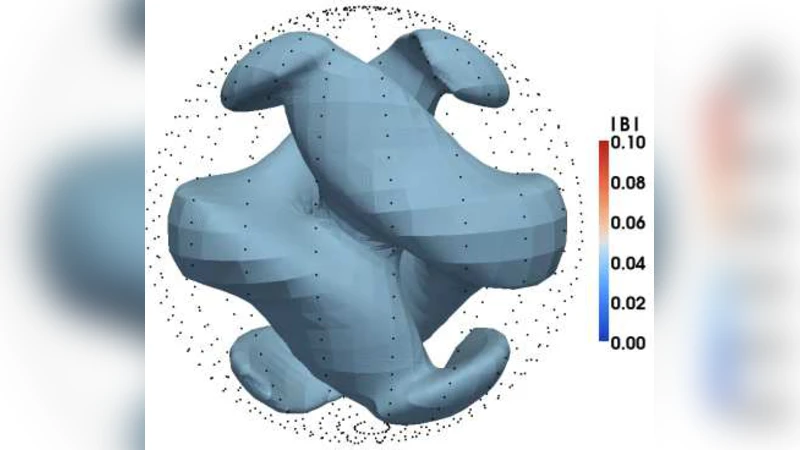
We propose a plasma experiment to be used to investigate fundamental properties of astrophysical dynamos. The highly conducting, fast-flowing plasma will allow experimenters to explore systems with magnetic Reynolds numbers an order of magnitude larger than those accessible with liquid-metal experiments. The plasma is confined using a ring-cusp strategy and subject to a toroidal differentially rotating outer boundary condition. As proof of principle, we present magnetohydrodynamic simulations of the proposed experiment. When a von K'arm'an-type boundary condition is specified, and the magnetic Reynolds number is large enough, dynamo action is observed. At different values of the magnetic Prandtl and Reynolds numbers the simulations demonstrate either laminar or turbulent dynamo action.
💡 Research Summary
The paper proposes a novel laboratory experiment designed to study astrophysical dynamo processes using a fast‑flowing, highly conducting plasma confined in a spherical geometry. Traditional dynamo experiments employ liquid metals such as sodium or gallium; while these media are electrically conductive, their achievable magnetic Reynolds numbers (Rm) are limited to a few hundred because of modest conductivity and practical constraints on flow speed and vessel size. In contrast, a plasma can be heated and rarefied to attain electrical conductivities orders of magnitude larger, allowing Rm values an order of magnitude higher under comparable flow conditions.
The experimental concept relies on a “ring‑cusp” magnetic confinement system. An array of permanent magnets (or electromagnets) placed around the sphere creates a magnetic cusp pattern that repels the plasma from the vessel walls, thereby eliminating direct plasma‑wall contact, reducing impurity influx, and minimizing thermal losses. This magnetic “cage” enables long‑duration, stable plasma operation without the need for material liners.
To drive the flow, the outer boundary of the sphere is forced to rotate differentially in the toroidal direction. In practice this can be realized by a set of motor‑driven rings or by electromagnetic torque applied to the cusp magnets. The rotation rate varies with latitude, producing a strong shear layer reminiscent of von Kármán flow in cylindrical experiments. This shear is the primary source of kinetic helicity and vorticity, both essential ingredients for dynamo action.
Numerical magnetohydrodynamic (MHD) simulations were performed to test the feasibility of the design. The authors imposed a von Kármán‑type boundary condition—two counter‑rotating hemispherical “plates” at the poles—and varied the magnetic Reynolds number, the ordinary Reynolds number (Re), and the magnetic Prandtl number (Pm = ν/η, where ν is kinematic viscosity and η magnetic diffusivity). The simulations reveal three distinct regimes:
-
Laminar (high‑Pm) dynamo – When Pm≫1, viscous forces dominate over magnetic diffusion. The flow remains largely laminar, and a large‑scale magnetic field grows exponentially once Rm exceeds a critical value (≈200 in the model). The resulting field is relatively simple, dominated by dipolar and quadrupolar components.
-
Turbulent (low‑Pm) dynamo – For Pm≪1, viscosity is negligible and the shear layer quickly becomes turbulent. Small‑scale vortices generate a broadband magnetic spectrum; the dynamo still operates but the field exhibits rapid fluctuations and a more complex spatial structure.
-
Non‑linear saturation – At sufficiently high Re and Rm, the magnetic field back‑reacts on the flow, leading to a saturated state where kinetic and magnetic energies reach a quasi‑steady balance. The saturated field displays mixed large‑scale and small‑scale features, reminiscent of the magnetic topology observed in stellar convection zones and planetary cores.
A key insight is that by adjusting plasma parameters (density, temperature, ion species) the experiment can emulate a wide range of astrophysical conditions. For example, a low‑density, high‑temperature hydrogen plasma mimics the high‑conductivity interior of a main‑sequence star, while a denser, cooler argon plasma reproduces the conductive properties of a planetary outer core.
The paper also outlines the practical hardware required: a spherical vacuum chamber, a modular ring‑cusp magnet assembly, RF or microwave heating for plasma generation, a set of motor‑driven outer rings to impose the toroidal shear, and diagnostic tools such as non‑intrusive magnetic probes, laser‑induced fluorescence, and Doppler spectroscopy to resolve flow velocity and magnetic field evolution with high temporal and spatial resolution.
In summary, the proposed spherical plasma dynamo experiment offers a transformative platform that surpasses the limitations of liquid‑metal dynamos. By achieving magnetic Reynolds numbers an order of magnitude larger and providing independent control over Pm, the setup enables systematic exploration of both laminar and turbulent dynamo regimes within a single apparatus. Successful implementation would open a new experimental window onto the fundamental physics of magnetic field generation in stars, planets, and accretion disks, and could validate or challenge existing theoretical models of astrophysical dynamos.
Comments & Academic Discussion
Loading comments...
Leave a Comment