Are Most Low-Luminosity AGN Really Obscured?
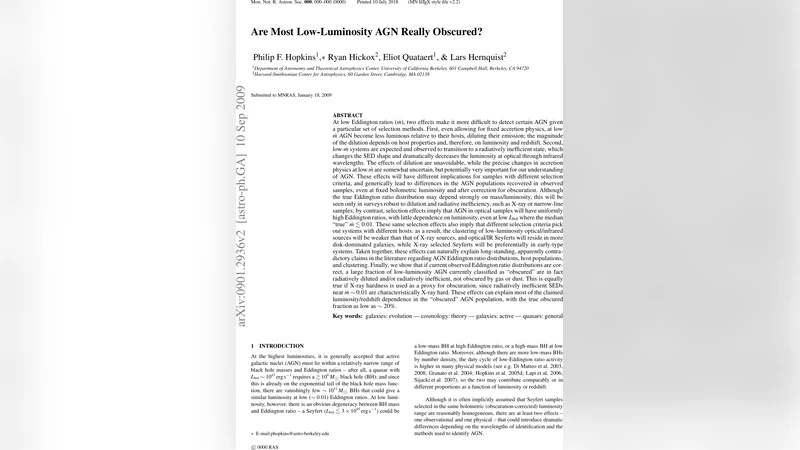
At low Eddington ratio (mdot), two effects make it harder to detect AGN given some selection criteria. First, even with fixed accretion physics, AGN are diluted/less luminous relative to their hosts; the magnitude of this depends on host properties and so on luminosity and redshift. Second, they may transition to a radiatively inefficient state, changing SED shape and dramatically decreasing in optical/IR luminosity. These effects lead to differences in observed AGN samples, even at fixed bolometric luminosity and after correction for obscuration. The true Eddington ratio distribution may depend strongly on luminosity, but this will be seen only in surveys robust to dilution and radiative inefficiency (X-ray or narrow-line samples); selection effects imply that AGN in optical samples will have uniformly high mdot. This also implies that different selection methods yield systems with different hosts: the clustering of faint optical/IR sources will be weaker than that of X-ray sources, and optical/IR Seyferts will reside in more disk-dominated galaxies while X-ray selected Seyferts will preferentially occupy early-type systems. If observed mdot distributions are correct, a large fraction of low-luminosity AGN currently classified as ‘obscured’ are in fact diluted and/or radiatively inefficient, not obscured by gas or dust. This is equally true if X-ray hardness is used as a proxy for obscuration, since radiatively inefficient SEDs near mdot~0.01 are X-ray hard. These effects can explain most of the claimed luminosity/redshift dependence in the ‘obscured’ AGN population, with the true obscured fraction as low as 20%.
💡 Research Summary
The paper investigates why many low‑luminosity active galactic nuclei (AGN) that appear “obscured” in surveys are in fact not hidden by dust or gas but are instead missed or mis‑characterized because of two physical effects that become important at low Eddington ratios (ṁ). The first effect is dilution: even if the intrinsic accretion physics remains unchanged, the AGN’s luminosity scales down with ṁ while the host galaxy’s stellar light does not. In optical and near‑infrared bands the host can dominate the total flux, especially for massive or star‑forming galaxies, making the AGN’s contribution indistinguishable unless the survey is deep enough or uses high‑contrast techniques. The degree of dilution depends on host mass, star‑formation rate, and redshift, and the authors model it using empirical mass‑luminosity and colour‑SFR relations. Their calculations show that for ṁ ≲ 0.05 the AGN signal is typically swamped in broadband optical/IR surveys, so only the high‑ṁ tail of the intrinsic population is selected.
The second effect is the transition to a radiatively inefficient accretion flow (RIAF/ADAF) when ṁ falls below ≈0.01. In this regime the standard thin‑disk spectrum collapses: the UV/optical “big blue bump” disappears, the infrared torus receives far less heating, and the X‑ray spectrum becomes harder because the hot, optically thin flow emits via bremsstrahlung and Comptonisation. Consequently, the bolometric correction to the X‑ray band rises sharply, while the optical/IR bolometric correction drops dramatically. Importantly, the hard X‑ray spectra produced by low‑ṁ RIAFs mimic the signatures of heavy photoelectric absorption, so X‑ray hardness ratios commonly used as obscuration proxies will misclassify many low‑ṁ AGN as obscured.
These two mechanisms generate strong selection biases. Samples built on X‑ray detection (especially hard‑band or high‑energy surveys) or on narrow emission‑line luminosities such as
Comments & Academic Discussion
Loading comments...
Leave a Comment