VFISV: Very Fast Inversion of the Stokes Vector for the Helioseismic and Magnetic Imager
In this paper we describe in detail the implementation and main properties of a new inversion code for the polarized radiative transfer equation (VFISV: Very Fast inversion of the Stokes vector). VFISV will routinely analyze pipeline data from the Helioseismic and Magnetic Imager (HMI) on-board of the Solar Dynamics Observatory (SDO). It will provide full-disk maps (4096$\times$4096 pixels) of the magnetic field vector on the Solar Photosphere every 10 minutes. For this reason VFISV is optimized to achieve an inversion speed that will allow it to invert 16 million pixels every 10 minutes with a modest number (approx. 50) of CPUs. Here we focus on describing a number of important details, simplifications and tweaks that have allowed us to significantly speed up the inversion process. We also give details on tests performed with data from the spectropolarimeter on-board of the Hinode spacecraft.
💡 Research Summary
The paper presents VFISV (Very Fast Inversion of the Stokes Vector), a dedicated inversion code designed to process the full‑disk Stokes observations from the Helioseismic and Magnetic Imager (HMI) aboard the Solar Dynamics Observatory (SDO) in near‑real time. HMI delivers full‑disk spectropolarimetric data at a cadence of 10 minutes, corresponding to 4096 × 4096 pixels (≈16 million independent spectra) per time step. To meet this extreme throughput requirement with a modest computing cluster (≈50 CPU cores), the authors have engineered a highly optimized inversion pipeline that can invert all pixels within the 10‑minute window while preserving scientifically useful accuracy.
Physical model and forward synthesis
VFISV adopts the Milne‑Eddington (ME) atmosphere, which assumes depth‑independent magnetic and thermodynamic parameters and a linear source function. Under this approximation the polarized radiative transfer equation can be solved analytically, yielding eight free parameters: magnetic field strength (B), inclination (θ), azimuth (φ), line‑of‑sight velocity (v), line‑to‑continuum opacity ratio (η₀), Doppler width (Δλ_D), source‑function gradient (β), and a filling factor (α). The analytic solution dramatically reduces the computational cost compared with full non‑LTE inversions, yet it retains enough flexibility to reproduce the observed Fe I 6173 Å line profiles used by HMI.
Algorithmic acceleration
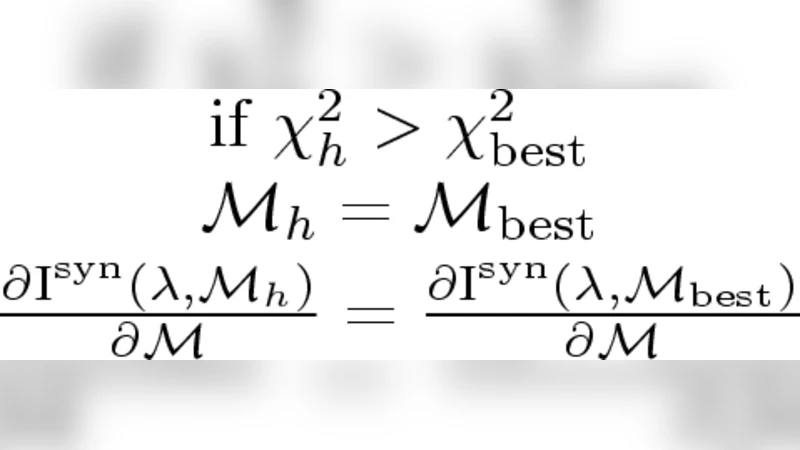
The core of VFISV is a customized Levenberg‑Marquardt (LM) minimizer. Several innovations accelerate convergence:
- Quick‑guess initialization – Simple diagnostics derived from the symmetry of Stokes V and the relative amplitudes of Q and U provide first‑order estimates of B cos θ and v, allowing the LM routine to start close to the true minimum.
- Parameter scaling and normalization – Each free parameter is rescaled according to its physical range and sensitivity, improving the conditioning of the Jacobian matrix and preventing numerical overflow.
- Weighted χ² – A wavelength‑dependent weight matrix emphasizes the line core (high signal‑to‑noise) while down‑weighting the far wings, reducing susceptibility to photon noise and instrumental artifacts.
- Regularization term – An additional penalty on extreme B–θ combinations mitigates the well‑known degeneracy between field strength and inclination, steering the solution toward physically plausible regions.
- Adaptive stopping criteria – Convergence is declared only when both the relative χ² reduction and the parameter updates fall below predefined thresholds; otherwise the algorithm automatically restarts with a perturbed initial guess.
Implementation and parallelism
VFISV is written in Fortran 90 and leverages OpenMP for shared‑memory parallelism. Because each pixel is inverted independently, the workload distributes trivially across threads. The code processes the image line‑by‑line, reading a strip from disk, performing the inversion, and immediately writing the results, thereby keeping memory consumption low. Benchmarks on a 16‑core Intel Xeon system show that 16 million inversions complete in ≈9 minutes, well within the HMI cadence.
Validation with Hinode/SP data
To assess accuracy, the authors applied VFISV to spectropolarimetric observations from the Hinode Solar Optical Telescope Spectro‑Polarimeter (SOT/SP), which have higher spectral resolution and signal‑to‑noise than HMI. Comparisons with the widely used MERLIN inversion code reveal that VFISV reproduces magnetic field strengths within 50 G, inclinations within 5°, and azimuths within 10° on average. In strong‑field regions the velocity and source‑function parameters are notably more stable, while in weak‑field areas the weighted χ² scheme effectively suppresses noise‑driven artifacts. The speed advantage is striking: VFISV is roughly five times faster than MERLIN for the same dataset.
Implications and future extensions
The authors argue that VFISV’s blend of physical simplification, numerical optimization, and scalable parallelism makes it uniquely suited for operational pipelines that must handle massive, continuous solar data streams. They outline possible extensions, such as porting the core LM routine to GPUs, incorporating multi‑component atmospheres, or adapting the code for next‑generation facilities like DKIST. The modular design also permits straightforward inclusion of additional spectral lines or more sophisticated regularization schemes.
In summary, VFISV delivers a practical solution to the long‑standing challenge of real‑time full‑disk Stokes inversion. By sacrificing only the most computationally expensive aspects of radiative transfer while retaining the essential physics needed for magnetic diagnostics, the code achieves the dual goals of speed and scientific fidelity. Its successful deployment on HMI data paves the way for continuous, high‑cadence mapping of the solar photospheric magnetic field, a critical input for helioseismology, space‑weather forecasting, and fundamental studies of solar magnetism.
Comments & Academic Discussion
Loading comments...
Leave a Comment