Disk formation and the origin of clumpy galaxies at high redshift
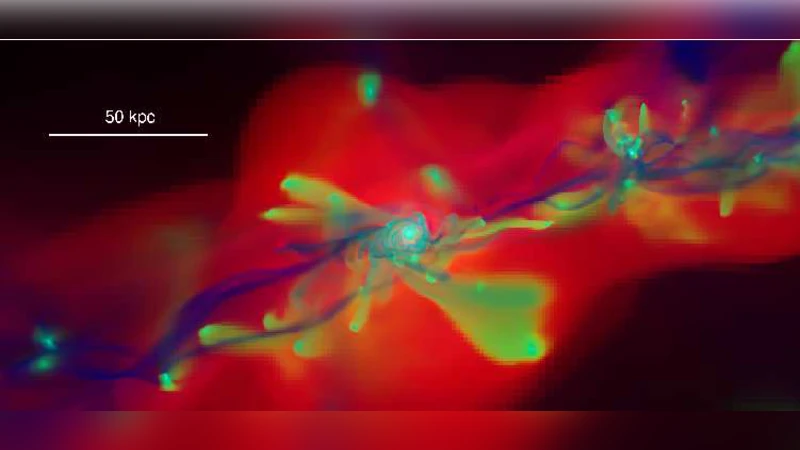
Observations of high redshift galaxies have revealed a multitude of large clumpy rapidly star-forming galaxies. Their formation scenario and their link to present day spirals is still unknown. In this Letter we perform adaptive mesh refinement simulations of disk formation in a cosmological context that are unrivalled in terms of mass and spatial resolution. We find that the so called “chain-galaxies” and “clump-clusters” are a natural outcome of early epochs of enhanced gas accretion from cold dense streams as well as tidally and ram-pressured stripped material from minor mergers and satellites. Through interaction with the hot halo gas, this freshly accreted cold gas settles into a large disk-like system, not necessarily aligned to an older stellar component, that undergoes fragmentation and subsequent star formation, forming large clumps in the mass range 10^7-10^9 M_sun. Galaxy formation is a complex process at this important epoch when most of the central baryons are being acquired through a range of different mechanisms - we highlight that a rapid mass loading epoch is required to fuel the fragmentation taking place in the massive arms in the outskirts of extended disks, an accretion mode that occurs naturally in the hierarchical assembly process at early epochs.
💡 Research Summary
The paper presents a high‑resolution cosmological simulation study that addresses the origin of the massive, clumpy galaxies observed at redshifts z ≈ 1–3, often classified as “chain‑galaxies” or “clump‑clusters.” Using an adaptive mesh refinement (AMR) code with a mass resolution of ~10⁴ M⊙ and a spatial resolution of ~10 pc, the authors follow the formation of a galaxy from the early universe within a ΛCDM framework. The simulation captures, for the first time in a single run, the simultaneous action of several gas‑accretion channels: (1) cold, dense streams that penetrate the hot circum‑galactic medium, (2) tidally stripped material from minor mergers, and (3) ram‑pressure stripped gas from satellite galaxies.
These inflows converge onto a nascent, extended gaseous disk that is not necessarily aligned with any pre‑existing stellar component. The rapid mass loading produced by the combined inflows drives the disk into a state of low Toomre‑Q (Q < 1) across its outer regions, making it highly susceptible to gravitational fragmentation. Within a few hundred Myr, the disk breaks up into giant clumps with masses ranging from 10⁷ to 10⁹ M⊙. Each clump experiences an intense burst of star formation, and stellar feedback partially disrupts the clump, but the majority of the clump’s mass migrates inward through dynamical friction and torques. This inward migration contributes to bulge growth and helps to stabilize the inner disk over longer timescales.
The simulated morphology reproduces the observed chain‑galaxy appearance when the clumps are still aligned along a single elongated arm, and it yields a clump‑cluster configuration once the clumps become more widely distributed across the disk. Thus, the two observational classes are interpreted as different evolutionary snapshots of the same physical process.
Key insights from the study include:
-
Rapid, multi‑mode mass loading is essential – a single accretion channel (e.g., only cold streams) cannot alone generate the high gas surface densities required for giant‑clump formation. The combination of cold streams, minor‑merger debris, and ram‑pressure stripping naturally provides the necessary gas supply.
-
Disk misalignment is common – because the newly accreted gas often arrives from directions unrelated to the angular momentum of any older stellar component, the resulting gaseous disk can be tilted or warped, influencing the pattern of fragmentation.
-
Clump formation drives early morphological diversity – the giant clumps dominate the visual appearance of high‑z galaxies, producing the irregular, clumpy morphologies seen in deep HST surveys. Their subsequent migration and coalescence help to transition these systems toward more regular, bulge‑dominated spirals at lower redshift.
-
Hierarchical assembly naturally yields the observed phenomena – the simulation demonstrates that the chaotic, multi‑source gas accretion expected in a ΛCDM universe is sufficient to explain the prevalence of clumpy galaxies without invoking exotic physics.
Overall, the work provides a coherent, physically motivated picture linking the early, gas‑rich phase of galaxy assembly to the clumpy morphologies observed at high redshift, and it outlines a plausible pathway by which these systems evolve into the more orderly spiral galaxies seen in the local universe.
Comments & Academic Discussion
Loading comments...
Leave a Comment