Discovery of a broad iron line in the black-hole candidate Swift J1753.5-0127, and the disk emission in the low/hard state revisited
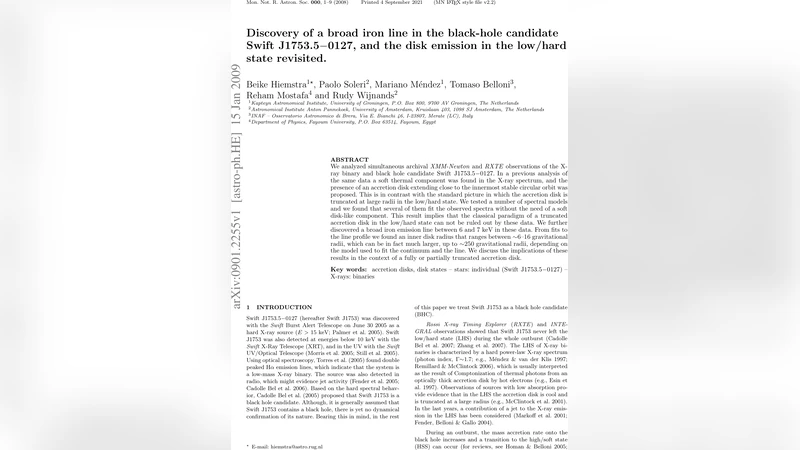
We analyzed simultaneous archival XMM-Newton and RXTE observations of the X-ray binary and black hole candidate Swift J1753.5-0127. In a previous analysis of the same data a soft thermal component was found in the X-ray spectrum, and the presence of an accretion disk extending close to the innermost stable circular orbit was proposed. This is in contrast with the standard picture in which the accretion disk is truncated at large radii in the low/hard state. We tested a number of spectral models and we found that several of them fit the observed spectra without the need of a soft disk-like component. This result implies that the classical paradigm of a truncated accretion disk in the low/hard state can not be ruled out by these data. We further discovered a broad iron emission line between 6 and 7 keV in these data. From fits to the line profile we found an inner disk radius that ranges between ~6-16 gravitational radii, which can be in fact much larger, up to ~250 gravitational radii, depending on the model used to fit the continuum and the line. We discuss the implications of these results in the context of a fully or partially truncated accretion disk.
💡 Research Summary
This paper revisits the X‑ray spectral analysis of the black‑hole candidate Swift J1753.5‑0127 using simultaneous archival XMM‑Newton and RXTE observations, focusing on the contentious issue of whether a cool accretion disc extends close to the innermost stable circular orbit (ISCO) during the low/hard state (LHS). Earlier work on the same dataset reported a soft thermal component (modeled as a multi‑color disk, MCD) and interpreted it as evidence for a disc reaching the ISCO, a conclusion at odds with the canonical picture of a truncated disc at large radii in the LHS.
The authors systematically test a suite of continuum models: a simple power‑law, a cut‑off power‑law, a thermal Comptonisation model (COMPTT), and combinations of these with a reflection component (REFLIONX) convolved with relativistic blurring kernels (KDBLUR or RELLINE). By fitting each model to the broadband 0.6–200 keV spectrum, they find that several configurations—particularly power‑law + reflection—provide statistically comparable or superior fits to the data without invoking any additional soft disk‑like component. This demonstrates that the presence of a low‑temperature thermal excess is not required by the data and that previous claims of a disc extending to the ISCO may be model‑dependent artifacts.
A key new result is the detection of a broad iron Kα emission line between 6 and 7 keV. The line is evident in the residuals of all continuum fits and is modeled using several relativistic line profiles (LAOR, KYRLINE, RELLINE). The inferred inner disc radius (R_in) is highly sensitive to the underlying continuum model. When a simple power‑law plus reflection is adopted, R_in lies in the range ≈6–16 R_g, suggesting a disc that reaches the ISCO. Conversely, with the COMPTT‑plus‑reflection continuum, the line profile demands a much larger inner radius, up to ≈250 R_g, consistent with a substantially truncated disc. The authors emphasize that the ionisation state of the reflector, the emissivity profile, and the assumed continuum shape all conspire to shift the derived R_in, highlighting a fundamental degeneracy in LHS spectral modeling.
The discussion places these findings in the broader context of accretion physics. The authors argue that the classical paradigm of a truncated disc in the LHS cannot be ruled out solely on the basis of the Swift J1753.5‑0127 data, nor can it be definitively confirmed. Instead, the data admit both scenarios, depending on the chosen spectral decomposition. They advocate for future observations with next‑generation high‑resolution spectrometers (e.g., XRISM Resolve, Athena X‑IFU) that will resolve the iron line profile with sufficient fidelity to break the continuum‑line degeneracy. Additionally, they suggest that simultaneous broadband coverage extending to higher energies (e.g., with NuSTAR) and timing‑spectral studies could provide independent constraints on the coronal geometry and disc truncation radius.
In summary, this work demonstrates that (1) a soft thermal component is not a mandatory ingredient for fitting the Swift J1753.5‑0127 LHS spectrum, (2) a broad iron line is robustly present, and (3) the inferred inner disc radius varies dramatically with the adopted continuum model, ranging from near‑ISCO values to several hundred gravitational radii. These results reinforce the need for caution when interpreting disc truncation from spectral fits alone and underscore the importance of high‑quality data and sophisticated, self‑consistent modeling to unravel the true geometry of accretion flows in the low/hard state.
Comments & Academic Discussion
Loading comments...
Leave a Comment