The CoRoT satellite in flight : description and performance
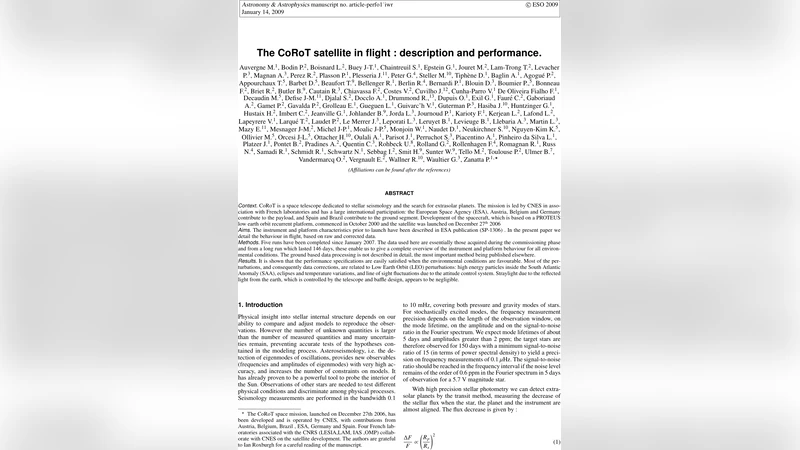
CoRoT is a space telescope dedicated to stellar seismology and the search for extrasolar planets. The mission is led by CNES in association with French laboratories and has a large international participation: the European Space Agency (ESA), Austria, Belgium and Germany contribute to the payload, and Spain and Brazil contribute to the ground segment. Development of the spacecraft, which is based on a PROTEUS low earth orbit recurrent platform, commenced in October 2000 and the satellite was launched on December 27th 2006. The instrument and platform characteristics prior to launch have been described in ESA publication (SP-1306) . In the present paper we detail the behaviour in flight, based on raw and corrected data. Five runs have been completed since January 2007. The data used here are essentially those acquired during the commissioning phase and from a long run which lasted 146 days, these enable us to give a complete overview of the instrument and platform behaviour for all environmental conditions. The ground based data processing is not described in detail, the most important method being published elsewhere. It is shown that the performance specifications are easily satisfied when the environmental conditions are favourable. Most of the perturbations, and consequently data corrections, are related to Low Earth Orbit (LEO) perturbations: high energy particles inside the South Atlantic Anomaly (SAA), eclipses and temperature variations, and line of sight fluctuations due to the attitude control system. Straylight due to the reflected light from the earth, which is controlled by the telescope and baffle design, appears to be negligible.
💡 Research Summary
The paper presents a comprehensive performance assessment of the CoRoT (Convection, Rotation and planetary Transits) space telescope, a mission dedicated to asteroseismology and the detection of transiting exoplanets. CoRoT was developed under the leadership of the French space agency CNES, with substantial contributions from French laboratories and a broad international partnership that includes ESA, Austria, Belgium, Germany, Spain, and Brazil. The spacecraft is built on the PROTEUS low‑Earth‑orbit (LEO) recurrent platform; development began in October 2000 and the satellite was launched on 27 December 2006.
The authors focus on in‑flight behavior, using data acquired during the commissioning phase and a long continuous observation that lasted 146 days. Five observing runs have been completed since January 2007, but the analysis concentrates on the commissioning data and the longest run because they provide a full range of environmental conditions. The paper does not detail the ground‑segment data processing pipeline; instead, it refers to a separate publication for the most important algorithms.
Key findings are organized around the dominant perturbations that affect the photometric quality in LEO:
-
South Atlantic Anomaly (SAA) particle hits – High‑energy particles generate transient charge deposits (“hot pixels” or “plugs”) on the CCDs. The authors quantify the SAA crossing duration, map the spatial distribution of affected pixels, and demonstrate that the automated flagging and correction procedures effectively remove these events. After exclusion of SAA‑contaminated intervals, the signal‑to‑noise ratio meets or exceeds the design requirement of 10⁴.
-
Eclipse‑induced thermal swings – During Earth eclipses the spacecraft temperature drops by several degrees Celsius, causing minute changes in focus position and CCD bias levels. Temperature sensors and a real‑time thermal model are used to correct these variations. The authors show that, after correction, the photometric precision remains stable and the point‑spread function does not degrade appreciably.
-
Attitude Control System (ACS) jitter and line‑of‑sight (LOS) fluctuations – The three‑axis gyros and star trackers keep the pointing stability within 0.5 arcsec, but residual jitter, magnetic torques, and atmospheric drag introduce both periodic (≈90 min orbital) and stochastic LOS errors. A Fourier analysis isolates the dominant frequencies, and the data reduction pipeline applies a LOS‑correction algorithm that restores the expected photometric stability.
-
Straylight from Earth albedo – The telescope and its baffle were designed to suppress reflected Earth light to below 10⁻⁶ W m⁻². In‑flight measurements confirm that straylight contributes negligibly to the background, validating the optical baffling concept.
-
Data processing workflow – Although the full pipeline is described elsewhere, the paper outlines the sequence of corrections applied to raw CCD frames: removal of read‑out noise and dark current, temperature‑dependent gain correction, SAA‑related pixel flagging, LOS jitter correction, and final light‑curve extraction. The authors compare the processed data against pre‑launch performance models and find excellent agreement.
Overall, the CoRoT mission satisfies its performance specifications under favorable environmental conditions. The dominant sources of noise are well‑understood and can be mitigated through a combination of hardware design (thermal control, baffling, ACS) and software corrections. The successful 146‑day continuous observation demonstrates that CoRoT can deliver high‑precision photometry over long timescales, a prerequisite for detecting the subtle signatures of stellar oscillations and planetary transits.
The paper concludes that the CoRoT platform and instrument behave as expected in orbit, that the LEO‑specific perturbations are manageable, and that the mission’s scientific goals are achievable with the attained data quality. These results provide valuable lessons for future low‑Earth‑orbit astrophysics missions, especially regarding radiation shielding, thermal stability, attitude control, and stray‑light mitigation.
Comments & Academic Discussion
Loading comments...
Leave a Comment