Protostellar disks formed from rigidly rotating cores
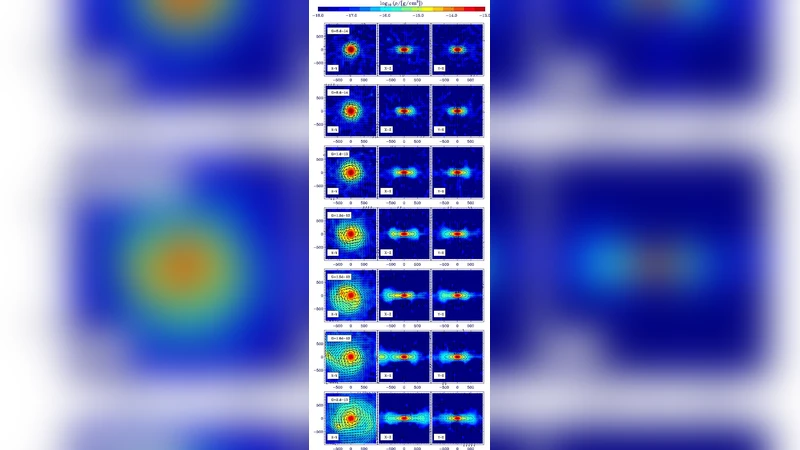
Abridged: We use three-dimensional SPH simulations to investigate the collapse of low-mass prestellar cores and the formation and early evolution of protostellar discs. The initial conditions are slightly supercritical Bonnor-Ebert spheres in rigid rotation. The core mass and initial radius are held fixed at M_O=6.1 M_sun and R_O=17,000 AU, and the only parameter that we vary is the initial angular speed \Omega_O. Protostellar discs forming from cores with \Omega_O<1.35 10d-13 1/s have radii between 100 and 300 AU and are quite centrally concentrated; due to heating by gas infall onto the disc and accretion onto the central object, they are also quite warm, T>100 K, and therefore stable against gravitational fragmentation. In contrast, more rapidly rotating cores form discs which are less concentrated and cooler, and have radii between 400 and 1000 AU; as a consequence they are prone to gravitational fragmentation and the formation of multiple systems. We derive a criterion that predicts whether a rigidly rotating core having given M_O, R_O and \Omega_O will produce a protostellar disc which fragments whilst material is still infalling from the core envelope. We then apply this criterion to core samples for which M_O, R_O and \Omega_O have been estimated observationally. We conclude that the observed cores are stable against fragmentation at this stage, due to their low angular speeds and the heat delivered at the accretion shock where the infalling material hits the disc.
💡 Research Summary
The paper presents a systematic numerical investigation of how the initial angular speed of a prestellar core influences the formation, structure, and stability of the protostellar disc that emerges during collapse. Using three‑dimensional Smoothed Particle Hydrodynamics (SPH), the authors model slightly super‑critical Bonnor‑Ebert spheres with a fixed mass of 6.1 M☉ and an initial radius of 17,000 AU. The only variable parameter is the rigid‑body rotation rate Ω₀, which is sampled over a range from 0.5 × 10⁻¹³ s⁻¹ to 3 × 10⁻¹³ s⁻¹. Each simulation contains roughly two million SPH particles, allowing sufficient spatial resolution to resolve the disc, the accretion shock, and the central protostar. The thermal physics includes radiative cooling, thermal conduction, and shock heating, so that the temperature evolution of the infalling gas and the disc is followed self‑consistently.
The results fall into two distinct regimes separated by a critical angular speed Ω_crit ≈ 1.35 × 10⁻¹³ s⁻¹. For Ω₀ < Ω_crit the disc remains compact (radii 100–300 AU), highly centrally concentrated, and warm (T > 100 K) because the kinetic energy of the infalling envelope is dissipated at the accretion shock and subsequently heats the disc. The Toomre Q parameter stays above unity (typically 1.5–2), indicating that the disc is gravitationally stable and does not fragment during the main accretion phase. In contrast, for Ω₀ > Ω_crit the disc spreads to 400–1000 AU, the outer regions cool to 30–50 K, and the surface density profile becomes shallower. The Q parameter drops below unity (≈0.8), and the disc becomes gravitationally unstable, leading to the formation of secondary condensations that can evolve into a multiple stellar system.
To make these findings applicable to observations, the authors derive an empirical fragmentation criterion that links the core’s mass M₀, radius R₀, and angular speed Ω₀ to the expected disc radius, temperature, and stability. The criterion predicts that a core with the given M₀ and R₀ will produce a fragmenting disc only if its Ω₀ exceeds the critical value. The authors then compile a sample of observed prestellar cores from regions such as Orion, Perseus, and Taurus, for which M₀, R₀, and Ω₀ have been estimated via molecular line mapping and dust continuum measurements. Applying the criterion shows that virtually all of these observed cores have angular speeds well below Ω_crit, implying that their nascent discs are presently too warm and compact to fragment. Consequently, the observed low incidence of multiplicity among the youngest protostars can be explained by the stabilizing effect of accretion‑shock heating combined with modest core rotation.
The discussion acknowledges the simplifying assumption of rigid rotation and the omission of magnetic fields, turbulence, and external radiation, all of which could modify the critical angular speed. Nevertheless, the study provides a clear, quantitative framework linking core angular momentum to disc morphology and fragmentation propensity. It suggests that, at least for low‑mass cores with modest rotation, disc fragmentation is unlikely during the main accretion phase, and that multiplicity must arise either from later disc evolution or from cores with significantly higher angular momentum or additional physical processes. The paper concludes by recommending future simulations that incorporate non‑rigid rotation, magnetohydrodynamics, and radiative feedback to refine the fragmentation criterion and to explore its applicability across a broader range of star‑forming environments.
Comments & Academic Discussion
Loading comments...
Leave a Comment