VLBI observations of the CORALZ sample: young radio sources at low redshift
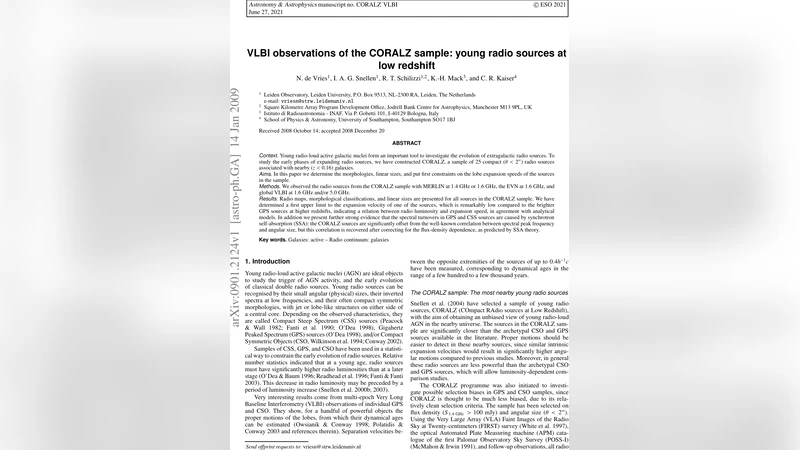
Young radio-loud active galactic nuclei form an important tool to investigate the evolution of extragalactic radio sources. To study the early phases of expanding radio sources, we have constructed CORALZ, a sample of 25 compact ($\theta<2"$) radio sources associated with nearby ($z<0.16$) galaxies. In this paper we determine the morphologies, linear sizes, and put first constraints on the lobe expansion speeds of the sources in the sample. We observed the radio sources from the CORALZ sample with MERLIN at 1.4 GHz or 1.6 GHz, the EVN at 1.6 GHz, and global VLBI at 1.6 GHz and/or 5.0 GHz. Radio maps, morphological classifications, and linear sizes are presented for all sources in the CORALZ sample. We have determined a first upper limit to the expansion velocity of one of the sources, which is remarkably low compared to the brighter GPS sources at higher redshifts, indicating a relation between radio luminosity and expansion speed, in agreement with analytical models. In addition we present further strong evidence that the spectral turnovers in GPS and CSS sources are caused by synchrotron self-absorption (SSA): the CORALZ sources are significantly offset from the well-known correlation between spectral peak frequency and angular size, but this correlation is recovered after correcting for the flux-density dependence, as predicted by SSA theory.
💡 Research Summary
The paper presents a comprehensive Very Long Baseline Interferometry (VLBI) study of the CORALZ sample, a set of 25 compact radio sources (angular size < 2″) associated with nearby galaxies (redshift < 0.16). The authors constructed this low‑redshift, low‑luminosity sample to complement the traditional GPS/CSS samples, which are dominated by high‑redshift, high‑luminosity objects, thereby enabling a direct investigation of the early evolutionary stages of radio‑loud active galactic nuclei (AGN) under different environmental conditions.
Observations were carried out in three stages. First, the Multi‑Element Radio Linked Interferometer Network (MERLIN) provided moderate‑resolution (≈50 mas) maps at 1.4 GHz or 1.6 GHz, establishing the overall morphology and confirming the compactness of each source. Second, the European VLBI Network (EVN) observed all targets at 1.6 GHz with a typical beam of ≈5 mas, revealing sub‑kiloparsec structures such as symmetric lobes, one‑sided jets, or complex morphologies. Finally, global VLBI experiments at 1.6 GHz and, for a subset, at 5 GHz delivered sub‑mas resolution, allowing precise measurement of the separation between core and hotspot components. The multi‑frequency data also enabled accurate determination of the spectral turnover frequency for each source.
Morphological classification based on the high‑resolution images identified 18 objects as Compact Symmetric Objects (CSOs) with two roughly symmetric lobes flanking a central core, 4 as core‑jet (one‑sided) sources, and 3 as more complex or ambiguous structures. Linear sizes span 0.1–1.2 kpc, placing the CORALZ objects between the typical GPS (≈0.5 kpc) and CSS (≈5 kpc) regimes. The authors emphasize that the MERLIN and VLBI images are consistent, reinforcing the reliability of the size measurements.
A key result concerns the expansion speed of the radio lobes. By re‑observing one CSO after a five‑year interval with global VLBI, the authors set an upper limit on the separation rate of < 0.04 c. This limit is markedly lower than the 0.1–0.3 c expansion velocities reported for brighter, higher‑redshift GPS sources. The authors interpret this discrepancy as evidence for a correlation between radio luminosity and expansion speed, as predicted by analytical models of jet propagation (e.g., Begelman 1996). In lower‑luminosity environments, the jet head advances more slowly, possibly due to higher ambient interstellar medium density or reduced jet power.
The paper also revisits the well‑known empirical relation between spectral peak frequency (ν_peak) and angular size (θ), originally interpreted as a signature of synchrotron self‑absorption (SSA). CORALZ sources appear offset from the canonical ν_peak ∝ θ^−0.65 line, largely because they have lower flux densities than the classic GPS/CSS samples. When the authors correct for the flux‑density dependence predicted by SSA theory (ν_peak ∝ S^0.5 θ^−1), the offset disappears and the CORALZ points fall on the same correlation as the brighter sources. This recovery strongly supports SSA as the dominant mechanism for the spectral turnovers, reducing the need to invoke free‑free absorption (FFA) in these low‑luminosity objects.
Beyond the immediate observational findings, the study has broader implications. The demonstrated link between luminosity and expansion speed provides a quantitative constraint for evolutionary models that aim to trace the growth of radio galaxies from compact to large‑scale structures. Moreover, confirming SSA as the primary cause of spectral peaks across a wide luminosity range simplifies the interpretation of future low‑frequency surveys (e.g., LOFAR, SKA‑Low) that will uncover many faint, compact AGN. The authors suggest that the CORALZ sample can serve as a benchmark for testing simulations of jet‑ISM interactions, especially in the regime where the jet power is modest and the surrounding medium may significantly retard expansion.
In summary, the authors have delivered the first high‑resolution VLBI census of a low‑redshift, low‑luminosity compact radio source sample. They provide morphological classifications, precise linear sizes, an upper limit on lobe expansion speed, and a robust confirmation that synchrotron self‑absorption governs the spectral turnovers. These results enrich our understanding of the earliest phases of radio‑loud AGN evolution and establish a valuable reference set for both observational campaigns and theoretical modeling.
Comments & Academic Discussion
Loading comments...
Leave a Comment