Kinematic and Excitation Structure of the NGC 1068 Narrow-Line Region
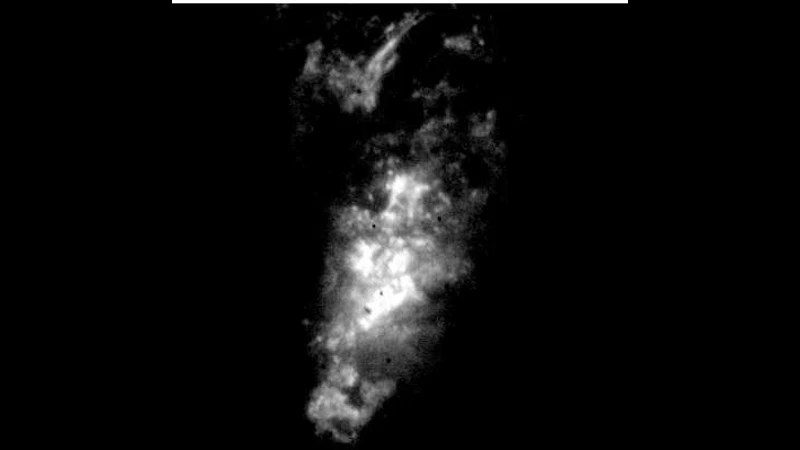
We investigated the kinematic and excitation structure of the NGC 1068 narrow-line region (NLR). We obtained profiles of several emission lines, [OIII]$\lambda$5007, H$\beta$, [OI]$\lambda$6300 and [FeVII]$\lambda$6087 at high-velocity resolution (R ~ 7500 - 11000), and confirmed that they showed different profiles. These profiles are useful for understanding the NLR structure, as they cover a wide ionization potential range. By comparing the results with a photoionization model, we found that 1) blueshifted components at the center are very dense, 2) those in the northeast region have slightly lower densities than those in the center, and 3) ionization parameters of the blueshifted components increase with increasing velocity with respect to the systemic velocity. We investigated the NLR structure in NGC 1068 based on these results. We show that both the observed velocity dependence of the ionization parameter and the gradually increasing velocity field can be reproduced by varying the ionizing continuum attenuation, assuming a hollowed biconical geometry and varying the column densities of outflowing clouds.
💡 Research Summary
This paper presents a detailed spectroscopic study of the narrow‑line region (NLR) in the prototypical Seyfert 2 galaxy NGC 1068. Using high‑resolution (R≈7,500–11,000) long‑slit spectra, the authors obtained velocity profiles for four emission lines that span a wide range of ionization potentials:
Comments & Academic Discussion
Loading comments...
Leave a Comment