The Earth as an extrasolar planet: The vegetation spectral signature today and during the last Quaternary climatic extrema
The so-called Vegetation Red-Edge (VRE), a sharp increase in the reflectance around $700 nm$, is a characteristic of vegetation spectra, and can therefore be used as a biomarker if it can be detected in an unresolved extrasolar Earth-like planet integrated reflectance spectrum. Here we investigate the potential for detection of vegetation spectra during the last Quaternary climatic extrema, the Last Glacial Maximum (LGM) and the Holocene optimum, for which past climatic simulations have been made. By testing the VRE detectability during these extrema when Earth’s climate and biomes maps were different from today, we are able to test the vegetation detectability on a terrestrial planet different from our modern Earth. Data from the Biome3.5 model have been associated to visible GOME spectra for each biome and cloud cover to derive Earth’s integrated spectra for given Earth phases and observer positions. The VRE is then measured. Results show that the vegetation remains detectable during the last climatic extrema. Compared to current Earth, the Holocene optimum with a greener Sahara slightly increases the mean VRE on one hand, while on the other hand, the large ice cap over the northern Hemisphere during the LGM decreases vegetation detectability. We finally discuss the detectability of the VRE in the context of recently proposed space missions.
💡 Research Summary
The paper investigates whether the Vegetation Red‑Edge (VRE)—a sharp increase in reflectance around 700 nm that is characteristic of photosynthetic vegetation—could be detected in the disk‑integrated spectrum of an Earth‑like exoplanet under climatic conditions that differ markedly from today’s. To this end the authors use two well‑studied Quaternary climate extremes: the Last Glacial Maximum (LGM, ~21 kyr ago) and the Holocene Optimum (~6 kyr ago). Both periods are characterized by dramatically altered biome distributions and cloud cover, providing natural test cases for a planet whose surface biosignature differs from modern Earth.
Methodology
- Climate‑Biome Modeling – The Biome3.5 model is driven with paleoclimate reconstructions for the LGM and Holocene Optimum, producing global maps of 17 biome types (tropical forest, savanna, temperate grassland, boreal forest, etc.) together with annual mean cloud fraction.
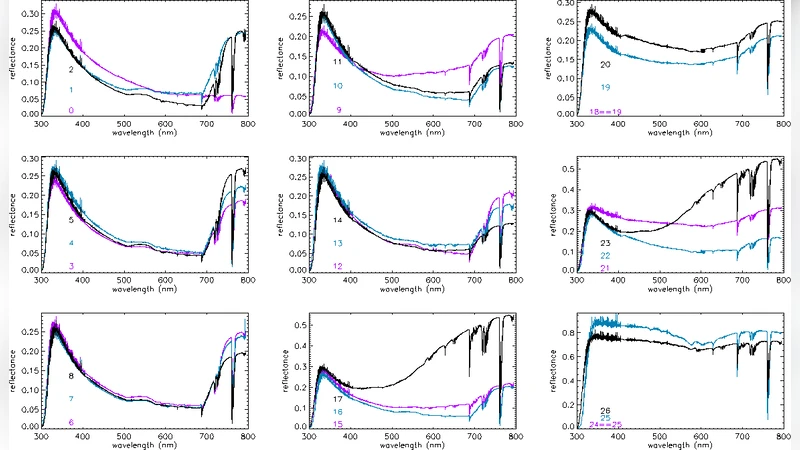
- Spectral Assignment – Each biome is assigned a visible‑range reflectance spectrum taken from the GOME satellite database. GOME provides high‑resolution (≈0.5 nm) spectra from 400–800 nm, including the VRE region. Cloudy grid cells are modified using GOME cloud spectra to simulate atmospheric scattering and absorption.
- Disk‑Integrated Synthesis – For a given Earth phase (e.g., full, crescent) and observer location (equatorial, polar), the model computes a weighted average of all grid‑cell spectra, accounting for the projected area visible to the observer. This yields a single, unresolved reflectance spectrum analogous to what a distant telescope would record.
- VRE Quantification – The VRE strength is expressed as a colour index:
\
Comments & Academic Discussion
Loading comments...
Leave a Comment