Imaging galactic diffuse clouds: CO emission, reddening and turbulent flow in the gas around Zeta Oph
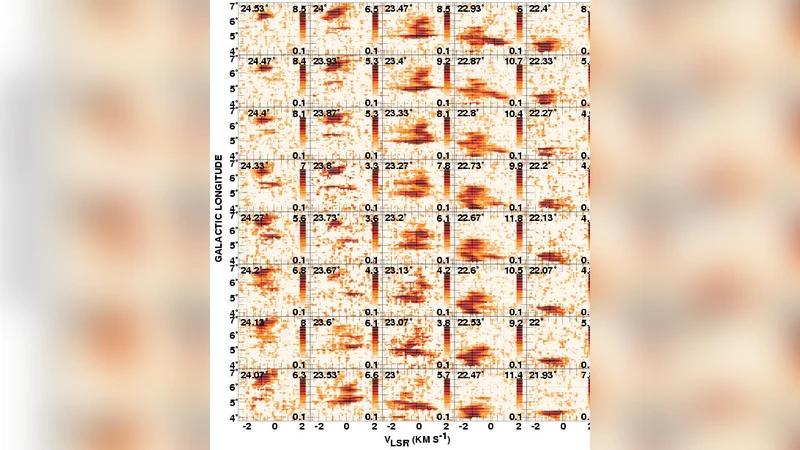
Methods: 12CO emission is imaged in position and position-velocity space analyzed statistically, and then compared with maps of total reddening and with models of the C+ - CO transition in H2-bearing diffuse clouds. Results: Around Zeta Oph, 12CO emission appears in two distinct intervals of reddening centered near EBV = 0.4 and 0.65 mag, of which < 0.2 mag is background material. Within either interval, the integrated 12CO intensity varies up to 6-12 K-km/s compared to 1.5 K-km/s toward Zeta Oph. Nearly 80% of the individual profiles have velocity dispersions < 0.6 km/s, which are subsonic at the kinetic temperature derived from H2 toward Zeta Oph, 55 K. Partly as a result, 12CO emission exposes the internal, turbulent, supersonic (1-3 km/s) gas flows with especial clarity in the cores of strong lines. The flows are manifested as resolved velocity gradients in narrow, subsonically-broadened line cores. Conclusions: The scatter between N(CO) and EBV in global, CO absorption line surveys toward bright stars is present in the gas seen around Zeta Oph, reflecting the extreme sensitivity of N(12CO) to ambient conditions. The two-component nature of the optical absorption toward Zeta Oph is coincidental and the star is occulted by a single body of gas with a complex internal structure, not by two distinct clouds. The very bright 12CO lines in diffuse gas arise at N(H2) ~ 10^21/cm^2 in regions of modest density n(H) ~ 200-500/cc and somewhat more complete C+-CO conversion. Given the variety of structure in the foreground gas, it is apparent that only large surveys of absorption sightlines can hope to capture the intrinsic behavior of diffuse gas.
💡 Research Summary
This study presents a high‑resolution imaging survey of the 12CO J=1‑0 line around the bright O‑type star Zeta Oph, aiming to characterize the physical, chemical, and dynamical state of the diffuse interstellar cloud that lies in front of the star. The authors mapped CO emission in both position–position and position–velocity space, applied statistical analyses to the line profiles, and compared the resulting CO distribution with a full‑sky reddening map (E(B–V)) and with theoretical models of the C⁺‑to‑CO transition in H₂‑bearing diffuse gas.
The CO emission is not uniformly distributed but clusters in two distinct reddening intervals, centered near E(B–V) ≈ 0.4 mag and 0.65 mag. Background material contributes less than 0.2 mag of reddening, indicating that the observed CO originates almost entirely from the cloud associated with Zeta Oph. Within each interval the integrated CO intensity (I_CO) varies dramatically, from a modest 1.5 K km s⁻¹ directly toward the star to 6–12 K km s⁻¹ in adjacent regions. This large intensity scatter, despite similar reddening, underscores the extreme sensitivity of CO column density to local physical conditions.
Profile analysis reveals that about 80 % of the individual spectra have velocity dispersions σ_v < 0.6 km s⁻¹, which is sub‑sonic relative to the kinetic temperature inferred from H₂ absorption (≈55 K, sound speed ≈0.5 km s⁻¹). Nevertheless, the cores of the brightest CO lines display σ_v of 1–3 km s⁻¹, indicating the presence of supersonic turbulent motions confined to narrow, sub‑sonically broadened line cores. These motions manifest as resolved velocity gradients in the position‑velocity diagrams, providing a clear view of internal turbulent flows that would be invisible in lower‑resolution data.
The authors interpret the CO–reddening scatter through the lens of C⁺‑to‑CO chemistry. Model calculations show that at H₂ column densities of ~10²¹ cm⁻² and gas densities of 200–500 cm⁻³, the conversion of C⁺ to CO becomes highly efficient, leading to a steep, non‑linear rise in CO abundance with only modest changes in shielding or density. Consequently, two sightlines with nearly identical E(B–V) can differ in N(CO) by orders of magnitude, a behavior that mirrors the large scatter seen in global CO absorption surveys toward bright stars.
A key implication concerns the long‑standing interpretation of the optical absorption spectrum toward Zeta Oph, which has traditionally been modeled as two separate clouds. The CO imaging demonstrates that the star is actually occulted by a single, structurally complex body of gas. The apparent two‑component absorption arises from distinct velocity and density sub‑structures within the same cloud rather than from two physically distinct clouds.
Overall, the study highlights that diffuse clouds are far from homogeneous. They contain a mixture of sub‑sonic envelopes and localized supersonic cores, and their CO emission is governed by a delicate balance of density, UV shielding, and chemical conversion. The authors argue that only large‑scale, multi‑sightline absorption surveys, combined with high‑resolution emission mapping, can capture the intrinsic variability of diffuse interstellar gas. Their findings thus provide a crucial benchmark for models of molecular formation, turbulence, and cloud evolution in the low‑density regime of the interstellar medium.
Comments & Academic Discussion
Loading comments...
Leave a Comment