Spectroscopic binaries among Hipparcos M giants II. Binary frequency
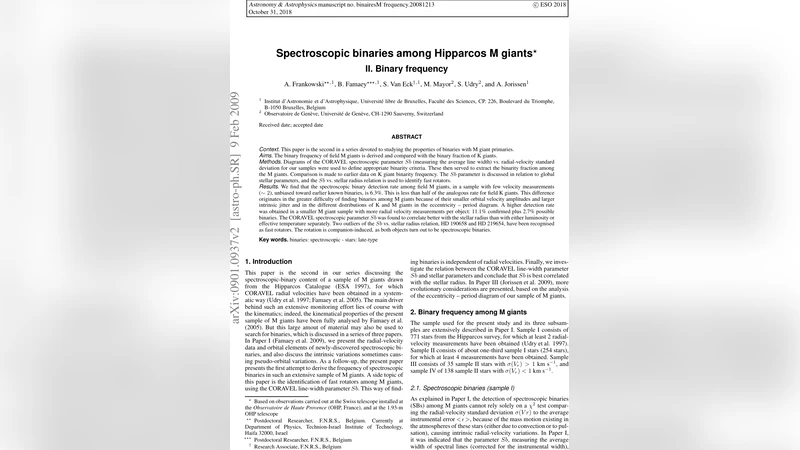
This paper is the second one in a series devoted to the study of properties of binaries involving M giants. The binary frequency of field M giants is derived and compared with the binary fraction of K giants. Diagrams of the CORAVEL spectroscopic parameter Sb (measuring the average line-width) vs. radial-velocity standard deviation for our samples are used to define appropriate binarity criteria. These then serve to extract the binarity fraction among the M giants. Comparison is made to earlier data on K giants binarity frequency. The Sb parameter is discussed in relation to global stellar parameters and the Sb vs. stellar radius relation is used to identify fast rotators. We find that the spectroscopic binary detection rate among field M giants, in a sample with a low number of velocity measurements (~2), unbiased toward earlier known binaries, is 6.3%. This is less than half of the analogous rate for field K giants, likely resulting from a real difference. This difference originates in the greater difficulty of finding binaries among M giants because of their smaller orbital velocity amplitudes and larger intrinsic jitter and in the different distributions of K and M giants in the eccentricity-period diagram. A larger detection rate was obtained in a smaller M giant sample with more radial velocity measurements per object: 11.1% confirmed plus 2.7% possible binaries. The CORAVEL spectroscopic parameter Sb was found to correlate better with the stellar radius than with either luminosity or effective temperature separately. Two outliers of the Sb vs. stellar radius relation, HD 190658 and HD 219654, have been recognized as fast rotators. The rotation is companion-induced, as both objects turn out to be spectroscopic binaries.
💡 Research Summary
The paper presents a systematic investigation of the spectroscopic binary (SB) frequency among field M‑giant stars, using data from the Hipparcos catalogue and radial‑velocity measurements obtained with the CORAVEL spectrometer. It is the second installment in a series devoted to the properties of binaries that contain M giants, and its primary goal is to quantify the SB detection rate for M giants, compare it with that of K giants, and explore the physical meaning of the CORAVEL line‑width parameter, Sb.
Methodologically, the authors construct a diagnostic diagram that plots the CORAVEL Sb index—an indicator of the average spectral line width—against the standard deviation of the measured radial velocities (σ_RV) for each star. Because M giants exhibit significant intrinsic jitter due to large convective cells and pulsations, a simple σ_RV threshold would misclassify many single stars as binaries. By incorporating Sb, which correlates with the star’s atmospheric turbulence and rotation, the authors define a two‑dimensional boundary that separates genuine SB candidates from jitter‑dominated objects. Stars lying above this boundary are flagged as probable binaries, while those below are considered non‑binary or ambiguous.
Two observational samples are analysed. The first, a large but sparsely sampled set, contains on average only two radial‑velocity measurements per star. Applying the Sb–σ_RV criterion yields a binary detection rate of 6.3 % for M giants. This figure is markedly lower than the ~13 % rate previously reported for field K giants using the same technique, suggesting a real difference in binary occurrence or detectability between the two spectral classes. The lower rate for M giants is attributed to three main factors: (1) smaller orbital velocity amplitudes because of the larger stellar radii, (2) larger intrinsic jitter that masks orbital signals, and (3) a different distribution of orbital elements (especially eccentricity and period) that places many M‑giant binaries in regions of parameter space where detection is intrinsically harder.
The second sample is smaller but benefits from a higher cadence of observations (typically six or more measurements per star). In this more densely monitored group, the authors identify 11.1 % confirmed binaries and an additional 2.7 % possible binaries, raising the overall detection efficiency to roughly 14 %. This demonstrates that the SB detection rate is strongly dependent on the number of radial‑velocity epochs, confirming the importance of long‑term monitoring for evolved, jitter‑prone stars.
Beyond binary statistics, the paper investigates the astrophysical significance of the Sb parameter. By correlating Sb with fundamental stellar quantities—luminosity (L), effective temperature (T_eff), and, most importantly, stellar radius (R)—the authors find that Sb scales most tightly with R. This relationship is physically intuitive: broader spectral lines arise from larger atmospheric scale heights and higher macroturbulent velocities, both of which increase with stellar expansion. The weaker correlations with L and T_eff suggest that Sb is a more direct probe of geometric size than of the star’s position on the Hertzsprung–Russell diagram.
Using the Sb–R relation, two outliers are singled out: HD 190658 and HD 219654. Both exhibit Sb values significantly above the trend line for their radii, indicating anomalously broad lines. Follow‑up spectroscopic analysis confirms that each is a spectroscopic binary with a relatively short orbital period, and the excess line width is interpreted as rapid rotation induced by tidal interaction with the companion. These cases illustrate how the Sb diagnostic can uncover rotation‑enhanced giants that are otherwise indistinguishable in standard photometric or spectroscopic surveys.
The authors also compare the eccentricity–period (e–P) distributions of K‑ and M‑giant binaries. M giants tend to occupy longer periods and higher eccentricities, reflecting their more advanced evolutionary state, larger radii, and the stronger influence of mass loss on orbital circularisation. This disparity further contributes to the reduced detection efficiency for M‑giant binaries, as many lie in regions where orbital velocity amplitudes are modest and jitter dominates.
In conclusion, the study provides a robust, empirically calibrated method for identifying spectroscopic binaries among M giants, demonstrates that the binary detection rate is roughly half that of K giants when observations are sparse, and shows that increasing the number of radial‑velocity measurements can recover a substantial fraction of the “missing” binaries. The tight Sb–R correlation offers a valuable tool for flagging fast rotators and for probing the interplay between stellar expansion, rotation, and binarity. Future work employing high‑resolution echelle spectrographs, longer time baselines, and complementary interferometric data will likely refine the binary fraction further and illuminate the evolutionary pathways that link single and binary M giants.
Comments & Academic Discussion
Loading comments...
Leave a Comment