Spectroscopic binaries among Hipparcos M giants I. Data, orbits, and intrinsic variations
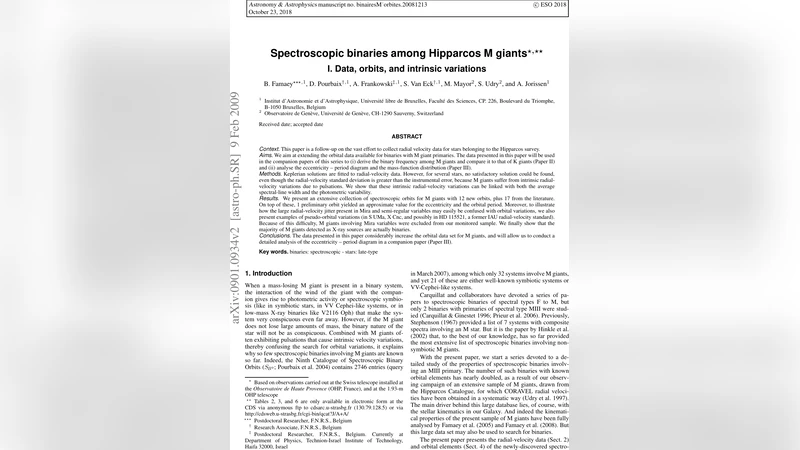
This paper is a follow-up of the vast effort to collect radial velocity data for stars belonging to the Hipparcos survey. We aim at extending the orbital data available for binaries with M giant primaries. The data will be used in the companion papers of this series to (i) derive the binary frequency among M giants and compare it to that of K giants (Paper II), and (ii) analyse the eccentricity-period diagram and the mass-function distribution (Paper III). Keplerian solutions are fitted to radial-velocity data. However, for several stars, no satisfactory solution could be found, despite the fact that the radial-velocity standard deviation is larger than the instrumental error, because M giants suffer from intrinsic radial-velocity variations due to pulsations. We show that these intrinsic radial-velocity variations can be linked with both the average spectral-line width and the photometric variability. We present an extensive collection of spectroscopic orbits for M giants, with 12 new orbits, plus 17 from the literature. Moreover, to illustrate the fact that the large radial-velocity jitter present in Mira and semi-regular variables may easily be confused with orbital variations, we also present examples of pseudo-orbital variations (in S UMa, X Cnc and possibly in HD 115521, a former IAU radial-velocity standard). Because of this difficulty, M giants involving Mira variables were excluded from our monitored sample. We finally show that the majority of M giants detected as X-ray sources are actually binaries.
💡 Research Summary
This paper presents a comprehensive spectroscopic survey of M‑type giant stars that were part of the Hipparcos catalog, with the primary goal of expanding the set of known orbital solutions for binaries whose primary component is an M giant. The authors collected high‑precision radial‑velocity measurements over a span of roughly fifteen years using the CORAVEL and ELODIE spectrographs at the Haute‑Provence Observatory. After careful calibration against standard stars, the typical instrumental error was about 0.3 km s⁻¹, sufficiently low to detect the intrinsic jitter that characterises M giants.
The analysis began by selecting stars whose radial‑velocity scatter exceeded the instrumental noise. For many of these objects, a Keplerian fit could be obtained, yielding a total of 12 new spectroscopic orbits. These were combined with 17 previously published orbits, resulting in a homogeneous sample of 29 M‑giant binaries. Each orbit is described by the usual Keplerian elements—period, eccentricity, projected semi‑major axis, and mass function—allowing a direct comparison with the analogous sample of K‑giant binaries that will be examined in Paper II.
A major difficulty highlighted in the study is the presence of intrinsic radial‑velocity variations caused by stellar pulsations, especially in semi‑regular and Mira variables. The authors demonstrate that the amplitude of this jitter correlates strongly with two observable quantities: the average width of spectral lines (σ₀) and the photometric variability amplitude (ΔV) derived from Hipparcos photometry. Stars with large σ₀·ΔV values exhibit the most pronounced velocity noise, which can masquerade as orbital motion. The paper provides explicit plots of σ₀·ΔV versus radial‑velocity scatter, establishing an empirical threshold above which “pseudo‑orbital” signals are likely. Three illustrative cases—S UMa, X Cnc, and the former radial‑velocity standard HD 115521—are shown to produce apparently periodic velocity curves that are in fact the result of pulsation rather than a companion. Consequently, all Mira variables were excluded from the monitored sample to avoid contamination of the binary statistics.
The orbital properties of the final sample reveal several noteworthy trends. Periods range from a few hundred to several thousand days, with a substantial fraction of long‑period, high‑eccentricity systems (e > 0.5). The derived mass functions typically lie between 0.1 and 0.5 M☉, suggesting that many companions are low‑mass main‑sequence stars or white dwarfs. Compared with K giants, M giants display a higher proportion of very eccentric orbits, possibly reflecting the larger stellar radii and stronger mass‑loss processes that can perturb orbital dynamics during the giant phase.
An additional, independent line of evidence for binarity comes from X‑ray observations. The authors cross‑matched their sample with ROSAT and other X‑ray catalogs, finding that the majority of X‑ray‑detected M giants are indeed members of binary systems. This supports the idea that X‑ray emission in these cool giants is largely associated with binary interactions such as wind accretion onto a compact companion or magnetic activity enhanced by tidal forces.
In summary, the paper delivers a valuable dataset of M‑giant spectroscopic binaries, clarifies the impact of intrinsic pulsation‑induced jitter on radial‑velocity studies, and establishes robust criteria for distinguishing genuine orbital motion from spurious signals. These results lay the groundwork for the subsequent statistical analyses of binary frequency (Paper II) and the eccentricity–period and mass‑function distributions (Paper III), thereby advancing our understanding of the evolutionary pathways of evolved low‑mass stars in binary systems.
Comments & Academic Discussion
Loading comments...
Leave a Comment