Formation of Interstellar Clouds: Parker Instability with Phase Transitions
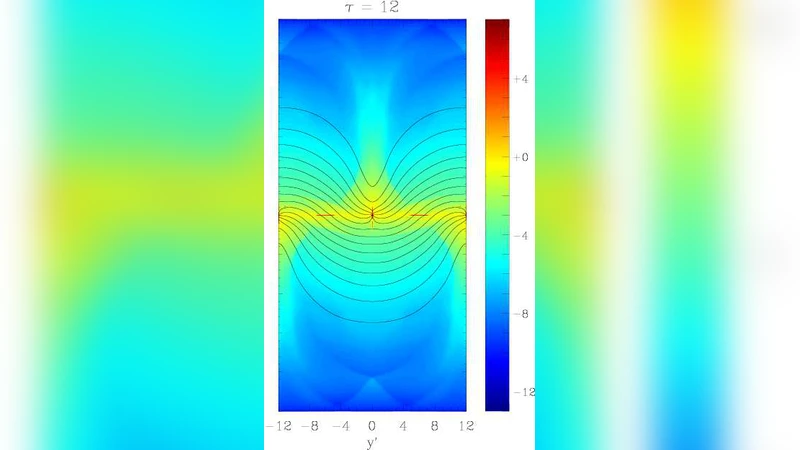
We follow numerically the nonlinear evolution of the Parker instability in the presence of phase transitions from a warm to a cold HI interstellar medium in two spatial dimensions. The nonlinear evolution of the system favors modes that allow the magnetic field lines to cross the galactic plane. Cold HI clouds form with typical masses ~= 10^5 M_sun, mean densities ~= 20 cm^-3, mean magnetic field strengths ~= 4.3 muG (rms field strengths ~= 6.4 muG), mass-to-flux ratios ~= 0.1 - 0.3 relative to critical, temperatures ~= 50 K, (two-dimensional) turbulent velocity dispersions ~= 1.6 km s^-1, and separations ~= 500 pc, in agreement with observations. The maximum density and magnetic field strength are ~= 10^3 cm^-3 and ~= 20 muG, respectively. Approximately 60% of all HI mass is in the warm neutral medium. The cold neutral medium is arranged into sheet-like structures both perpendicular and parallel to the galactic plane, but it is also found almost everywhere in the galactic plane, with the density being highest in valleys of the magnetic field lines. `Cloudlets’ also form whose physical properties are in quantitative agreement with those observed for such objects by Heiles (1967). The nonlinear phase of the evolution takes ~< 30 Myr, so that, if the instability is triggered by a nonlinear perturbation such as a spiral density shock wave, interstellar clouds can form within a time suggested by observations.
💡 Research Summary
This paper investigates how interstellar neutral‑hydrogen (HI) clouds can arise from the Parker instability when the gas is allowed to undergo thermal phase transitions from a warm neutral medium (WNM) to a cold neutral medium (CNM). Using two‑dimensional magnetohydrodynamic (MHD) simulations that incorporate a realistic cooling‑heating function and a critical pressure/density threshold, the authors follow the nonlinear evolution of a magnetized galactic disk initially in hydrostatic equilibrium with a horizontal magnetic field of roughly 5 µG. A modest, non‑linear perturbation is introduced to trigger the Parker instability, which then proceeds through three distinct stages.
In the linear stage the magnetic field begins to buckle vertically, but the gas remains in the warm phase and density changes are minimal. Once the perturbation grows into the nonlinear regime, the field lines develop pronounced valleys and ridges that cross the galactic plane. Gas slides down the magnetic valleys under gravity, its pressure rises, and when it exceeds the prescribed critical value the gas undergoes a rapid phase transition to the cold phase. This transition drops the temperature from ≈8000 K to ≈50 K, while the density jumps to ≈10³ cm⁻³ and the magnetic field is amplified to ≈20 µG by compression. The cold condensations that form have typical masses of ∼10⁵ M⊙, mean densities of ∼20 cm⁻³, mean magnetic fields of ∼4.3 µG (rms ≈ 6.4 µG), and mass‑to‑flux ratios of 0.1–0.3 relative to the critical value, matching observed HI cloud properties. Their internal turbulent velocity dispersion settles at ≈1.6 km s⁻¹, and the spacing between adjacent clouds is about 500 pc, again consistent with surveys.
In addition to the large sheet‑like clouds that align both perpendicular and parallel to the galactic plane, the simulations produce numerous small, roughly spherical “cloudlets” with diameters of order 1 pc, densities of 30–50 cm⁻³, temperatures near 50 K, and magnetic fields of a few µG. These objects reproduce the physical characteristics reported by Heiles (1967) for tiny HI structures, suggesting that the same instability can generate the full hierarchy of observed neutral‑hydrogen features.
The nonlinear phase of the evolution completes in less than 30 Myr. This timescale is short enough that a large‑scale trigger such as a spiral‑density‑wave shock could initiate cloud formation well within the lifetimes inferred from star‑formation observations. Throughout the simulation roughly 60 % of the total HI mass remains in the warm phase, while the cold phase is concentrated in the magnetic valleys and sheet structures. The results demonstrate that the Parker instability, when coupled with realistic thermal physics, naturally yields the observed mass, density, magnetic‑field strength, temperature, velocity dispersion, and spatial distribution of interstellar HI clouds without invoking additional external compression mechanisms.
The authors conclude that the combined Parker‑instability‑plus‑phase‑transition model provides a self‑consistent, quantitative framework for the rapid formation of cold HI clouds in galactic disks. They recommend extending the work to three dimensions, refining the cooling‑heating prescriptions, and performing direct comparisons with high‑resolution HI surveys to further validate the model and explore its implications for subsequent star formation.
Comments & Academic Discussion
Loading comments...
Leave a Comment