Probing the age and structure of the nearby very young open clusters NGC 2244 and NGC 2239
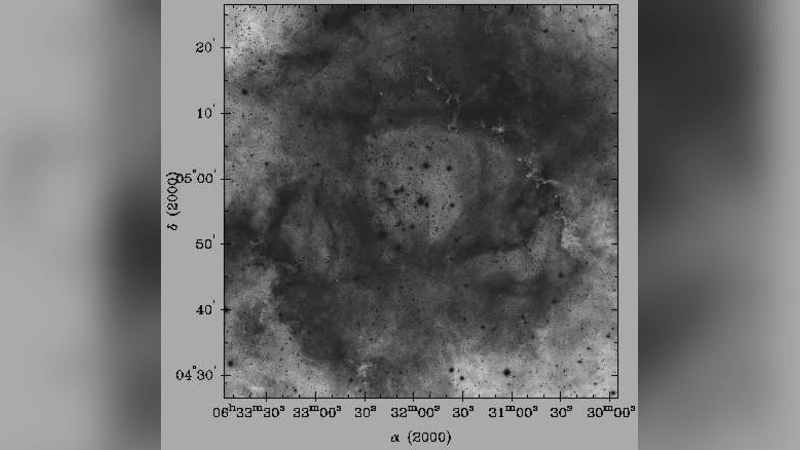
The very young open cluster (OC) NGC 2244 in the Rosette Nebula was studied with field-star-decontaminated 2MASS photometry, which shows the main-sequence (MS) stars and an abundant pre-MS (PMS) population. Fundamental and structural parameters were derived with colour-magnitude diagrams (CMDs), stellar radial density profiles (RDPs) and mass functions (MFs). Most previous studies centred NGC 2244 close to the bright K0V star 12 Monocerotis, which is not a cluster member. Instead, the near-IR RDP indicates a pronounced core near the O5 star HD 46150. We derive an age within 1–6 Myr, an absorption $\aV=1.7\pm0.2$, a distance from the Sun $\ds=1.6\pm0.2$ kpc ($\approx1.5$ kpc outside the Solar circle), an MF slope $\chi=0.91\pm0.13$ and a total (MS+PMS) stellar mass of $\sim625 \ms$. Its RDP is characterised by the core and cluster radii $\rc\approx5.6\arcmin$ ($\approx2.6$ pc) and $\rl\approx10\arcmin$ ($\approx4.7$ pc), respectively. Departure from dynamical equilibrium is suggested by the abnormally large core radius and the marked central stellar excess. We also investigate the elusive neighbouring OC NGC 2239, which is low-mass ($m_{MS+PMS}\approx301 \ms$), young ($5\pm4$ Myr) rather absorbed ($\aV=3.4\pm0.2$), and located in the background of NGC 2244 at $\ds=3.9\pm0.4$ kpc. Its RDP follows a King-like function of $\rc\approx0.5\arcmin\approx0.5$ pc and $\rl\approx5.0\arcmin\approx5.6$ pc. The MF slope, $\chi=1.24\pm0.06$, is essentially Salpeter’s IMF. NGC 2244 is probably doomed to dissolution in a few $10^7$ yr. Wide-field extractions and field-star decontamination increase the stellar statistics and enhance both CMDs and RDPs, which is essential for faint and bright star clusters.
💡 Research Summary
This paper presents a comprehensive study of the very young open clusters NGC 2244 and its neighboring cluster NGC 2239 using wide‑field 2MASS JHK_s photometry combined with a rigorous field‑star decontamination technique. By extracting stars over a large area (≈30′×30′) and statistically removing foreground/background contaminants, the authors obtain clean colour‑magnitude diagrams (CMDs) that reveal both the main‑sequence (MS) and a rich pre‑main‑sequence (PMS) population for each cluster.
For NGC 2244, the CMD fitting with isochrones and PMS tracks yields an age between 1 and 6 Myr, a visual extinction A_V = 1.7 ± 0.2 mag, and a distance of 1.6 ± 0.2 kpc (≈1.5 kpc outside the solar circle). The derived mass function (MF) slope χ = 0.91 ± 0.13 is slightly flatter than the Salpeter value, indicating a modest excess of massive stars. Summing MS and PMS members gives a total stellar mass of roughly 625 M_⊙. Radial density profile (RDP) analysis, fitted with a King‑like model, shows a core radius r_c ≈ 5.6′ (≈2.6 pc) and a limiting radius r_l ≈ 10′ (≈4.7 pc). The unusually large core and a pronounced central stellar excess suggest that NGC 2244 is far from dynamical equilibrium, likely expanding after rapid gas expulsion, and is projected to dissolve within a few × 10⁷ yr. Notably, the historically adopted centre near the bright K0V star 12 Monocerotis is not a cluster member; the true density peak aligns with the O5 star HD 46150.
NGC 2239, situated behind NGC 2244, is identified as a distinct, low‑mass cluster. Its CMD indicates a higher extinction A_V = 3.4 ± 0.2 mag, an age of 5 ± 4 Myr, and a distance of 3.9 ± 0.4 kpc. The total stellar mass (MS + PMS) is about 301 M_⊙. The MF slope χ = 1.24 ± 0.06 is essentially identical to the Salpeter IMF, implying a normal stellar mass distribution. The RDP follows a King‑like profile with a compact core radius r_c ≈ 0.5′ (≈0.5 pc) and a limiting radius r_l ≈ 5.0′ (≈5.6 pc), indicating a relatively relaxed structure.
The study demonstrates that wide‑field extractions and meticulous field‑star decontamination dramatically improve the statistical robustness of both CMDs and RDPs, especially for clusters containing faint PMS stars and bright massive members. These methodological advances enable more accurate determinations of fundamental parameters (age, distance, extinction, mass) and structural diagnostics (core size, density profile), which are crucial for understanding the early dynamical evolution and eventual fate of young open clusters. The contrasting dynamical states of NGC 2244 (rapidly dissolving) and NGC 2239 (more stable) provide valuable empirical constraints for theoretical models of cluster formation, gas expulsion, and early mass segregation.
Comments & Academic Discussion
Loading comments...
Leave a Comment