Predictions of polarized dust emission from interstellar clouds: spatial variations in the efficiency of radiative torque alignment
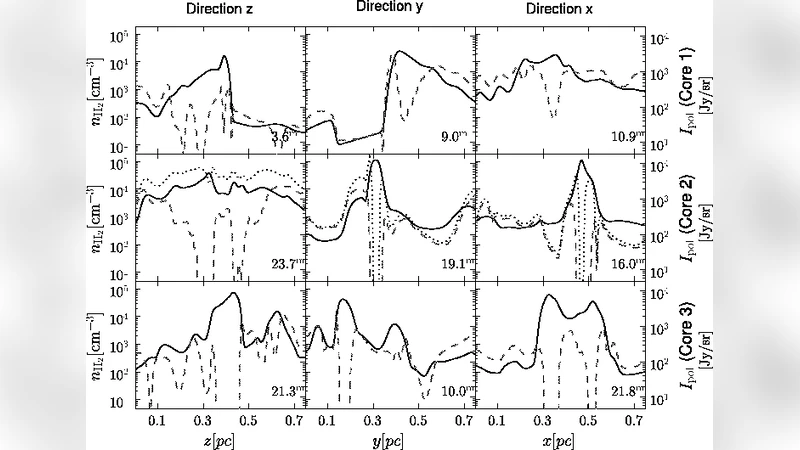
Polarization carries information about the magnetic fields in interstellar clouds. The observations of polarized dust emission are used to study the role of magnetic fields in the evolution of molecular clouds and the initial phases of star-formation. We study the grain alignment with realistic simulations, assuming the radiative torques to be the main mechanism that spins the grains up. The aim is to study the efficiency of the grain alignment as a function of cloud position and to study the observable consequences of these spatial variations. Our results are based on the analysis of model clouds derived from MHD simulations. The continuum radiative transfer problem is solved with Monte Carlo methods to estimate the 3D distribution of dust emission and the radiation field strength affecting the grain alignment. We also examine the effect of grain growth in cores. We are able to reproduce the results of Cho & Lazarian using their assumptions. However, the anisotropy factor even in the 1D case is lower than their assumption of $\gamma = 0.7$, and thus we get less efficient radiative torques. Compared with our previous paper, the polarization degree vs. intensity relation is steeper because of less efficient grain alignment within dense cores. Without grain growth, the magnetic field of the cores is poorly recovered above a few $A_{\rm V}$. If grain size is doubled in the cores, the polarization of dust emission can trace the magnetic field lines possibly up to $A_{\rm V} \sim 10$ magnitudes. However, many of the prestellar cores may be too young for grain coagulation to play a major role. The inclusion of direction dependent radiative torque efficiency weakens the alignment. Even with doubled grain size, we would not expect to probe the magnetic field past a few magnitudes in $A_{\rm V}$.
💡 Research Summary
The paper investigates how efficiently interstellar dust grains become aligned by radiative torques (RATs) and how this alignment translates into observable polarized thermal emission, with a focus on spatial variations across a model molecular cloud. The authors start from three‑dimensional magneto‑hydrodynamic (MHD) simulations that provide realistic density and magnetic‑field structures. Using a Monte‑Carlo radiative‑transfer code, they compute the local radiation field intensity and anisotropy factor (γ) in every cell. Contrary to the common assumption of a high anisotropy (γ≈0.7) used in earlier analytic work (e.g., Cho & Lazarian 2005), their full radiative‑transfer calculations yield γ values typically between 0.3 and 0.4, even in a simple one‑dimensional geometry. This lower anisotropy directly reduces the torque efficiency and therefore the grain spin‑up rate.
With the local radiation field known, the authors apply the RAT alignment theory to a standard MRN grain‑size distribution, calculating the minimum grain size that can be spun up to suprathermal rotation (the “alignment threshold”). They explore two additional physical ingredients: (1) grain growth inside dense cores, modeled by doubling the maximum grain radius, and (2) a direction‑dependent torque efficiency that accounts for the angle between the incoming radiation and the grain symmetry axis. Both effects are incorporated into synthetic Stokes‑parameter maps (I, Q, U) that are subsequently analyzed.
The main results are as follows:
-
Polarization‑Intensity Relation: Because the anisotropy is lower than previously assumed, RATs are less effective in dense regions. Consequently, the polarization degree declines more steeply with increasing intensity (or column density) than in earlier studies. This steepening matches recent observational trends showing a rapid loss of polarization in high‑column‑density filaments.
-
Magnetic‑Field Tracing in Cores: Without grain growth, the polarized emission from cores with visual extinctions A_V > 3–5 mag becomes very weak, making the underlying magnetic‑field geometry essentially unrecoverable. When the grain size distribution is artificially enlarged (maximum radius doubled), the alignment threshold shifts to larger grains, allowing alignment to persist up to A_V ≈ 10 mag. In this scenario, the synthetic polarization vectors still follow the simulated magnetic field lines, suggesting that grain growth could, in principle, extend the observable depth of magnetic‑field tracing.
-
Realistic Grain Growth Timescales: The authors caution that many prestellar cores are likely too young for significant coagulation to have occurred, so the optimistic case of doubled grain size may not be widely applicable.
-
Direction‑Dependent RAT Efficiency: Incorporating the angle‑dependence of the torque further weakens alignment, even when grain growth is assumed. The net effect is that the polarization signal drops sharply beyond A_V ≈ 5 mag, limiting the depth at which magnetic fields can be probed.
Overall, the study demonstrates that realistic radiative‑transfer calculations, a proper treatment of anisotropy, and the inclusion of grain‑size evolution and torque angular dependence are essential for interpreting dust‑polarization observations. The findings suggest that previous models have overestimated the depth to which magnetic fields can be traced by polarized emission, especially in the densest parts of molecular clouds. Future work should couple time‑dependent grain‑growth models with multi‑wavelength polarization observations to better constrain the interplay between dust physics and magnetic‑field diagnostics in star‑forming regions.
Comments & Academic Discussion
Loading comments...
Leave a Comment