The early evolution of the star cluster mass function
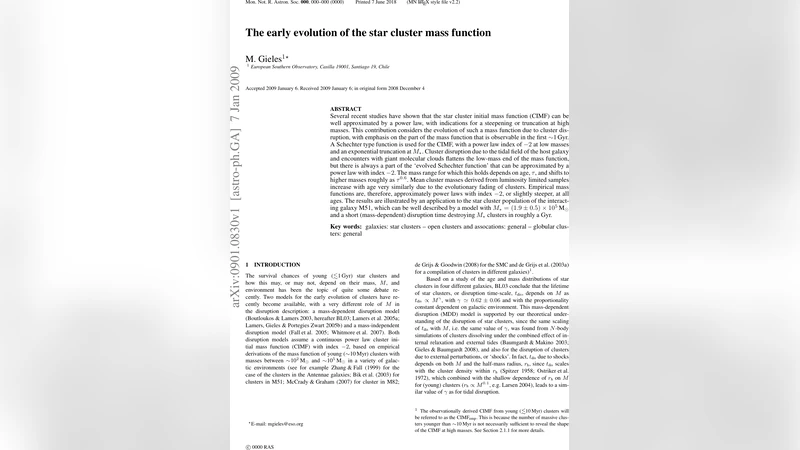
Several recent studies have shown that the star cluster initial mass function (CIMF) can be well approximated by a power law, with indications for a steepening or truncation at high masses. This contribution considers the evolution of such a mass function due to cluster disruption, with emphasis on the part of the mass function that is observable in the first ~Gyr. A Schechter type function is used for the CIMF, with a power law index of -2 at low masses and an exponential truncation at M*. Cluster disruption due to the tidal field of the host galaxy and encounters with giant molecular clouds flattens the low-mass end of the mass function, but there is always a part of the `evolved Schechter function’ that can be approximated by a power law with index -2. The mass range for which this holds depends on age, t, and shifts to higher masses roughly as t^0.6. Mean cluster masses derived from luminosity limited samples increase with age very similarly due to the evolutionary fading of clusters. Empirical mass functions are, therefore, approximately power laws with index -2, or slightly steeper, at all ages. The results are illustrated by an application to the star cluster population of the interacting galaxy M51, which can be well described by a model with M*=(1.9+/-0.5)x10^5 M_sun and a short (mass-dependent) disruption time destroying M* clusters in roughly a Gyr.
💡 Research Summary
The paper investigates how the initial mass function of star clusters (CIMF) evolves under the combined influence of tidal fields and giant molecular cloud (GMC) encounters. Rather than assuming a pure power‑law, the authors adopt a Schechter form for the CIMF: dN/dM ∝ M⁻² exp(−M/M*), where the low‑mass slope is –2 and M* marks an exponential truncation at high masses. They then introduce a mass‑dependent disruption law, τ_dis ∝ M^γ, with γ≈0.62, which reflects the empirical finding that more massive clusters survive longer.
Analytically, the disruption flattens the low‑mass end of the mass function, but a portion of the “evolved Schechter function” retains the original –2 slope. The mass at which the transition from a flat, disrupted regime to the –2 power‑law occurs scales with age as M_t ∝ t^{1/(1−γ)} ≈ t^{0.6}. Consequently, for any given age (up to ∼1 Gyr) there is a mass interval that still looks like a pure –2 power‑law; this interval shifts to higher masses as clusters age.
Because clusters fade rapidly in luminosity, a luminosity‑limited sample will preferentially miss low‑mass, old clusters. This selection effect makes the mean observed mass increase with age, even though the underlying mass distribution does not necessarily evolve in that way. Thus, observed age‑mass trends are largely driven by fading combined with the near‑constant –2 slope of the observable mass function.
The authors test the framework on the well‑studied cluster population of the interacting galaxy M51. By fitting the age‑mass distribution, they infer a truncation mass M* ≈ (1.9 ± 0.5) × 10⁵ M_⊙ and a short, mass‑dependent disruption timescale: a cluster of mass M* is expected to dissolve in roughly 1 Gyr, while a 10⁴ M_⊙ cluster disrupts in about 0.1 Gyr. The model reproduces the observed mass functions at different ages, the increase of mean mass with age, and the overall decline in cluster numbers.
In summary, the study shows that an initial Schechter CIMF, when subjected to realistic, mass‑dependent disruption, naturally yields an observable mass function that is approximately a –2 power‑law (or slightly steeper) at all ages up to a gigayear. The shift of the “power‑law window” to higher masses with time, together with luminosity fading, explains why many galaxies display a seemingly universal –2 cluster mass function despite underlying evolutionary processes. These results provide a quantitative bridge between cluster formation theories, disruption physics, and the empirical mass functions measured in diverse galactic environments.
Comments & Academic Discussion
Loading comments...
Leave a Comment