A Keck/DEIMOS spectroscopic survey of the faint M31 satellites And XV and And XVI
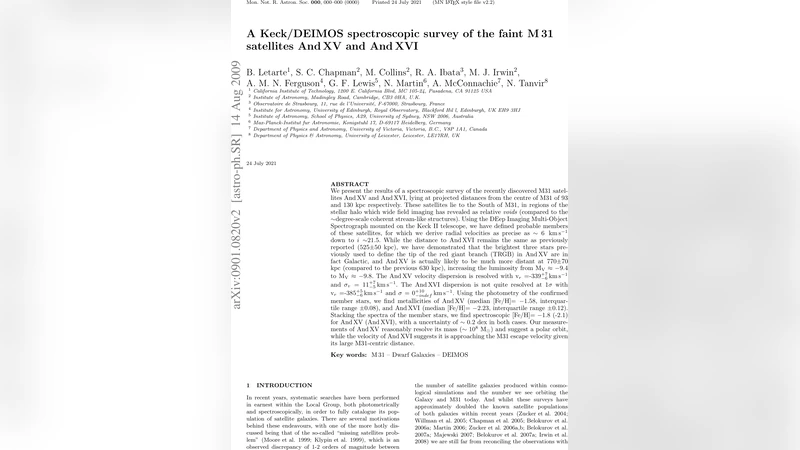
We present the results of a spectroscopic survey of the recently discovered M31 satellites And XV and And XVI, lying at projected distances from the centre of M31 of 93 and 130 kpc respectively. These satellites lie to the South of M31, in regions of the stellar halo which wide field imaging has revealed as relative voids (compared to the degree-scale coherent stream-like structures). Using the DEep Imaging Multi-Object Spectrograph mounted on the Keck II telescope, we have defined probable members of these satellites, for which we derive radial velocities as precise as 6 km/s down to i21.5. While the distance to And XVI remains the same as previously reported (525pm50 kpc), we have demonstrated that the brightest three stars previously used to define the tip of the red giant branch (TRGB) in And XV are in fact Galactic, and And XV is actually likely to be much more distant at 770pm70 kpc (compared to the previous 630 kpc), increasing the luminosity from MV -9.4 to MV~-9.8. The And XV velocity dispersion is resolved with vr =-339+7-6 km/s and sigma-v = 11+7-5 km/s. The And XVI dispersion is not quite resolved at 1sigma with vr =-385+5-6 km/s and sigma-v = 0+10-indef km/s. Using the photometry of the confirmed member stars, we find metallicities of And XV (median [Fe/H]=-1.58, interquar- tile range +-0.08), and And XVI (median [Fe/H]=-2.23, interquartile range +-0.12). Stacking the spectra of the member stars, we find spectroscopic [Fe/H]=-1.8 (-2.1) for And XV (And XVI), with a uncertainty of ~0.2 dex in both cases. Our measure- ments of And XV reasonably resolve its mass (~10^8 Msun) and suggest a polar orbit, while the velocity of And XVI suggests it is approaching the M31 escape velocity given its large M31-centric distance.
💡 Research Summary
This paper presents a spectroscopic investigation of two recently discovered dwarf satellite galaxies of the Andromeda galaxy (M31), designated Andromeda XV (And XV) and Andromeda XVI (And XVI). Using the DEep Imaging Multi-Object Spectrograph (DEIMOS) on the Keck II 10‑meter telescope, the authors obtained medium‑resolution spectra for candidate red‑giant branch (RGB) stars down to i ≈ 21.5 mag, achieving radial‑velocity precisions of roughly 6 km s⁻¹.
Candidate members were selected from existing wide‑field photometry by locating stars that lie on the expected RGB in the colour‑magnitude diagram and that fall within a narrow velocity window. For And XV, the authors discovered that the three brightest stars previously used to define the tip of the red‑giant branch (TRGB) are foreground Milky Way stars. Consequently, the TRGB distance estimate for And XV was revised upward from ~630 kpc to 770 ± 70 kpc. This larger distance raises the absolute V‑band magnitude from MV ≈ ‑9.4 to MV ≈ ‑9.8. The distance to And XVI remains consistent with earlier work at 525 ± 50 kpc.
Radial‑velocity analysis yields systemic velocities of vr = ‑339 +7/‑6 km s⁻¹ for And XV and vr = ‑385 +5/‑6 km s⁻¹ for And XVI. The velocity dispersion of And XV is resolved at σv = 11 +7/‑5 km s⁻¹, indicating an intrinsic dynamical temperature. In contrast, And XVI’s dispersion is not significantly detected; the best‑fit value is σv ≈ 0 km s⁻¹ with a 1σ upper limit of ~10 km s⁻¹, implying a low dynamical mass or insufficient data to measure it precisely.
Photometric metallicities were derived by comparing the colours of confirmed members to isochrones. The median photometric
Comments & Academic Discussion
Loading comments...
Leave a Comment