The evolution of star formation in quasar host galaxies
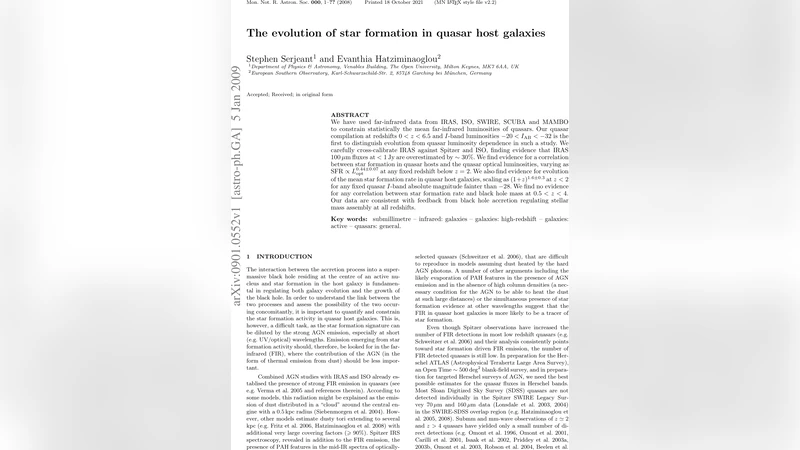
We have used far-infrared data from IRAS, ISO, SWIRE, SCUBA and MAMBO to constrain statistically the mean far-infrared luminosities of quasars. Our quasar compilation at redshifts 0<z<6.5 and I-band luminosities -20<I(AB)<-32 is the first to distinguish evolution from quasar luminosity dependence in such a study. We carefully cross-calibrate IRAS against Spitzer and ISO, finding evidence that IRAS 100um fluxes at <1Jy are overestimated by ~30%. We find evidence for a correlation between star formation in quasar hosts and the quasar optical luminosities, varying as SFR proportional to L_opt^(0.44+/-0.07) at any fixed redshift below z=2. We also find evidence for evolution of the mean star formation rate in quasar host galaxies, scaling as (1+z)^(1.6+/-0.3) at z<2 for any fixed quasar I-band absolute magnitude fainter than -28. We find no evidence for any correlation between star formation rate and black hole mass at 0.5<z<4. Our data are consistent with feedback from black hole accretion regulating stellar mass assembly at all redshifts.
💡 Research Summary
The authors present a comprehensive statistical study of the far‑infrared (FIR) emission from quasar host galaxies, using a heterogeneous collection of archival data from IRAS, ISO, the Spitzer‑based SWIRE survey, SCUBA, and MAMBO. Their sample comprises roughly two thousand quasars spanning a wide redshift range (0 < z < 6.5) and optical I‑band absolute magnitudes (‑20 > I(AB) > ‑32). This breadth allows, for the first time, a clear separation of the effects of cosmic evolution from those of quasar luminosity on the average FIR output.
A key methodological step is the cross‑calibration of the IRAS 100 µm fluxes against the more recent Spitzer and ISO measurements. The authors demonstrate that for sources fainter than 1 Jy, IRAS systematically overestimates the flux by about 30 %. Applying this correction reduces a major systematic bias that would otherwise inflate the inferred star‑formation rates (SFRs) of low‑luminosity quasars.
Because most individual quasars are undetected in the FIR, the authors employ a stacking analysis. By co‑adding the FIR maps of quasars that share similar redshift and optical luminosity, they recover a robust average FIR luminosity for each bin. The FIR luminosities are then converted to SFRs using the Kennicutt (1998) relation, assuming a standard initial mass function.
The main empirical findings are:
-
Luminosity‑SFR correlation – At any fixed redshift below z ≈ 2, the average SFR scales with the optical luminosity of the quasar as SFR ∝ L_opt^0.44 ± 0.07. This sub‑linear relation indicates that more optically luminous quasars tend to reside in host galaxies with higher star‑formation activity, but the increase is modest rather than proportional.
-
Redshift evolution – For quasars fainter than I = ‑28, the mean SFR evolves with redshift as SFR ∝ (1 + z)^{1.6 ± 0.3} for z < 2. This implies that the typical host galaxy at z ≈ 2 forms stars at roughly five times the rate of a comparable host at the present epoch.
-
Lack of SFR–black‑hole‑mass correlation – In the interval 0.5 < z < 4, the authors find no statistically significant dependence of SFR on the estimated black‑hole mass (M_BH). This suggests that, while the instantaneous accretion power (traced by L_opt) influences the surrounding interstellar medium, the integrated black‑hole mass does not directly dictate the host’s star‑formation level.
These results are interpreted in the context of AGN feedback models. The observed sub‑linear SFR–L_opt relation and the modest redshift evolution are consistent with a scenario where energy output from the accreting black hole regulates, but does not completely quench, star formation in the host galaxy. The absence of a strong SFR–M_BH link further supports the idea that feedback operates on relatively short timescales, decoupling the cumulative black‑hole growth from the long‑term star‑formation history.
In summary, by carefully calibrating heterogeneous FIR datasets and applying a robust stacking methodology, the paper quantifies how quasar optical power and cosmic time shape the average star‑forming properties of their host galaxies. The findings reinforce the view that black‑hole accretion and stellar mass assembly are intimately linked through feedback processes across the full span of cosmic history, providing valuable constraints for future high‑resolution FIR observations (e.g., with JWST and ALMA) and for theoretical models of co‑evolution.
Comments & Academic Discussion
Loading comments...
Leave a Comment