Perturbative reconstruction of a gravitational lens: when mass does not follow light
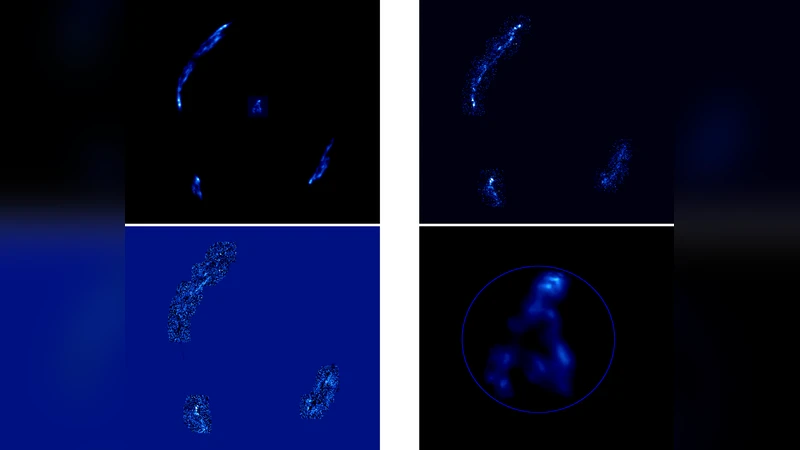
The structure and potential of a complex gravitational lens is reconstructed using the perturbative method presented in Alard 2007, MNRAS, 382L, 58; Alard 2008, MNRAS, 388, 375. This lens is composed of 6 galaxies belonging to a small group. The lens inversion is reduced to the problem of reconstructing non-degenerate quantities: the 2 fields of the perturbative theory of strong gravitational lenses. Since in the perturbative theory the circular source solution is analytical, the general properties of the perturbative solution can be inferred directly from the data. As a consequence, the reconstruction of the perturbative fields is not affected by degeneracy, and finding the best solution is only a matter of numerical refinement. The local shape of the potential and density of the lens are inferred from the perturbative solution, revealing the existence of an independent dark component that does not follow light. The most likely explanation is that the particular shape of the dark halo is due to the merging of cold dark matter halos. This is a new result illustrating the structure of dark halos at the scale of galaxies.
💡 Research Summary
The paper presents a novel application of the perturbative method for strong gravitational lensing, originally introduced by Alard (2007, 2008), to a complex lens system composed of six galaxies belonging to a small group. Traditional lens inversion techniques rely on parametric mass models and assume a close correspondence between light and mass, leading to severe degeneracies between mass distribution, source structure, and lens potential. In contrast, the perturbative approach expands the lens potential around an axis‑symmetric circular model and describes all deviations with two scalar fields: the radial perturbation f₁(θ) and the angular derivative df₀/dθ. These fields are non‑degenerate, and because the solution for a circular source is analytical, the reconstruction reduces to a well‑posed numerical refinement problem without the need for any prior mass‑light relation.
The authors first process high‑resolution Hubble Space Telescope images of the system, extracting precise positions, shapes, and fluxes of the multiple images and arcs. An initial guess for the perturbative fields is obtained by aligning the observed image configuration with a circularly symmetric potential. They then iteratively minimize a χ² functional using a non‑linear least‑squares algorithm, adjusting f₁ and df₀/dθ until the model reproduces the observed image morphology to within the measurement uncertainties. Because the method does not impose any parametric form on the underlying mass distribution, the resulting fields are uniquely determined by the data.
From the reconstructed fields the authors compute the second derivatives of the lensing potential, which directly yield the projected surface‑density (convergence) map. The convergence map shows two distinct components: (1) high‑density peaks that coincide with the luminous centers of the six group galaxies, and (2) an additional, spatially extended mass concentration that does not align with any visible galaxy. This “dark” component contributes significantly to the overall lensing effect, especially in regions where the arcs are most strongly distorted. The angular structure of the perturbative fields exhibits strong higher‑order modes (m ≥ 3), indicating pronounced non‑circularity and asymmetry in the mass distribution.
The authors interpret the misaligned dark mass as evidence for a non‑spherical dark halo formed through the merging of cold dark matter (CDM) sub‑halos. In such a scenario, the individual galaxy halos retain their luminous cores, while the surrounding dark matter merges into a larger, irregularly shaped halo that does not trace the light distribution. This finding challenges the common simplifying assumption that mass follows light on galaxy‑group scales and provides a direct observational probe of halo assembly processes predicted by ΛCDM cosmology.
Beyond the specific system, the study demonstrates the power of the perturbative framework for lens reconstruction. By focusing on the two non‑degenerate fields, the method sidesteps the traditional mass‑sheet and source‑position degeneracies, delivering a clean, data‑driven map of the lens potential. The authors argue that applying this technique to larger samples of group‑scale lenses—especially those with high‑quality imaging from space‑based observatories—could yield statistically robust constraints on the shapes, orientations, and substructure content of dark halos. Such constraints would be invaluable for testing predictions of structure formation models, probing the interplay between baryonic and dark components, and refining our understanding of how galaxies assemble within their dark matter environments.
Comments & Academic Discussion
Loading comments...
Leave a Comment