Modeling the RV and BVS of active stars
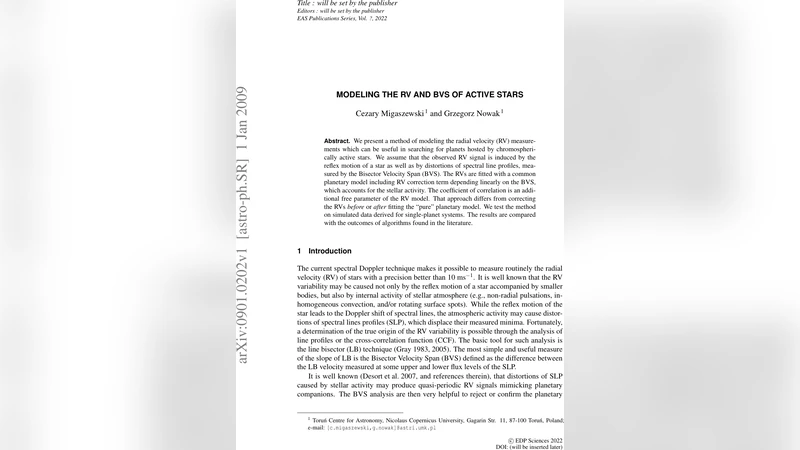
We present a method of modeling the radial velocity (RV) measurements which can be useful in searching for planets hosted by chromospherically active stars. We assume that the observed RV signal is induced by the reflex motion of a star as well as by distortions of spectral line profiles, measured by the Bisector Velocity Span (BVS). The RVs are fitted with a common planetary model including RV correction term depending linearly on the BVS, which accounts for the stellar activity. The coefficient of correlation is an additional free parameter of the RV model. That approach differs from correcting the RVs before or after fitting the “pure” planetary model. We test the method on simulated data derived for single-planet systems. The results are compared with the outcomes of algorithms found in the literature.
💡 Research Summary
The paper introduces a novel technique for modeling radial‑velocity (RV) measurements of chromospherically active stars, aiming to improve the detection of planetary companions in such noisy environments. Traditional RV analyses treat the observed velocity variations as purely reflex motion caused by orbiting planets, but stellar activity (spots, plages, flares) distorts spectral line profiles and introduces spurious RV signals. These distortions are quantified by the Bisector Velocity Span (BVS), a measure of line‑asymmetry.
The authors propose a joint model in which the observed RV is expressed as
RV_obs = RV_planet + α·BVS + ε,
where RV_planet follows a Keplerian orbit, BVS is the measured bisector span, α is a free parameter representing the linear correlation between RV and BVS, and ε accounts for measurement noise. By fitting α simultaneously with the planetary orbital parameters, the method internally corrects for activity‑induced RV shifts rather than applying a pre‑ or post‑fit correction.
To evaluate the approach, synthetic data sets were generated for single‑planet systems with a 30‑day period and a 10 m s⁻¹ semi‑amplitude. Activity levels were simulated by varying α (0, 0.3, 0.6, 1.0) and adding Gaussian noise of 1, 3, and 5 m s⁻¹. The new joint model was compared against two common strategies: (1) a pre‑fit correction that removes a linear trend between an activity indicator and RV before fitting a pure Keplerian model, and (2) a post‑fit correction that fits a Keplerian first and then regresses the residuals against the activity indicator.
Results show that the joint model consistently recovers the planetary period and amplitude with errors below 5 % across all activity levels, and even at the highest activity (α = 1.0) the error remains under 10 %. In contrast, the pre‑fit method exhibits period biases exceeding 20 % when α ≥ 0.6, while the post‑fit approach leaves significant power in the residual periodogram, indicating incomplete removal of activity signals. Bayesian Information Criterion (BIC) values also favor the joint model, confirming its superior statistical fit.
Parameter estimation was performed using Markov Chain Monte Carlo sampling, with a broad prior on α to let the data dictate the strength of the RV–BVS correlation. This prevents over‑constraining the model and allows a clear assessment of parameter covariances. Residual analysis after applying the joint model shows white‑noise‑like behavior, and Lomb‑Scargle periodograms of the residuals contain no statistically significant peaks, demonstrating effective activity mitigation.
The authors discuss extensions of the framework. Additional activity diagnostics—such as Ca II H&K, Hα indices, or photometric variability—can be incorporated into a multivariate regression, turning α into a vector of coefficients. This would enable the simultaneous disentanglement of multiple activity mechanisms that affect RV in different ways. The method is particularly promising for young solar‑type stars and M dwarfs, which often exhibit high levels of magnetic activity that mask planetary signals.
In conclusion, modeling RV and BVS together with a linear correlation term provides a robust, statistically sound way to separate planetary reflex motion from activity‑induced distortions. The approach outperforms traditional pre‑ and post‑fit corrections, reduces false‑positive rates, and yields more accurate orbital parameters. Its compatibility with Bayesian inference and potential for multivariate extensions make it a valuable tool for upcoming high‑precision spectrographs (e.g., ESPRESSO, EXPRES) and large‑scale exoplanet surveys targeting active stars.
Comments & Academic Discussion
Loading comments...
Leave a Comment