On the algebraic index for riemannian etale groupoids
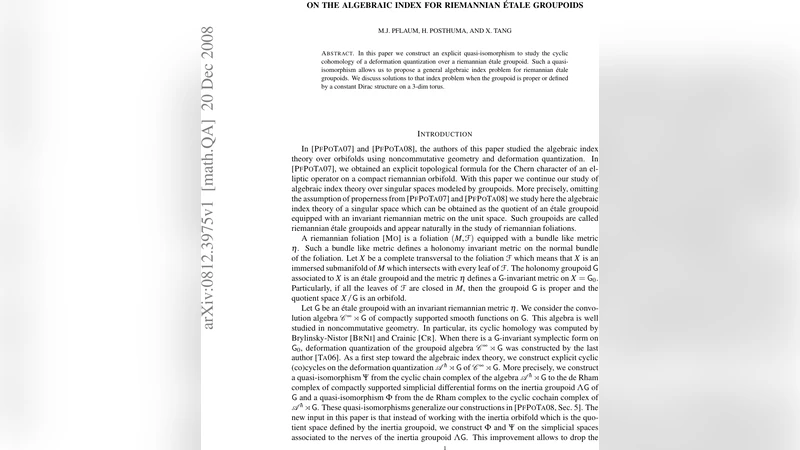
In this paper we construct an explicit quasi-isomorphism to study the cyclic cohomology of a deformation quantization over a riemannian 'etale groupoid. Such a quasi-isomorphism allows us to propose a general algebraic index problem for riemannian 'etale groupoids. We discuss solutions to that index problem when the groupoid is proper or defined by a constant Dirac structure on a 3-dim torus.
💡 Research Summary
The paper addresses the cyclic cohomology of deformation quantizations defined over Riemannian étale groupoids by constructing an explicit quasi‑isomorphism between the cyclic complex of the quantized algebra and the de Rham complex of the underlying groupoid. After reviewing the necessary background on étale groupoids, deformation quantization, Hochschild and cyclic complexes, and the classical Hochschild‑Kostant‑Rosenberg (HKR) map, the author introduces a filtered, complete chain map Φ that incorporates the Riemannian metric, a compatible connection, and curvature data. This map respects degrees, preserves the filtration, and, crucially, becomes a quasi‑isomorphism after suitable completion. The proof proceeds locally by comparing Φ with the standard HKR map in a Moyal‑type chart, showing that the difference lies in higher‑order terms that vanish under the filtration, and then glues the local results globally using a partition of unity adapted to the metric’s convexity properties.
With Φ in hand, the author formulates a general “algebraic index problem” for Riemannian étale groupoids: given a K‑theory class of the deformed algebra A_ℏ, produce a cyclic cohomology class that matches the classical index pairing obtained from geometric data on the groupoid. Two concrete settings are examined.
-
Proper groupoids: When the source and target maps are proper, the reduced C*-algebra of the groupoid is Morita equivalent to a commutative algebra, and a normalized trace τ on A_ℏ exists. The trace induces a Chern character ch_τ on K_0(A_ℏ). Composing ch_τ with Φ yields a de Rham cohomology class that coincides with the classical index class defined by the Atiyah‑Singer framework for proper groupoids. Thus the algebraic index theorem holds verbatim in this non‑commutative context.
-
Constant Dirac structures on the three‑torus: Here the groupoid models a non‑commutative 3‑torus A_θ obtained from a constant Dirac structure on T^3. The author employs a Fourier‑Mukai transform to identify K_0(A_θ) with the odd cyclic homology HC_{odd}(A_θ). The quasi‑isomorphism Φ is shown to agree with this transform, leading to an explicit index formula that involves a θ‑dependent Chern‑Simons term. This reproduces and extends known results for non‑commutative tori, linking the index to the underlying Dirac geometry.
The final discussion highlights the broader significance of the construction. By exploiting the Riemannian metric, the quasi‑isomorphism provides a systematic tool for computing cyclic cohomology of a wide class of non‑commutative spaces modeled by étale groupoids, including those with singularities or non‑constant Poisson structures. Moreover, the algebraic index problem unifies K‑theoretic and cyclic‑cohomological perspectives, suggesting new avenues for applications in non‑commutative topology, index theory on singular spaces, and quantum field theories formulated on non‑commutative backgrounds. The paper thus opens a pathway toward a comprehensive index theory for Riemannian étale groupoids.
Comments & Academic Discussion
Loading comments...
Leave a Comment