$q$-Breathers in finite lattices: nonlinearity and weak disorder
Nonlinearity and disorder are the recognized ingredients of the lattice vibrational dynamics, the factors that could be diminished, but never excluded. We generalize the concept of $q$-breathers -- periodic orbits in nonlinear lattices, exponentially…
Authors: M.V. Ivanchenko
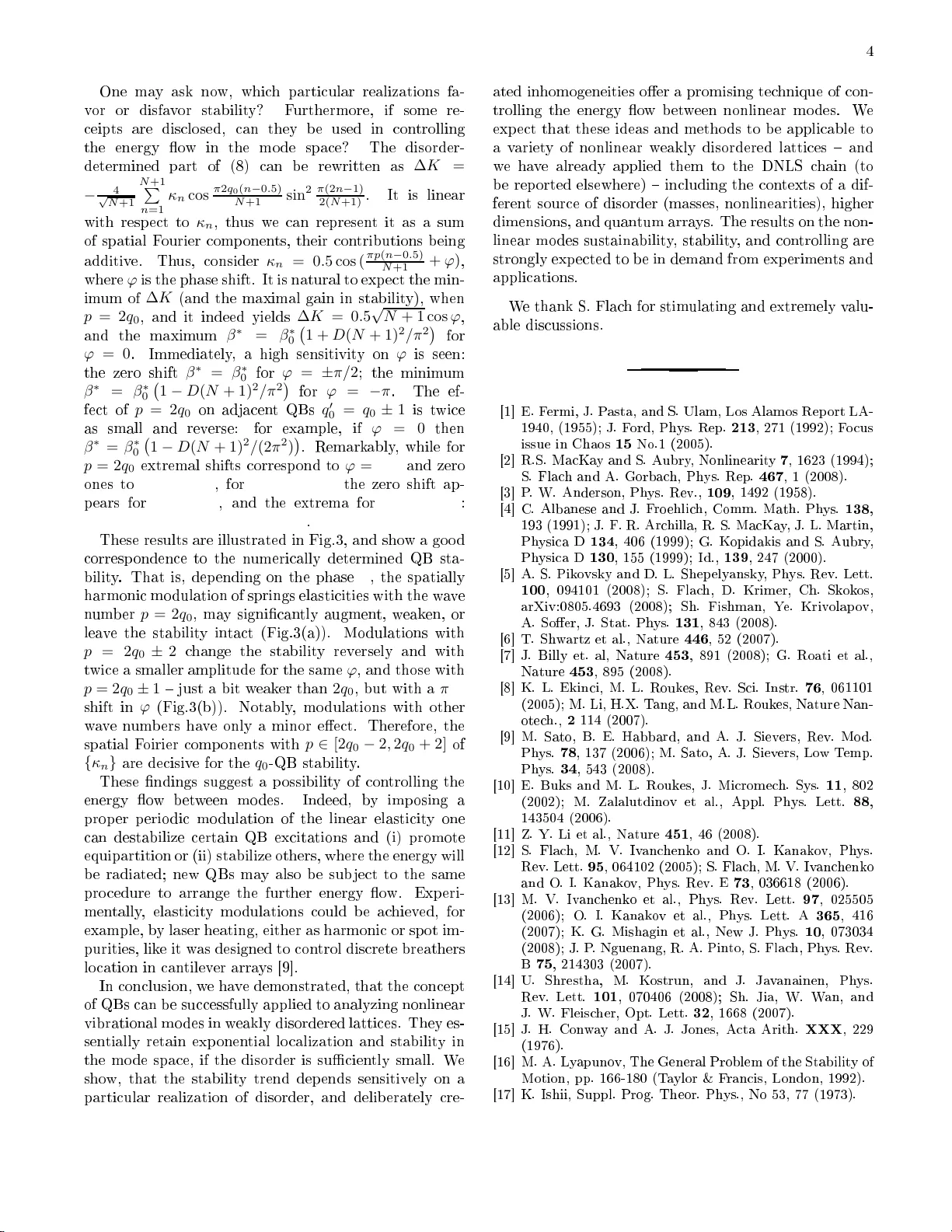
q -Breathers in nite latties: nonlinearit y and w eak disorder M. V. Iv an henk o Dep artment of Applie d Mathematis, University of L e e ds, LS2 9JT, L e e ds, Unite d Kingdom Nonlinearit y and disorder are the reognized ingredien ts of the lattie vibrational dynamis, the fators that ould b e diminished, but nev er exluded. W e generalize the onept of q -breathers p erio di orbits in nonlinear latties, exp onen tially lo alized in the reipro al linear mo de spae to the ase of w eak disorder, taking the F ermi-P asta-Ulan hain as an example. W e sho w, that these nonlinear vibrational mo des remain exp onen tially lo alized near the en tral mo de and stable, pro vided the disorder is suien tly small. The instabilit y threshold dep ends sensitiv ely on a par- tiular realization of disorder and an b e mo died b y sp eially designed impurities. Basing on it, an approa h to on trolling the energy o w b et w een the mo des is prop osed. The relev ane to other mo del latties and exp erimen tal miniature arra ys is disussed. P A CS n um b ers: 63.20.Pw, 63.20.Ry , 05.45.-a Nonlinearit y and disorder are ubiquitous and una v oid- able features of disrete extended systems, the k ey pla y- ers in a w ealth of fundamen tal dynamial and statistial ph ysial phenomena su h as thermalization, thermal on- dutivit y , w a v e propagation, eletron and phonon sat- tering. Studying lattie vibrational mo des is vital to gain full understanding of these problems. Nonlinear- it y indues in teration b et w een normal mo des and en- ergy sharing if strong enough (kno wn as the F ermi-P asta- Ulam (FPU) problem) [1 ℄, and time-p erio di exp onen tial lo alizations in diret spae (disrete breathers) [2 ℄. Lin- ear systems with disorder supp ort another generi lass of exp onen tially lo alized mo des (Anderson mo des) [3 ℄. A t the same time a satisfatory full understanding of the onurr ent ee t of nonlinearit y and disorder is missing. This gap is b eing progressiv ely lled for str ongly disor- der e d and we akly nonline ar latties b y in tensiv e resear h on on tin uation of Anderson mo des in to nonlinear regime [4℄, w a v epa k et spreading [5 ℄, ligh t propagation in pho- toni latties [6 ℄, and Bose-Einstein ondensate (BEC) lo alization in random optial p oten tials [7℄. Little, ho w ev er, is kno wn on ho w the systems with pr o- noun e d nonline arity and we ak disor der b eha v e. Remark- ably , it is a demand in a n um b er of exp erimen tal and appliational on texts, b eside a hallenge from theory . Miro- and nano-eletro-me hanial systems are rapidly dev eloping omp onen ts in miroinstrumen ts design (ul- trafast sensors, radio frequeny lters, added mass sen- sors) [8 ℄. Their arra y strutures oer broadband exita- tions, elasti w a v es, and eets of disp ersion to b e uti- lized [9, 10 ℄. Imp ortan tly , they are often suggested to op erate in the nonlinear regime, while maturing te hnol- ogy redues fabriation errors, hene diminishing spatial disorder. On the atomi sale, three-dimensional gold nano-luster strutures are found to b e ativ e and se- letiv e atalysts for a v ariet y of hemial reations, the surfae vibrational mo des b eing p ossible initiators [11 ℄. One of the fundamen tal t yp es of nonlinear osillatory mo des is q-breathers (QBs) - exat time-p erio di solu- tions on tin ued from linear mo des and preserving ex- p onen tial lo alization in the linear normal mo de o or- dinates. Originally prop osed to explain the FPU para- do x (the energy lo king in lo w-frequeny mo des of a w eakly nonlinear hain, reurrenies, and size-dep enden t sto hastiit y thresholds) [12 ℄, they ha v e b een diso v ered in t w o and three dimensional aousti latties, saled to innite systems, found in disrete nonlinear S hrö dinger (DNLS) arra ys, and quan tum QBs w ere observ ed in the Bose-Hubbard hain [13 ℄. Reen tly , QBs ha v e b een sug- gested as ma jor ators in a BEC pulsating instabilit y and a four-w a v e mixing pro ess in a nonlinear rystal [ 14 ℄. In this pap er w e extend the onept of QBs to ran- dom nonlinear media, exemplifying in the FPU hain. The ornerstones of our approa h are on tin uation of QBs in to non-zero 'frozen' disorder, taking a nonlinear lo alized solution as a seed, and statistial analysis of on tin ued solutions. W e sho w that QBs demonstrate the rosso v er from the exp onen tial lo alization near the en- tral mo de to plateaus at a distane. The a v erage sta- bilit y threshold in nonlinearit y remains the same in the rst order of appro ximation. In on trast, the standard deviation inreases linearly with disorder, manifesting a high sensitivit y on realizations. W e analyze the eet of the harmoni in spae inhomogeneities and disuss the energy o w on trol b y impurities design. The FPU- β hain of N equal masses, oupled b y springs with disorder in linear o eien ts and quarti nonlinearit y in p oten tial, is desrib ed b y the Hamilto- nian H = 1 2 N X n =1 p 2 n + N +1 X n =1 1 2 (1 + D κ n )( x n − x n − 1 ) 2 + β 4 ( x n − x n − 1 ) 4 (1) where x n ( t ) is the displaemen t of the n -th partile from its original p osition, p n ( t ) its momen tum, x 0 = x N +1 = 0 , κ n ∈ [ − 1 / 2 , 1 / 2] are random, uniformly distributed, and unorrelated with h κ n κ m i = σ 2 κ δ n,m , σ 2 κ = 1 / 12 in our ase. A anonial transformation 2 x n ( t ) = q 2 N +1 N P q =1 Q q ( t ) sin π qn N +1 denes the reipro- al w a v e n um b er spae with N normal mo de o ordinates Q q ( t ) , b eing solutions to the linear disorder-free ase. The normal mo de spae is spanned b y q and represen ts a hain similar to the situation in real spae. The equations of motion read ¨ Q q + ω 2 q Q q = − β 2( N + 1) N X p,r,s C q,p,r,s ω q ω p ω r ω s × Q p Q r Q s − D √ N + 1 N X p ω q ω p K q,p Q p . (2) Here ω q = 2 sin π q 2( N +1) are the normal mo de frequen- ies. The oupling o eien ts C q,p,r,s [12 ℄ indue the se- letiv e nonlinear in teration b et w een distan t mo des and K q,p = 2 √ N +1 N +1 P n =1 κ n cos π q ( n − 1 / 2) N +1 cos π p ( n − 1 / 2) N +1 reet the all-to-all linear in teration due to disorder. Our metho dology onsists of t w o steps. Firstly , w e tak e a kno wn QB solution for non-zero nonlinearit y [12 ℄. A partiular realization of { κ n } is hosen and d = D / √ N + 1 regarded as the disorder parameter. T o- gether with the nonlinearit y parameter ν = β / ( N + 1 ) , it is assumed to b e small: ν, d ≪ 1 . Then, an asymp- toti expansion in p o w ers of { ν, d } is dev elop ed. Linear stabilit y analysis is based on the onstruted solution. Seondly , w e address the statistial prop erties of the QB solution and instabilit y threshold alulating resp etiv e a v erages and v arianes. Con tin uation of QBs to β , D 6 = 0 from β 6 = 0 , D = 0 emplo ys the same te hnique as to β 6 = 0 , D = 0 from β = D = 0 [12 ℄. F or ν, d << 1 and small amplitude ex- itations the q -osillators get eetiv ely deoupled, their harmoni energy E q = 1 2 ˙ Q 2 q + ω 2 q Q 2 q b eing almost on- serv ed in time. Single q -osillator exitations E q 6 = 0 for q ≡ q 0 only are trivial time-p erio di and q -lo alized so- lutions for β = D = 0 . F or the disorder-free hain su h p erio di orbits an b e on tin ued in to the nonlinear ase at xed total energy [12 ℄ b eause the non-resonane ondition nω q 0 6 = ω q 6 = q 0 ( n b eing an in teger) holds for an y nite size [15 ℄ and the Ly apuno v theorem [16 ℄ applies. Same ideas are exp eted to w ork for d ≪ 0 , as the sp etrum remains non-resonan t with the probabilit y 1 [4 ℄. Su h on tin uation sueeded for all parameters w e to ok. W e on tin ue QBs from nonlinear disorder-free solu- tions inreasing D and k eeping a partiular random real- ization { κ n } xed. The total energy of the hain is E = 1 in all examples, and 100 realizations of disorder are tak en and used for a v eraging. Dep endene of the a v erage QB energy distribution on the lev el of disorder is rep orted in Fig.1 . W e observ e the harateristi QB exp onen tially lo alized prole on the almost at disorder-indued ba k- ground. The heigh t of the plateau gro ws with D , grad- 5 10 15 20 25 30 −30 −20 −10 q log 10 〈 E q 〉 D=0 D=5*10 −9 D=5*10 −7 D=5*10 −5 D=5*10 −3 D=0.1 FIG. 1: The a v erage mo de energy distribution in QBs with q 0 = 5 , β = 0 . 01 , N = 32 under inreasing disorder. Dashed lines are theoretial estimates (5). ually absorbing lo alized mo des. F or β = 0 . 0 1 , q 0 = 5 , and N = 32 the seond large mo de is o v erome near D = 0 . 01 , and in terp olation predits the en tral one re- mains w ell ab o v e the ba kground ev en for D > 2 , when some linear elastiit y o eien ts ma y b eome negativ e with a non-zero probabilit y . Let us reall, that in ase D = 0 the QB solution ˆ Q N L q ( t ) with a lo w-frequeny seed mo de n um b er q 0 an b e written as an asymptoti expansion in p o w ers of the small nonlinearit y parameter ν [12 ℄. The energies of the mo des q 0 , 3 q 0 ,. . . , (2 n + 1) q 0 ,. . . ≪ N read E N L (2 n +1) q 0 = λ 2 n E q 0 , λ = 3 β E q 0 ( N + 1) 8 π 2 q 2 0 , (3) and the frequeny ω N L = ω q 0 (1 + 9 / 4 ν E q 0 ) . No w w e de- v elop a p erturbation theory to (2) in terms of the small disorder parameter d : ˆ Q q ( t ) = Q (0) q ( t ) + dQ (1) q ( t ) + . . . , its frequeny b eing ˆ ω = ω (0) + dω (1) + . . . , substituting Q (0) q ( t ) = ˆ Q N L q ( t ) and ω (0) = ω N L . In the rst order appro ximation (2) b eomes the equation of a fored os- illator: ¨ Q (1) q + ω 2 q Q (1) q = − ω q ω q 0 K q,q 0 Q (0) q 0 . It follo ws that all mo des get exited b y disorder, their amplitude the bigger the loser its frequeny to ω q 0 : A (1) q = − ω q ω q 0 ω 2 q − ω 2 q 0 K q,q 0 A q 0 , q 6 = q 0 , (4) the frequeny b eing ˆ ω = ω q 0 (1 + 9 / 4 ν E q 0 + d/ 2 K q,q 0 ) . As h K q,q 0 i = 0 , the rst order orretions in d v anish for the a v erages D A (1) q E = ω (1) = 0 . Naturally , the v arianes are non-zero as the amplitude and frequeny orretions v ary dep ending on realization of { κ n } . The mo de energy (a v eraged o v er p erio d of a QB) appro ximately separates in to nonlinearit y and disorder-indued parts E q ≈ E N L q + E DO q , where E DO q = d 2 E q 0 ω 4 q 2( ω 2 q − ω 2 q 0 ) 2 K 2 q,q 0 = d 2 E q 0 σ 2 κ ω 4 q 2( ω 2 q − ω 2 q 0 ) 2 (5) T w o limit ases are of partiular in terest: (i) q ≫ q 0 , then E DO q ≈ d 2 E q 0 σ 2 κ / 2 that giv es a q -indep enden t plateau energy (dashed lines in Fig.1 ), and (ii) q = 3 0 1 2 3 4 5 x 10 −3 0 2 4 6 x 10 −3 D σ β * , 〈β * (D) 〉 − 〈β * (0) 〉 (b) 0.01 0.015 0.02 0.025 0.03 0.035 0.04 0.999 0.9995 1 1.0005 1.001 (a) β θ q 0 =3, N=16 q 0 =3, N=32 q 0 =6, N=64 D=0 D=0.002 D=0.0035 D=0.005 FIG. 2: (a) The maximal and minimal absolute v alues of the eigen v alues of QBs with q 0 = 6 , N = 64 for t w o real- izations of { κ n } . F or one realization the instabilit y thresh- old in nonlinearit y is inreasing with D , for another de- reasing. (b) Empt y mark ers, dotted line: dep endene of the v ariane of the instabilit y threshold σ β ∗ on the disor- der strength. Solid lines are theoretial estimates (8). Filled mark ers: h β ∗ ( D ) − h β ∗ (0) i . q 0 + 1 , then E DO q ≈ d 2 σ 2 κ ω 2 q 0 ( N + 1) 2 E q 0 / 2 , that yields the QB lo alization riterion E q 0 ≫ E q 0 +1 if ω q 0 D σ κ ≪ 2 E q 0 / ( N + 1) . Expressions (i) and (3) pre- dit the rosso v er b et w een the exp onen tial lo alization and the plateau at q c ≈ ln Dσ 2 κ 2( N +1) / ln λ + 1 q 0 . Expres- sion (ii) suggests the 'small' D σ κ ≪ p 2 π 3 / ( N + 1) 3 and 'large' D σ κ ≫ p 8( N + 1) disorder riteria, the former implying that all QBs are lo alized and the latter that ev en QBs with q 0 = 1 are delo alized. It also reo v ers the b oundary q ∗ 0 ∝ √ N + 1 b et w een the lo alized (QBs) and delo alized in the q-spae (but lo alized in the diret spae) solutions (Anderson mo des), that agrees with the previous results [17 ℄. Note, that the parameters tak en in this pap er orresp ond to the 'small' disorder. The linear stabilit y of the on tin ued p erio di orbits is determined b y linearizing the phase spae o w around them and omputing the eigen v alues θ i , i = 1 , 2 N of the orresp onding sympleti Flo quet matrix [12 ℄. A QB is stable if | θ i | = 1 , ∀ i . The maximal and minimal abso- lute v alues of θ i of QBs with q 0 = 6 , N = 64 for sev eral inreasing v alues of D and t w o dieren t { κ n } are plot- ted vs. β in Fig.2(a). Remark ably , while the instabilit y threshold v aries monotonously with D , it ma y not only derease, but inrease as w ell, dep ending on a partiu- lar { κ n } . Moreo v er, stabilizing realizations are ommon, neatly balaning destabilizing ones. The observ ed devi- ation of the a v erage instabilit y threshold h β ∗ i from the disorder-free v alue β ∗ 0 w as m u h smaller that the v ariane (Fig.2(b)). The latter gro ws almost linearly in D , up to σ β ∗ ≈ 0 . 2 5 β ∗ 0 , as seen for q 0 = 6 , N = 64 (Fig.2(b); note 4 6 8 10 12 14 0.04 0.05 0.06 q β * (a) 5 10 15 20 25 30 0.04 0.045 0.05 0.055 0.06 p β * (b) ϕ=0 ϕ=π ϕ=π/2 ϕ=0 ϕ=π/2 FIG. 3: QB stabilit y in ase of spatially harmoni mo dula- tions: N = 32 , D = 0 . 0025 and (a) p = 10 , the en tral mo de q is hanged, (b) the en tral mo de q = 8 , the mo dulation w a v e n um b er p is v aried. Dashed lines are theoretial estimates. that for larger D the linear t ma y b eome violated, due to the lo w er b ound β ∗ > 0 ). The monotonous dep endene of the instabilit y thresh- old on D suggests that it is aused b y the same resonane with the mo des q 0 ± 1 as in the disorder-free ase. Let us explore the impat of disorder on this bifuration. Lin- earizing equations of motion (2) around a QB solution Q q = ˆ Q q ( t ) + ξ q ( t ) , one gets ¨ ξ q + ω 2 q ξ q = − 3 ν ω q E q 0 cos 2 ( ˆ ω t ) X p C q,q 0 ,q 0 ,p ω p ξ p − dω q X p ω p K p,q ξ p + O ( ν 2 , ν d, d 2 ) (6) The strongest instabilit y is due to primary parametri resonane in (6) and in v olv es a pair of the resonan t mo des ˜ q , ˜ p = q 0 ± 1 . Omitting non-resonan t and O ( ν 2 , ν d, d 2 ) terms it is redued to ( ¨ ξ ˜ q + ω 2 ˜ q (1 + dK ˜ q, ˜ q ) ξ ˜ q = − 3 ν ω ˜ q ω ˜ p E q 0 cos 2 ( ˆ ω t ) ξ ˜ p ¨ ξ ˜ p + ω 2 ˜ p (1 + dK ˜ p, ˜ p ) ξ ˜ p = − 3 ν ω ˜ p ω ˜ q E q 0 cos 2 ( ˆ ω t ) ξ ˜ q (7) Th us, the disorder do es not reate new resonan t terms, its impat b eing onned to the QB and resonan t mo des frequeny shifts. The analysis analogous to [12 ℄ yields the instabilit y threshold β ∗ , its mean and v ariane: β ∗ = β ∗ 0 1 − 2 d ( N + 1) 2 π 2 ∆ K , h β ∗ i = β ∗ 0 , σ β ∗ = 2 σ κ D √ N + 1 /E q 0 , (8) where the disorder-free v alue is β ∗ 0 = π 2 6 E q 0 ( N +1) and ∆ K = K ˜ q, ˜ q − 2 K q 0 ,q 0 + K ˜ p , ˜ p . It agrees w ell with the n umerial results (Fig.2(b)). 4 One ma y ask no w, whi h partiular realizations fa- v or or disfa v or stabilit y? F urthermore, if some re- eipts are dislosed, an they b e used in on trolling the energy o w in the mo de spae? The disorder- determined part of (8) an b e rewritten as ∆ K = − 4 √ N +1 N +1 P n =1 κ n cos π 2 q 0 ( n − 0 . 5) N +1 sin 2 π (2 n − 1) 2( N +1) . It is linear with resp et to κ n , th us w e an represen t it as a sum of spatial F ourier omp onen ts, their on tributions b eing additiv e. Th us, onsider κ n = 0 . 5 cos ( π p ( n − 0 . 5) N +1 + ϕ ) , where ϕ is the phase shift. It is natural to exp et the min- im um of ∆ K (and the maximal gain in stabilit y), when p = 2 q 0 , and it indeed yields ∆ K = 0 . 5 √ N + 1 cos ϕ , and the maxim um β ∗ = β ∗ 0 1 + D ( N + 1 ) 2 /π 2 for ϕ = 0 . Immediately , a high sensitivit y on ϕ is seen: the zero shift β ∗ = β ∗ 0 for ϕ = ± π / 2 ; the minim um β ∗ = β ∗ 0 1 − D ( N + 1) 2 /π 2 for ϕ = − π . The ef- fet of p = 2 q 0 on adjaen t QBs q ′ 0 = q 0 ± 1 is t wie as small and rev erse: for example, if ϕ = 0 then β ∗ = β ∗ 0 1 − D ( N + 1 ) 2 / (2 π 2 ) . Remark ably , while for p = 2 q 0 extremal shifts orresp ond to ϕ = 0 , π and zero ones to ϕ = ± π / 2 , for p = 2 q 0 ± 1 the zero shift ap- p ears for ϕ = 0 , π , and the extrema for ϕ = ± π / 2 : β ∗ = β ∗ 0 1 ∓ 8 D ( N + 1) 2 / (3 π 3 ) . These results are illustrated in Fig.3 , and sho w a go o d orresp ondene to the n umerially determined QB sta- bilit y . That is, dep ending on the phase ϕ , the spatially harmoni mo dulation of springs elastiities with the w a v e n um b er p = 2 q 0 , ma y signian tly augmen t, w eak en, or lea v e the stabilit y in tat (Fig.3(a)). Mo dulations with p = 2 q 0 ± 2 hange the stabilit y rev ersely and with t wie a smaller amplitude for the same ϕ , and those with p = 2 q 0 ± 1 just a bit w eak er than 2 q 0 , but with a π / 2 shift in ϕ (Fig.3(b)). Notably , mo dulations with other w a v e n um b ers ha v e only a minor eet. Therefore, the spatial F oirier omp onen ts with p ∈ [2 q 0 − 2 , 2 q 0 + 2] of { κ n } are deisiv e for the q 0 -QB stabilit y . These ndings suggest a p ossibilit y of on trolling the energy o w b et w een mo des. Indeed, b y imp osing a prop er p erio di mo dulation of the linear elastiit y one an destabilize ertain QB exitations and (i) promote equipartition or (ii) stabilize others, where the energy will b e radiated; new QBs ma y also b e sub jet to the same pro edure to arrange the further energy o w. Exp eri- men tally , elastiit y mo dulations ould b e a hiev ed, for example, b y laser heating, either as harmoni or sp ot im- purities, lik e it w as designed to on trol disrete breathers lo ation in an tilev er arra ys [9 ℄. In onlusion, w e ha v e demonstrated, that the onept of QBs an b e suessfully applied to analyzing nonlinear vibrational mo des in w eakly disordered latties. They es- sen tially retain exp onen tial lo alization and stabilit y in the mo de spae, if the disorder is suien tly small. W e sho w, that the stabilit y trend dep ends sensitiv ely on a partiular realization of disorder, and delib erately re- ated inhomogeneities oer a promising te hnique of on- trolling the energy o w b et w een nonlinear mo des. W e exp et that these ideas and metho ds to b e appliable to a v ariet y of nonlinear w eakly disordered latties and w e ha v e already applied them to the DNLS hain (to b e rep orted elsewhere) inluding the on texts of a dif- feren t soure of disorder (masses, nonlinearities), higher dimensions, and quan tum arra ys. The results on the non- linear mo des sustainabilit y , stabilit y , and on trolling are strongly exp eted to b e in demand from exp erimen ts and appliations. W e thank S. Fla h for stim ulating and extremely v alu- able disussions. [1℄ E. F ermi, J. P asta, and S. Ulam, Los Alamos Rep ort LA- 1940, (1955); J. F ord, Ph ys. Rep. 213 , 271 (1992); F o us issue in Chaos 15 No.1 (2005). [2℄ R.S. MaKa y and S. Aubry , Nonlinearit y 7 , 1623 (1994); S. Fla h and A. Gorba h, Ph ys. Rep. 467 , 1 (2008). [3℄ P . W. Anderson, Ph ys. Rev., 109 , 1492 (1958). [4℄ C. Albanese and J. F ro ehli h, Comm. Math. Ph ys. 138 , 193 (1991); J. F. R. Ar hilla, R. S. MaKa y , J. L. Martin, Ph ysia D 134 , 406 (1999); G. K opidakis and S. Aubry , Ph ysia D 130 , 155 (1999); Id., 139 , 247 (2000). [5℄ A. S. Pik o vsky and D. L. Shep ely ansky , Ph ys. Rev. Lett. 100 , 094101 (2008); S. Fla h, D. Krimer, Ch. Sk ok os, (2008); Sh. Fishman, Y e. Kriv olap o v, A. Soer, J. Stat. Ph ys. 131 , 843 (2008). [6℄ T. Sh w artz et al., Nature 446 , 52 (2007). [7℄ J. Billy et. al, Nature 453 , 891 (2008); G. Roati et al., Nature 453 , 895 (2008). [8℄ K. L. Ekini, M. L. Rouk es, Rev. Si. Instr. 76 , 061101 (2005); M. Li, H.X. T ang, and M.L. Rouk es, Nature Nan- ote h., 2 114 (2007). [9℄ M. Sato, B. E. Habbard, and A. J. Siev ers, Rev. Mo d. Ph ys. 78 , 137 (2006); M. Sato, A. J. Siev ers, Lo w T emp. Ph ys. 34 , 543 (2008). [10℄ E. Buks and M. L. Rouk es, J. Mirome h. Sys. 11 , 802 (2002); M. Zalalutdino v et al., Appl. Ph ys. Lett. 88 , 143504 (2006). [11℄ Z. Y. Li et al., Nature 451 , 46 (2008). [12℄ S. Fla h, M. V. Iv an henk o and O. I. Kanak o v, Ph ys. Rev. Lett. 95 , 064102 (2005); S. Fla h, M. V. Iv an henk o and O. I. Kanak o v, Ph ys. Rev. E 73 , 036618 (2006). [13℄ M. V. Iv an henk o et al., Ph ys. Rev. Lett. 97 , 025505 (2006); O. I. Kanak o v et al., Ph ys. Lett. A 365 , 416 (2007); K. G. Mishagin et al., New J. Ph ys. 10 , 073034 (2008); J. P . Nguenang, R. A. Pin to, S. Fla h, Ph ys. Rev. B 75 , 214303 (2007). [14℄ U. Shrestha, M. K ostrun, and J. Ja v anainen, Ph ys. Rev. Lett. 101 , 070406 (2008); Sh. Jia, W. W an, and J. W. Fleis her, Opt. Lett. 32 , 1668 (2007). [15℄ J. H. Con w a y and A. J. Jones, A ta Arith. XXX , 229 (1976). [16℄ M. A. Ly apuno v, The General Problem of the Stabilit y of Motion, pp. 166-180 (T a ylor & F ranis, London, 1992). [17℄ K. Ishii, Suppl. Prog. Theor. Ph ys., No 53, 77 (1973).
Original Paper
Loading high-quality paper...
Comments & Academic Discussion
Loading comments...
Leave a Comment