Extremum complexity in the monodimensional ideal gas: the piecewise uniform density distribution approximation
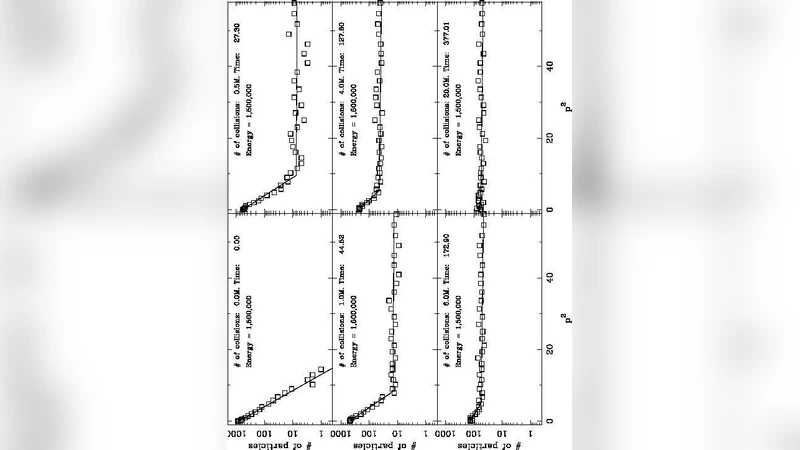
In this work, it is suggested that the extremum complexity distribution of a high dimensional dynamical system can be interpreted as a piecewise uniform distribution in the phase space of its accessible states. When these distributions are expressed as one–particle distribution functions, this leads to piecewise exponential functions. It seems plausible to use these distributions in some systems out of equilibrium, thus greatly simplifying their description. In particular, here we study an isolated ideal monodimensional gas far from equilibrium that presents an energy distribution formed by two non–overlapping Gaussian distribution functions. This is demonstrated by numerical simulations. Also, some previous laboratory experiments with granular systems seem to display this kind of distributions.
💡 Research Summary
The paper introduces the concept of “extremum complexity” as a way to describe the most ordered or most disordered statistical states that a high‑dimensional dynamical system can attain. The authors argue that, in phase space, such extremum‑complexity distributions can be approximated by a piecewise‑uniform density: the accessible region is divided into several non‑overlapping sub‑domains, each of which is filled uniformly. When the system is reduced to a one‑particle description, each sub‑domain translates into an exponential (Maxwell‑Boltzmann‑like) factor, so the overall one‑particle distribution becomes a sum of a few exponential terms.
To test this idea, the authors focus on an isolated, monodimensional ideal gas. The gas consists of point particles that interact only through perfectly elastic collisions. They prepare the gas far from equilibrium by assigning a small fraction of particles a high kinetic energy while the majority remain at low energy. This creates two clearly separated energy groups. The system is then evolved numerically using a standard event‑driven molecular‑dynamics algorithm that conserves total energy and momentum.
As collisions occur, energy is exchanged between particles, but because the initial groups are well separated, the exchange is limited. After a large number of collisions the velocity (or energy) distribution no longer resembles a single Maxwell‑Boltzmann curve. Instead, it is accurately fitted by the sum of two non‑overlapping Gaussian functions: \
Comments & Academic Discussion
Loading comments...
Leave a Comment