Combinatorics of dispersionless integrable systems and universality in random matrix theory
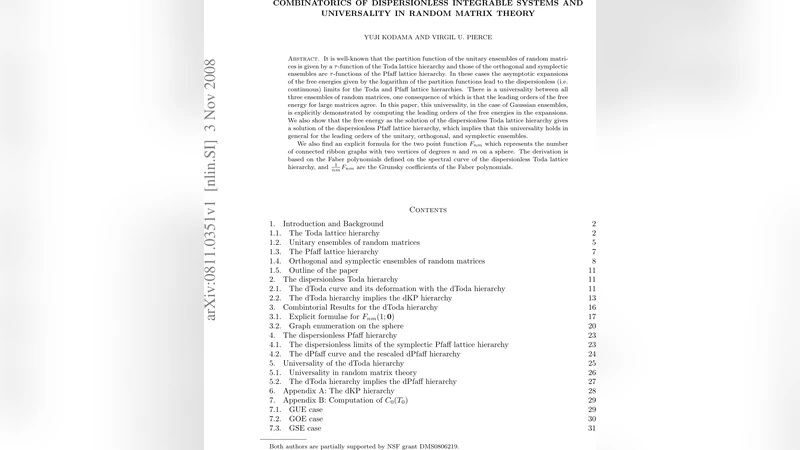
It is well-known that the partition function of the unitary ensembles of random matrices is given by a tau-function of the Toda lattice hierarchy and those of the orthogonal and symplectic ensembles are tau-functions of the Pfaff lattice hierarchy. In these cases the asymptotic expansions of the free energies given by the logarithm of the partition functions lead to the dispersionless (i.e. continuous) limits for the Toda and Pfaff lattice hierarchies. There is a universality between all three ensembles of random matrices, one consequence of which is that the leading orders of the free energy for large matrices agree. In this paper, this universality, in the case of Gaussian ensembles, is explicitly demonstrated by computing the leading orders of the free energies in the expansions. We also show that the free energy as the solution of the dispersionless Toda lattice hierarchy gives a solution of the dispersionless Pfaff lattice hierarchy, which implies that this universality holds in general for the leading orders of the unitary, orthogonal, and symplectic ensembles. We also find an explicit formula for the two point function $F_{nm}$ which represents the number of connected ribbon graphs with two vertices of degrees n and m on a sphere. The derivation is based on the Faber polynomials defined on the spectral curve of the dispersionless Toda lattice hierarchy, and $\frac{1}{nm} F_{nm}$ are the Grunsky coefficients of the Faber polynomials.
💡 Research Summary
The paper investigates the deep connections between random matrix theory (RMT) and dispersionless integrable hierarchies, focusing on the unitary (U(N)), orthogonal (O(N)), and symplectic (Sp(N)) Gaussian ensembles. It begins by recalling the well‑known fact that the partition functions of these ensembles are τ‑functions of the Toda lattice (U(N)) and Pfaff lattice (O(N), Sp(N)) hierarchies. By expanding the free energy F = log Z in powers of 1/N², the authors isolate the leading term F⁽⁰⁾, which scales as N², and demonstrate that F⁽⁰⁾ is identical for all three ensembles. This establishes a strong form of universality: not only do the large‑N limits of the eigenvalue densities coincide, but the entire leading‑order τ‑function of the dispersionless Toda hierarchy coincides with that of the dispersionless Pfaff hierarchy.
To make the universality explicit, the authors work with the Gaussian potential V(M)=½M². They compute the dispersionless limit of the Toda hierarchy by introducing the spectral curve w+1/w=2z and constructing the associated Faber polynomials Φₙ(z). The coefficients of these polynomials are the Grunsky coefficients γₙₘ, which satisfy γₙₘ = Fₙₘ/(nm). The paper proves that Fₙₘ counts connected ribbon graphs (or maps) on the sphere with two vertices of valences n and m. This combinatorial interpretation links the analytic structure of the integrable hierarchy to classical enumeration problems in topological graph theory.
The second major contribution is the demonstration that the same spectral curve and Faber polynomial machinery apply to the dispersionless Pfaff hierarchy. By showing that any solution of the dispersionless Toda hierarchy automatically satisfies the dispersionless Pfaff equations, the authors extend the universality beyond the leading free‑energy term to the two‑point function Fₙₘ. Consequently, the counting of ribbon graphs derived from the Toda side is also valid for the orthogonal and symplectic ensembles.
Finally, the authors discuss broader implications. The identification of Fₙₘ with Grunsky coefficients provides a bridge between random matrix models, complex analysis (through univalent function theory), and algebraic combinatorics (through Hurwitz numbers and map enumeration). The results suggest that the universal structures observed in Gaussian ensembles are manifestations of deeper geometric properties of the underlying spectral curve, and they hint at possible extensions to non‑Gaussian potentials and higher‑genus corrections. In summary, the paper offers a rigorous proof of universality for the leading orders of the three classical matrix ensembles, supplies an explicit combinatorial formula for ribbon‑graph counts via integrable‑system techniques, and unifies the Toda and Pfaff dispersionless hierarchies under a common spectral‑curve framework.
Comments & Academic Discussion
Loading comments...
Leave a Comment