Toward homochiral protocells in noncatalytic peptide systems
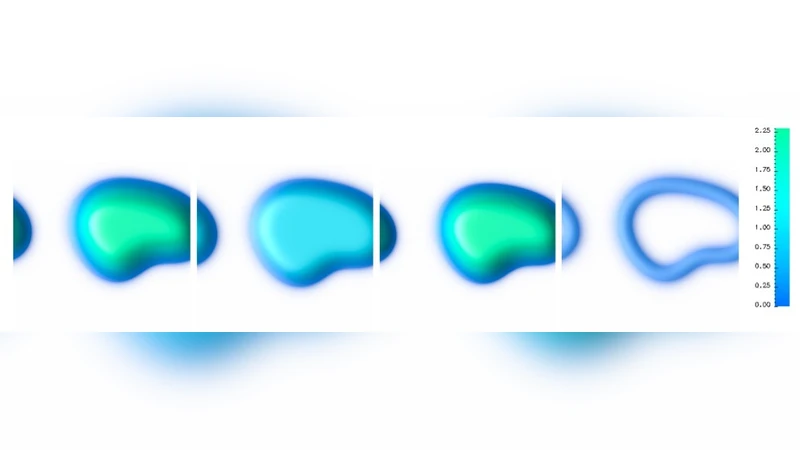
The activation-polymerization-epimerization-depolymerization (APED) model of Plasson et al. has recently been proposed as a mechanism for the evolution of homochirality on prebiotic Earth. The dynamics of the APED model in two-dimensional spatially-extended systems is investigated for various realistic reaction parameters. It is found that the APED system allows for the formation of isolated homochiral proto-domains surrounded by a racemate. A diffusive slowdown of the APED network such as induced through tidal motion or evaporating pools and lagoons leads to the stabilization of homochiral bounded structures as expected in the first self-assembled protocells.
💡 Research Summary
The paper investigates the spatial dynamics of the activation‑polymerization‑epimerization‑depolymerization (APED) model, a non‑catalytic peptide network proposed as a plausible route to homochirality on the early Earth. By embedding the APED reactions in a two‑dimensional reaction‑diffusion framework, the authors explore how realistic variations in kinetic parameters (activation, polymerization, epimerization, and depolymerization rates) and diffusion coefficients affect the emergence of chiral domains. In simulations with high diffusion, any local excess of one enantiomer is rapidly smeared out, and the system remains racemic. When diffusion is deliberately slowed—mimicking tidal stagnation, evaporation of shallow pools, or other geophysical processes—local fluctuations can be amplified. Small “chiral nuclei” appear, where either L‑ or D‑peptides dominate, surrounded by a racemic matrix. The interface between the nucleus and the surrounding mixture forms a diffusive front that maintains a sharp compositional boundary.
The stability of these nuclei depends sensitively on the balance of reaction rates. Low epimerization rates (slow conversion between enantiomers) allow the chiral excess to persist, while high depolymerization rates erode it. When the supply of activated monomers continues, nuclei can grow; when the environment becomes depleted (as in evaporating lagoons), nuclei may shrink or dissolve. Crucially, once a nucleus reaches a critical size, the diffusion barrier at its perimeter effectively isolates its interior, creating a bounded compartment that the authors liken to a primitive protocell. This compartment does not require a lipid membrane; the chemical gradient itself provides a functional boundary.
Through systematic parameter sweeps, the study identifies a “sweet spot” where activation and polymerization are fast enough to generate peptide chains, epimerization is slow enough to preserve chiral bias, and depolymerization is moderate enough to avoid complete breakdown. Within this regime, the model predicts spontaneous formation of isolated homochiral domains that can remain stable over long timescales under realistic prebiotic conditions.
The authors argue that such chemically defined compartments could serve as scaffolds for subsequent evolutionary steps: accumulation of amphiphilic molecules, emergence of primitive membranes, and integration of metabolic pathways. By demonstrating that a simple, non‑enzymatic peptide system can self‑organize into spatially confined, homochiral structures, the work bridges a gap between abstract kinetic models of symmetry breaking and the physical reality of early Earth environments. It suggests that tidal cycles, seasonal drying, or localized evaporation could have been critical drivers that slowed diffusion enough to let homochirality lock in, thereby setting the stage for the first protocells and, ultimately, the origin of life.
Comments & Academic Discussion
Loading comments...
Leave a Comment