Compactons and kink-like solutions of BBM-like equations by means of factorization
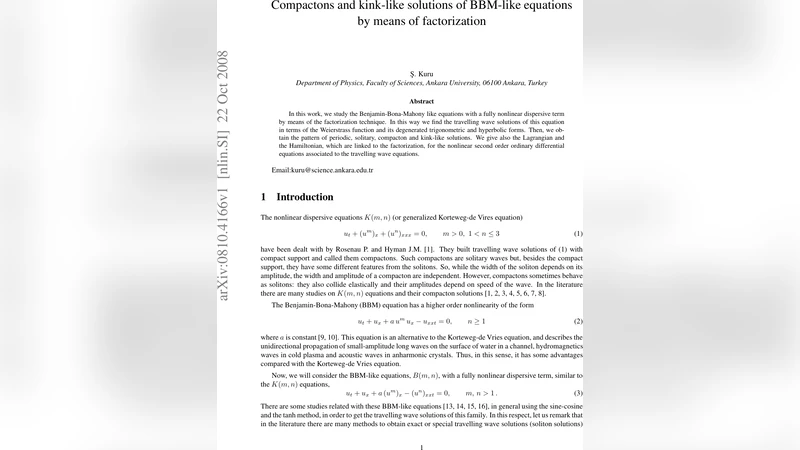
In this work, we study the Benjamin-Bona-Mahony like equations with a fully nonlinear dispersive term by means of the factorization technique. In this way we find the travelling wave solutions of this equation in terms of the Weierstrass function and its degenerated trigonometric and hyperbolic forms. Then, we obtain the pattern of periodic, solitary, compacton and kink-like solutions. We give also the Lagrangian and the Hamiltonian, which are linked to the factorization, for the nonlinear second order ordinary differential equations associated to the travelling wave equations.
💡 Research Summary
The paper investigates a class of Benjamin‑Bona‑Mahony (BBM)–like equations that contain a fully nonlinear dispersive term, i.e.
(u_{t}+u_{x}+(u^{m}){x}-(u^{n}){xxt}=0) with positive integers (m) and (n).
Because the dispersion is nonlinear, standard linearisation or perturbation techniques are ineffective. The authors therefore adopt a factorization method that reduces the travelling‑wave ordinary differential equation (ODE) to a product of two first‑order operators, allowing the second‑order ODE to be integrated in closed form.
First, a travelling‑wave ansatz (\xi=x-ct) (with speed (c)) is introduced, and after one integration a second‑order ODE is obtained:
(c,u’’+(c-1)u’+\frac{m}{m+1}u^{m+1}-\frac{n}{n+1}u^{n+1}=K),
where (K) is an integration constant. The factorization hypothesis assumes that this equation can be written as ((D-f_{1}(u))(D-f_{2}(u))u=0) with (D=d/d\xi). By choosing the functions (f_{1,2}(u)) so that the factorization condition holds, the ODE collapses to a first‑order nonlinear equation of the form (u’=\Phi(u)), where (\Phi(u)) is a square‑root of a cubic polynomial in (u).
Integrating (u’=\Phi(u)) yields the canonical elliptic integral
(\int!\frac{du}{\sqrt{4u^{3}-g_{2}u-g_{3}}}= \xi+\xi_{0}),
which is inverted by the Weierstrass elliptic function (\wp(\xi+\xi_{0};g_{2},g_{3})). The invariants (g_{2}) and (g_{3}) are explicit functions of the original parameters ((m,n,c,K)). Consequently, the general travelling‑wave solution is expressed as
(u(\xi)=\wp(\xi+\xi_{0};g_{2},g_{3})).
The discriminant (\Delta=g_{2}^{3}-27g_{3}^{2}) determines the nature of the solution. When (\Delta<0) the (\wp)‑function possesses two complex conjugate roots and a real period, leading to periodic waveforms that can be written in terms of Jacobian elliptic functions ((\operatorname{cn},\operatorname{sn},\operatorname{dn})). For (\Delta>0) there is a single real root; the (\wp)‑function degenerates to hyperbolic forms and the solution becomes a localized solitary wave. In the limiting case (\Delta=0) the elliptic function collapses to elementary trigonometric or hyperbolic functions, giving rise to kink‑type or compacton profiles. The compacton solutions are especially noteworthy: because the nonlinear dispersion forces the wave to vanish exactly outside a finite interval, the solution has compact support, a property not shared by classical solitons.
Beyond constructing explicit waveforms, the authors demonstrate that the factorization is intimately linked to the variational structure of the ODE. The second‑order equation can be derived from the Lagrangian
(\mathcal{L}= \tfrac12 u’^{2}-V(u))
with a potential (V(u)) that contains the nonlinear terms and the integration constant (K). Each first‑order factor corresponds to a reduced Lagrangian, and the associated Hamiltonian is a conserved quantity. Thus the factorization not only simplifies the integration but also reveals the underlying energy conservation law.
The paper supplies several illustrative parameter sets (e.g., (m=2,n=1) reproducing the classical BBM case, and higher‑order choices such as (m=3,n=2)) and plots the resulting waveforms. These examples show how varying the speed (c) and the constant (K) triggers transitions among periodic, solitary, compacton, and kink‑like regimes. The authors also discuss the broader applicability of the method: the same factorization approach can be applied to other nonlinear dispersive equations such as the (K(m,n)) family or the Rosenau‑Hyman compacton equation, offering a unified framework that surpasses ad‑hoc techniques like the tanh‑method or sine‑cosecant expansions.
In summary, the work provides a rigorous, analytically tractable pathway to obtain a rich catalogue of travelling‑wave solutions for BBM‑like equations with fully nonlinear dispersion. By coupling the factorization technique with the theory of elliptic functions, the authors not only generate explicit periodic, solitary, compacton, and kink‑like solutions but also expose the Lagrangian‑Hamiltonian structure underlying these waves. This dual achievement—exact solution construction and variational insight—makes the paper a valuable contribution to the theory of nonlinear wave propagation and to the toolbox of applied mathematicians working on dispersive PDEs.