The Equivalence of Semidefinite Relaxation MIMO Detectors for Higher-Order QAM
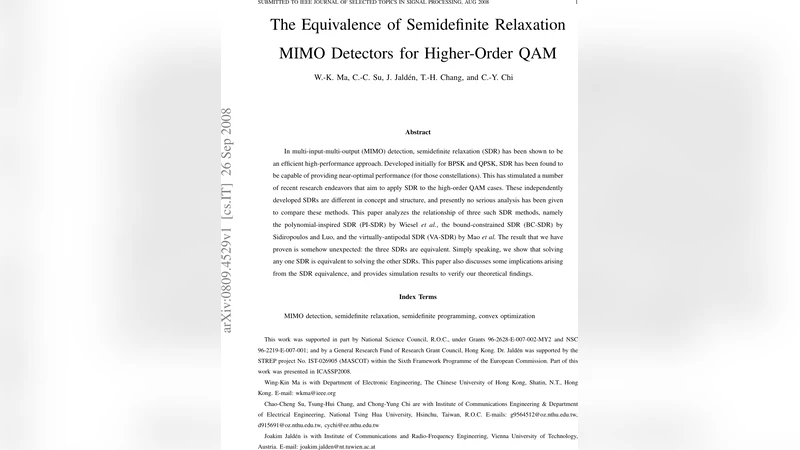
In multi-input-multi-output (MIMO) detection, semidefinite relaxation (SDR) has been shown to be an efficient high-performance approach. Developed initially for BPSK and QPSK, SDR has been found to be capable of providing near-optimal performance (for those constellations). This has stimulated a number of recent research endeavors that aim to apply SDR to the high-order QAM cases. These independently developed SDRs are different in concept and structure, and presently no serious analysis has been given to compare these methods. This paper analyzes the relationship of three such SDR methods, namely the polynomial-inspired SDR (PI-SDR) by Wiesel et al., the bound-constrained SDR (BC-SDR) by Sidiropoulos and Luo, and the virtually-antipodal SDR (VA-SDR) by Mao et al. The result that we have proven is somehow unexpected: the three SDRs are equivalent. Simply speaking, we show that solving any one SDR is equivalent to solving the other SDRs. This paper also discusses some implications arising from the SDR equivalence, and provides simulation results to verify our theoretical findings.
💡 Research Summary
The paper investigates three semidefinite relaxation (SDR) formulations that have been independently proposed for detecting higher‑order quadrature amplitude modulation (QAM) symbols in multi‑input‑multi‑output (MIMO) systems: the polynomial‑inspired SDR (PI‑SDR) by Wiesel et al., the bound‑constrained SDR (BC‑SDR) by Sidiropoulos and Luo, and the virtually‑antipodal SDR (VA‑SDR) by Mao et al. While each method originates from a different conceptual viewpoint—polynomial modeling, explicit interval bounding, and decomposition into binary antipodal components—the authors demonstrate that all three are mathematically equivalent.
The analysis begins with a brief review of the MIMO detection problem, which can be expressed as a minimum‑mean‑square‑error (MMSE) objective subject to discrete constellation constraints. For binary constellations (BPSK, QPSK) SDR is known to achieve near‑optimal performance, but extending SDR to multi‑level QAM introduces additional challenges because the symbol set is no longer antipodal. To retain the tightness of the relaxation, each of the three SDRs augments the basic formulation in a distinct way.
PI‑SDR treats each QAM symbol as a polynomial in a binary variable and introduces quadratic constraints that enforce the correct amplitude levels. BC‑SDR directly imposes upper and lower bounds on the real and imaginary parts of the transmitted vector, translating these bounds into linear matrix inequalities (LMIs) within the semidefinite program. VA‑SDR first maps a high‑order QAM point onto a virtual constellation consisting of multiple antipodal (±1) components; the detection problem is then solved by applying the classic 2‑level SDR to each component and recombining the results.
The core contribution of the paper is a rigorous proof that the feasible sets defined by PI‑SDR, BC‑SDR, and VA‑SDR are identical. The proof proceeds in three steps. First, the quadratic constraints of PI‑SDR are shown to be equivalent to the interval constraints of BC‑SDR through a linear change of variables that maps polynomial coefficients to real‑imaginary bounds. Second, the interval constraints of BC‑SDR are expressed as LMIs that exactly match the convex hull of the binary antipodal variables used in VA‑SDR. Third, by constructing the Lagrangian duals of the three programs and comparing their Karush‑Kuhn‑Tucker (KKT) conditions, the authors demonstrate that any optimal primal‑dual pair for one formulation satisfies the optimality conditions of the other two. Consequently, solving any one of the SDRs yields the same optimal objective value and the same relaxed solution matrix.
The equivalence has several practical implications. It allows practitioners to select the formulation that best fits their computational environment: BC‑SDR typically involves the fewest decision variables and thus the lowest per‑iteration cost; VA‑SDR offers the most straightforward implementation because existing binary‑SDR code can be reused; PI‑SDR provides a natural extension for constellations that can be expressed as higher‑order polynomials. Moreover, because all three relaxations share a common convex feasible region, any algorithmic advances—such as customized interior‑point methods, first‑order solvers, or hardware‑accelerated implementations—developed for one formulation can be directly applied to the others without loss of optimality.
Simulation results corroborate the theoretical findings. Over a range of antenna configurations (e.g., 4×4, 8×8) and QAM orders (16‑QAM, 64‑QAM), the three SDRs produce identical bit‑error‑rate (BER) curves, confirming that the relaxations are equally tight. Computational profiling shows that BC‑SDR achieves the lowest runtime, while VA‑SDR incurs a modest overhead due to the extra virtual‑antipodal expansion, and PI‑SDR lies in between.
In conclusion, the paper establishes that PI‑SDR, BC‑SDR, and VA‑SDR, despite their disparate derivations, are in fact the same semidefinite program expressed in different guises. This unifying result simplifies the landscape of high‑order QAM detection, enables the reuse of algorithmic and hardware resources across previously separate research streams, and opens the door to extending the unified SDR framework to even larger constellations and to other nonlinear detection problems.
Comments & Academic Discussion
Loading comments...
Leave a Comment